
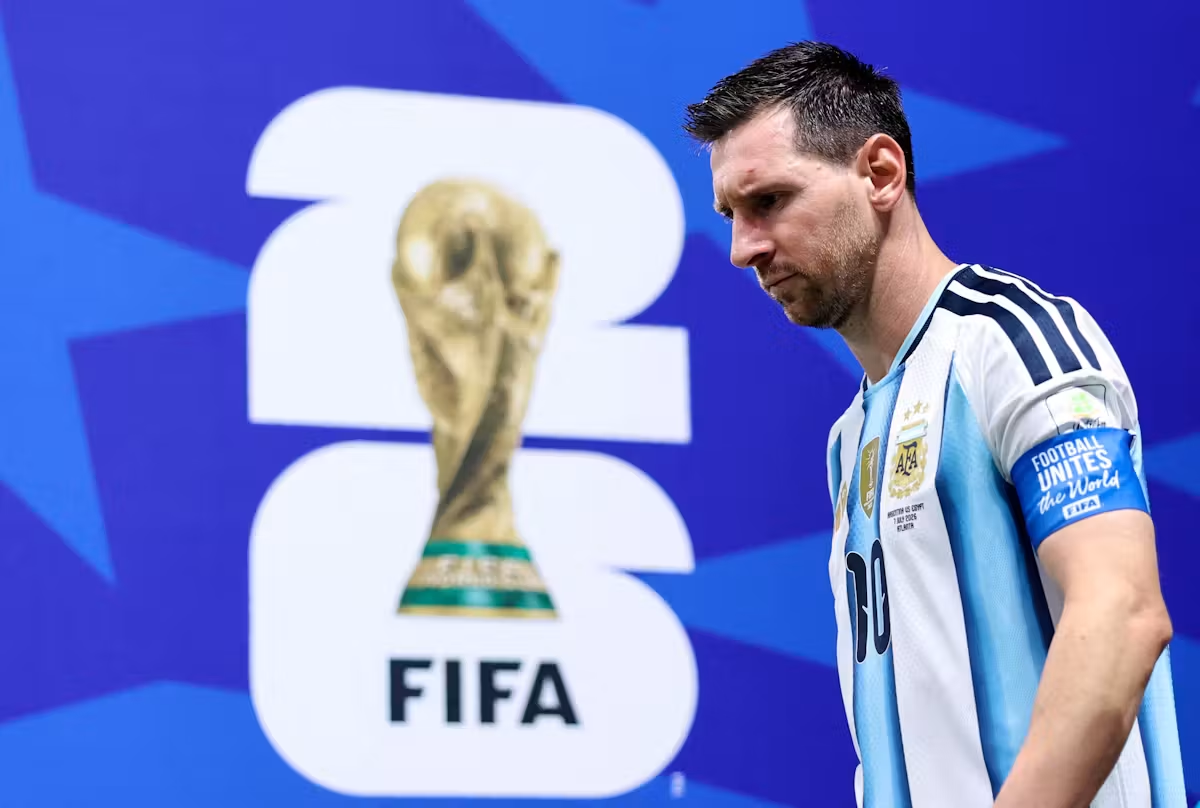
At 39 years old, Lionel Messi still splashes the World Cup with his extraordinary talent thanks to an astonishing cocktail, between limited efforts and sharp flashes, while offering the image of an “animal” inhabited by his mission with Argentina, quarter-finalist against Switzerland, on Saturday.
The little dribbler with golden feet no longer has his former legs; it is common to see him walking when all his teammates are running, tackling and bustling around him. But it seems more like a plan than a limit, a way to adapt to today’s Messi.
“He likes to stay on the side and sometimes he likes to stop in front of the goal in an offside position. This does not mean that they are playing one less, rather that they have one less player on the counter-press. This is precisely what makes him so dangerous, because he can find himself unmarked,” observed Austria coach Ralf Rangnick.
Despite this fair analysis, delivered on the eve of their duel, the distinguished tactician took lightning on two lightning strikes from N.10 Albiceleste (2-0) in the group stage.
The former FC Barcelona leader knows how to save himself and strike at the right time, even at the end of the match, as he showed in the round of 16 during the fantastic final against Egypt (3-2), with an assist then a goal in the space of five minutes.
A Nation’s Guide
“Frankly, it doesn’t matter if we say that he walks on the field, because in football it’s not the one who runs the most who wins. He is the one who plays the best, and no one plays like him,” praised the Argentinian newspaper Clarín.
This keen-eyed walking side has not escaped the BBC either: “Messi is watching. Messi is waiting. Messi saves his energy for the moments that matter. The body may be slower, but the brain remains sharp as a blade. Genius is permanent.
In the United States, the Inter Miami player displays astonishing statistics: eight goals in five matches, like Kylian Mbappé and better than Erling Haaland (7 goals) and Harry Kane (6 goals).
And again, he could have reached a double-digit total if he had not missed his two penalties, against Austria and Egypt.
These failures irritated the Argentina captain each time and he transformed his frustration into a driving force to once again become the one his partners revere, and towards whom all their efforts are directed.
Messi “is our balance, our guide, our leader,” summarized Lautaro Martinez. “We will continue to give everything for him.”
“Don’t wake the beast”
The “pulga” (the flea) may disappear from the match in sequences, but it jumps with redoubled energy when its team is led, or strongly shaken, which makes its legitimacy incontestable.
At 2-0 for Egypt, “we saw that something had changed,” described Zlatan Ibrahimovic on Fox Sports. “It had become an animal”, he was “on a mission” and was “not going to let go” of his prey, said the former Swedish goleador. “When he started hunting, no one could stop him.”
“With Leo, sometimes, you really shouldn’t wake the beast,” agreed Thierry Henry, his former teammate at Barça, on set.
And the former Blues scorer recounts a training scene where the Argentinian, unhappy at having conceded a goal after a refereeing error, according to him, took justice into his own hands.
“There, you look at his eyes and you see that he has shifted. He goes to get the ball and he scores three goals in a row: he scores straight away, he steals the ball from you, he scores again, he takes it back from you, he scores again, then he turns around and says: next time, call the foul. And all of us were there: yes, yes, next time call the foul, because he is just unstoppable when he gets into that state.
