
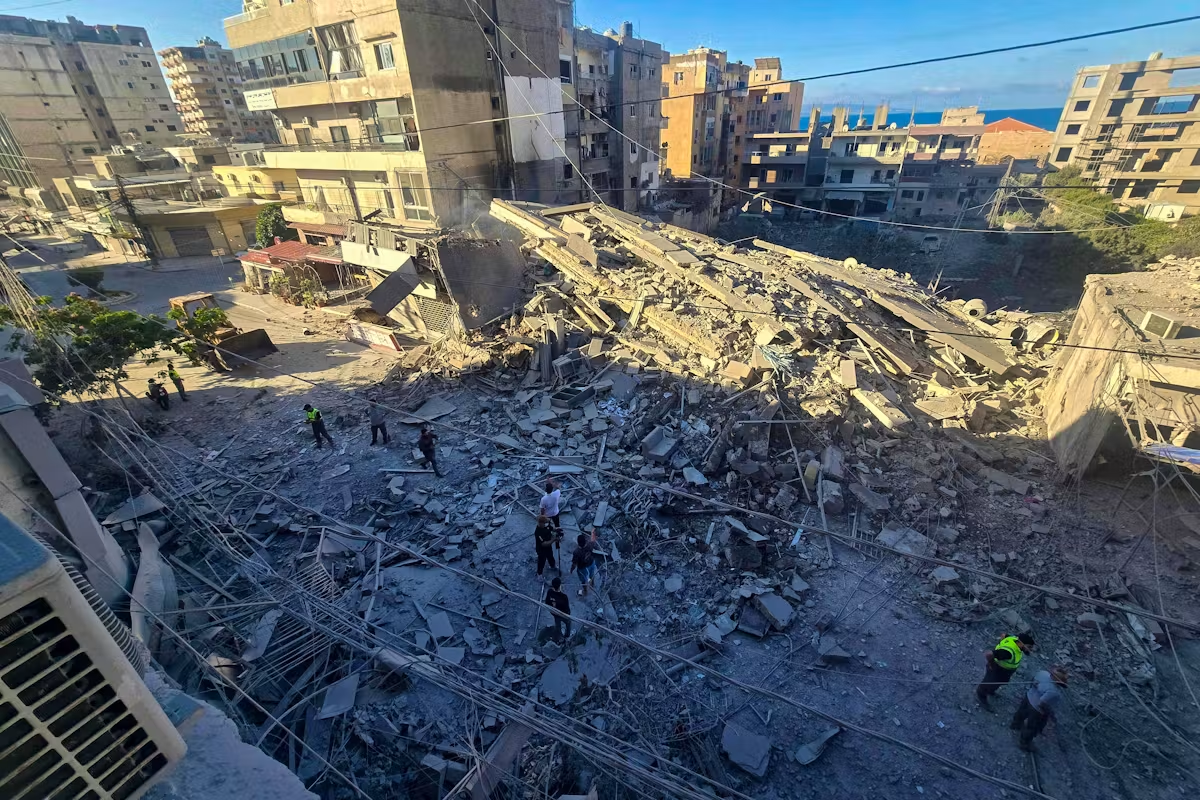
Clashes between Israel and Hezbollah are almost daily despite the April 17 truce, which has never been respected. On Saturday morning, the Israeli army called on the inhabitants of more than ten Lebanese villages to evacuate before strikes, which affected several localities in the south according to the Lebanese National Information Agency (Ani, official).
The Lebanese army announced that a “targeted” Israeli drone strike had hit and seriously injured two of its soldiers aboard a vehicle near the southern town of Nabatiyé.
Artillery fire also took place near the medieval Beaufort fortress, while the Minister of Culture had expressed concern the day before about the “serious danger” posed to heritage by Israeli attacks.
Hezbollah, for its part, claimed responsibility for rocket attacks towards northern Israel. The Israeli army said it had intercepted several projectiles – except for one that fell on its soil but without causing any injuries.
In a statement, the Lebanese President and Prime Minister, Joseph Aoun and Nawaf Salam, denounced “the reprehensible practices of Israel”, the “extension” of its attacks, particularly in the areas of Tire and Nabatiyé, as well as the “continuation of bombings and bulldozing of homes and historical sites”.
The Israeli army has intensified its air and ground operations in Lebanon in recent days, where it says it is targeting Hezbollah, which it wants to see disarmed. The movement refuses and opposes any talks between the Lebanese government and Israel.
A truce, “obligatory passage”
Military delegations from the two countries met in Washington on Friday to prepare for a new round of talks, scheduled for June 2-3 – the fourth since the war broke out in early March.
And this, in difficult negotiations between the United States and Iran, which demands to include the Lebanese front of the conflict in any agreement to end the war in the Middle East.
In total since the start of the war in early March, Israeli strikes in Lebanon have killed 3,355 people and displaced more than a million people, according to the authorities. In the past week alone, 15 children were killed and 62 injured, according to Unicef.
Israel said this week that it considers much of southern Lebanon a “combat zone.”
And according to Israeli Prime Minister Benjamin Netanyahu, Israeli soldiers “crossed” the Litani, a river located about thirty kilometers from the border, on Friday.
Hezbollah said it attacked Israeli troops who were trying to advance in the Beaufort Fortress area.
He also claimed to have targeted military infrastructures in Safed, in northern Israel, about thirty km from the border at dawn, a shot that the Israeli army did not confirm.
Lebanon and Israel began unprecedented negotiations in April under the auspices of the United States to reach a security agreement. Friday’s military meeting, “constructive” according to the Pentagon, will serve as “a basis for the political component”, which must be discussed during meetings scheduled for June 2 and 3, according to Pentagon number two, Elbridge Colby.
The Lebanese president told the head of American diplomacy Marco Rubio that a truce was “the necessary step” for any progress in the negotiations.
