
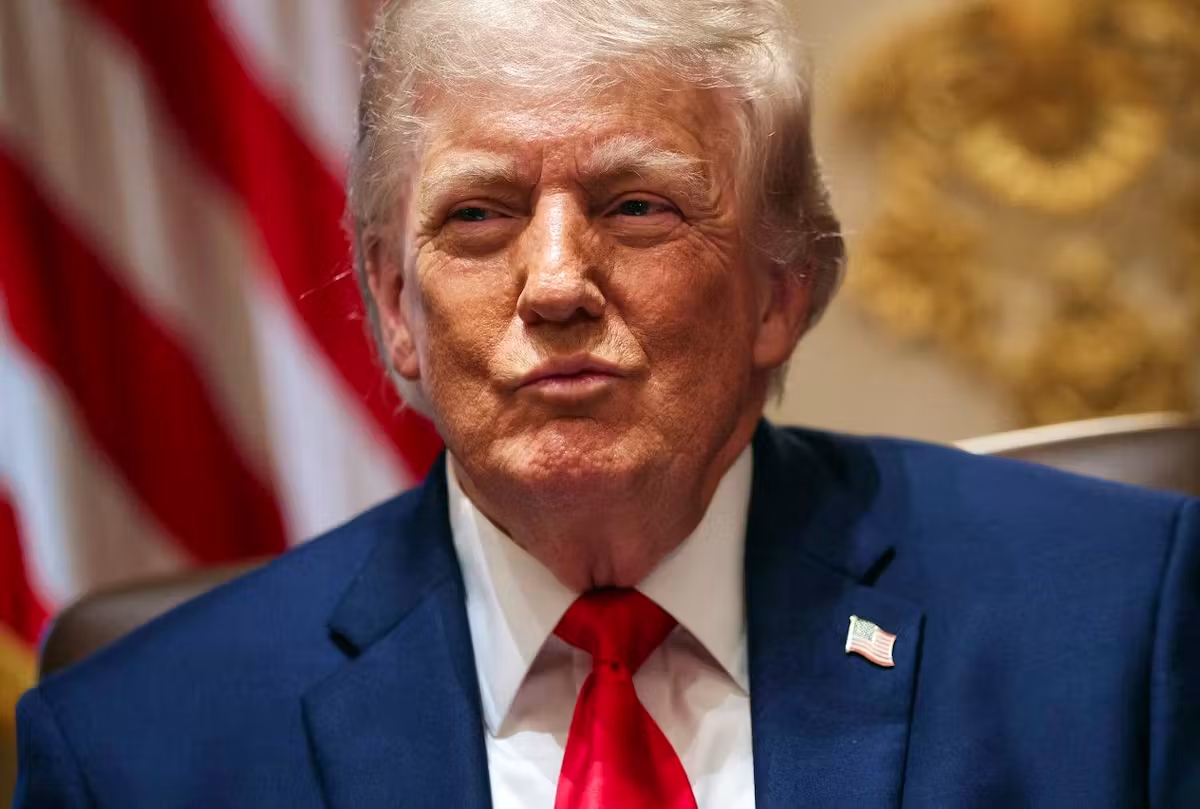
Donald Trump affirmed that Iran had committed not to acquire nuclear weapons, one of the major points of friction in the negotiations between Washington and Tehran to end their war.
While the two countries seemed, in recent days, to be getting closer to an agreement, the “New York Times” reported on Saturday that the American president had toughened his proposal and sent a new version of the text to Tehran.
The American media was not able to detail the changes made. But according to the Axios site, Mr. Trump wants more firmness in Washington’s position on several aspects that he personally considers important, notably the fate of Iranian nuclear materials.
In an interview with his daughter-in-law Lara Trump, recorded earlier this week and broadcast on Fox News on Saturday, the president claimed to have received a guarantee that Tehran would not acquire atomic weapons, whether by manufacturing them or buying them.
“The only guarantee I must have is that there will be no nuclear weapons. They accepted that, and it was very interesting,” Mr. Trump said.
“They initially said ‘we will not develop a nuclear weapon’. I said ‘well, what would happen if you bought a nuclear weapon?’. Now they say ‘we will not develop, nor in any way purchase a weapon,’ he continued.
Trump “in no hurry”
“I’m not in a hurry,” said the Republican billionaire. “Slowly but surely, I believe we are getting what we want. And if we don’t get what we want, things will end up differently,” he added.
On Saturday, his Defense Minister, Pete Hegseth, affirmed that the United States was “more than capable” of going to war against Iran if talks failed.
The nuclear issue is one of the main points of friction between the United States and Iran in these negotiations to end the war, triggered on February 28 by the Israeli-American offensive against the Islamic Republic.
The United States and Israel accuse Tehran of wanting to acquire atomic weapons, which it refutes. Iran has so far insisted on tackling the nuclear issue later, after signing the memorandum of understanding currently under discussion.
The war has left thousands dead and is shaking the global economy by pushing up oil prices.
The other major point of dispute is the Strait of Hormuz, a strategic passage for global hydrocarbon trade, almost blocked by Iran since the start of the war. The United States, for its part, imposes a blockade of Iranian ports.
Washington has affirmed its opposition to maintaining Iranian control over this maritime passage.
The American military command for the Middle East (Centcom) said on Saturday that it had stopped a cargo ship sailing under the Gambian flag and trying to reach an Iranian port, using a missile fired at its engine room.
And according to contacts of Iranian sailors cited by the Tasnim news agency, the United States continues to prevent Iranian commercial ships from circulating.
The Revolutionary Guards, the ideological army of the Islamic Republic, claimed on Sunday to have shot down an American MQ1 drone which, according to them, was preparing to enter Iranian territorial waters for “hostile operations”. The US military did not immediately respond.
Tehran, for its part, is demanding the release of billions of $ in assets frozen abroad by the United States. State television reported on Saturday, citing an unofficial transcript of the text, that the memorandum of understanding discussed provides for the release within 60 days of 12 billion $.
Israeli advance in southern Lebanon
Iran is also demanding an end to the fighting in Lebanon where its ally, Hezbollah, and Israel have been clashing since March 2, which has intensified its strikes and ground operations, despite a truce in force since April 17, but not respected.
On Sunday, Israeli Defense Minister Israel Katz announced that the army had “expanded its operations in Lebanon, crossed the Litani River,” about 30 kilometers north of the border, and planted the Israeli flag on the medieval Beaufort Fortress, one of its bases during its occupation of southern Lebanon, which lasted two decades and ended in 2000.
The Israeli army also called on Sunday for the evacuation of the entire area located south of the Lebanese Zahrani river, about forty km from the border, which it had declared a “combat zone” on Wednesday. She announced the death of a soldier killed the day before by a Hezbollah explosive drone.
