
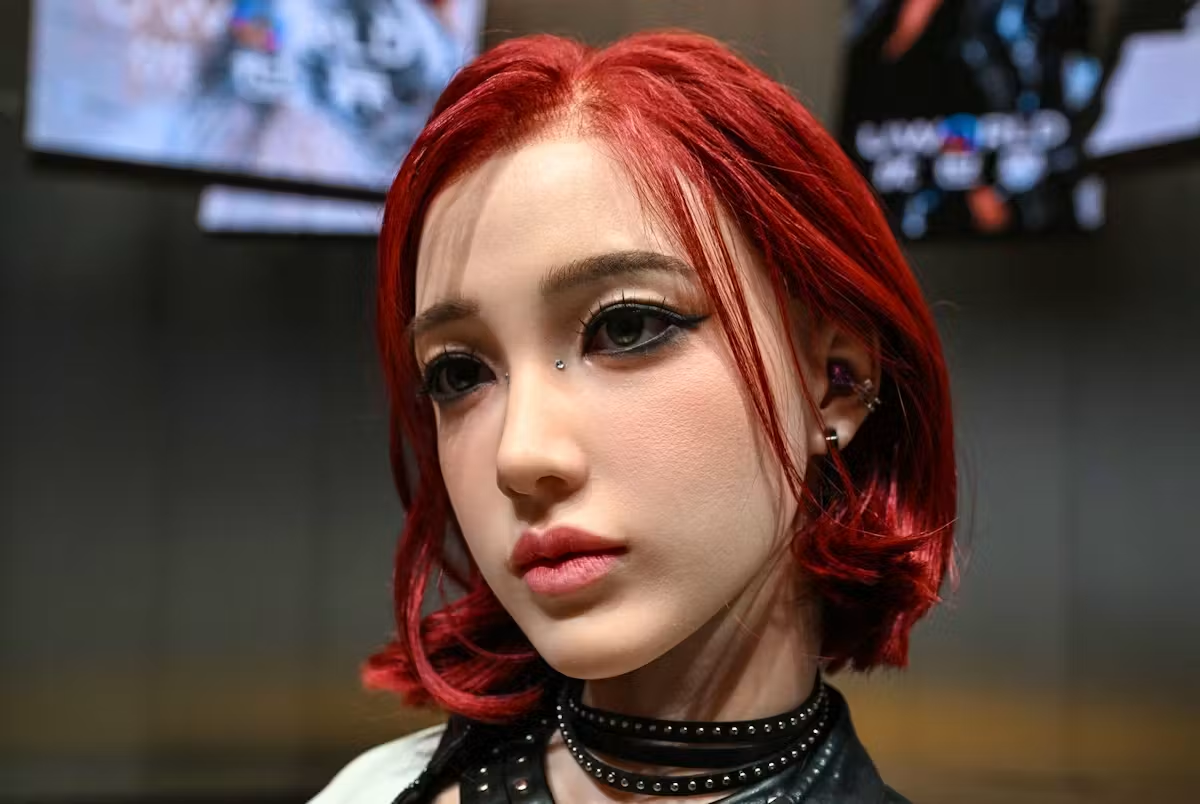
Will your next confidant be a robot? Soft skin to the touch, soothing voice: the Chinese company UBTech unveiled on Tuesday brand new androids with hyper-realistic human appearance, equipped with artificial intelligence (AI) and presented as remedies for loneliness.
The company offers its “emotional companions” from 119,800 yuan (15,500 euros). In short, embodied artificial intelligences, sitting in your living room, that can patiently listen to your worries and chat 24 hours a day.
Symbolic of Chinese advances in robotics, this product named “U1” is described by UBTech as “the world’s first life-size humanoid robot with an ultra-realistic appearance”.
Spaceship on giant screen, science fiction atmosphere, presence of the famous Norwegian DJ Alan Walker: it was with great fanfare that the company presented its humanoids on Tuesday in Shenzhen (south of China).
Everywhere, a slogan: “Endless love”, the promise of robots offering their affection “for life”, explains to AFP Michael Tam, the general director of UWorld, a sub-brand of UBTech which designed the U1.
The robot is mainly intended for “singles” and “over 60s”, who represent 120 and 320 million people in China respectively, according to Mr. Tam, “a colossal market”.
“These people have a great need for companionship, which provides emotional comfort,” he emphasizes.
With a battery life of up to four hours, the U1 offers soothing words if it detects fatigue or stress and refines its knowledge of the user over time.
It can also, for example, identify health problems, remind you to take your medication, recommend what you should wear or even suggest watching a World Cup match together, says UBTech.
Emotional dependence
The robot can move its head, eyes and mouth. But he doesn’t do the cleaning, cooking or ironing.
Her skills don’t extend to the bedrooms either. It is not intended “for the moment” to offer intimate relationships, underlines UBTech.
The U1 is available in “woman” (1.68 m) and “man” (1.83 m) versions, with many looks: blonde in a sexy dress, adventurer in a white jumpsuit, or even ephebes with charming eyes.
It can be personalized to look like a loved one, a celebrity or an imaginary character.
Prices vary between 119,800 yuan for the “Lite” version and 990,000 yuan (128,000 euros) for the “Ultra”, with more sophisticated features.
This type of product divides, with some seeing it as a trivialization of emotional dependence on machines and a risk in terms of confidentiality.
UBTech promises “encryption” of the data and assures that it will not be used for training AI models.
From shopping malls to hotels, robots are omnipresent in China. This familiarity, celebrated by official media, generates broad social acceptance — a contrast to the distrust generally observed in the West.
Engaged with the United States in a fierce technological rivalry, China is at the forefront in terms of humanoid robots.
The Asian country represented 85% of those installed worldwide in 2025, according to Barclays bank.
Strategic industry
They are particularly deployed in factories, express delivery and public places. Demand is increasing, supported by strong support from the authorities.
By 2025, more than 140 Chinese companies had already launched more than 330 models of humanoid robots, according to the Ministry of Industry and Information Technology.
Robotics is a priority for China, which has designated it as a strategic industry in its 2026-2030 five-year plan.
China’s market for humanoid robots is expected to reach $2 billion this year and $15 billion by 2030, according to a study by Morgan Stanley.
Created in 2012, UBTech designs robots for industry. With the U1, the company wants to break into the consumer humanoid market, a niche that has so far not been very promising.
“I see an interest in a companion robot, even if it is a niche,” Lian Jye Su, an analyst at Omdia, told AFP.
But these U1s should suffer from the discomfort sometimes inspired by robots that are too human-like without being human, “which will reduce their acceptance on the market,” he predicts.
For its part, UBTech already has more than 13,300 pre-orders. Deliveries are scheduled to begin September 16.
