
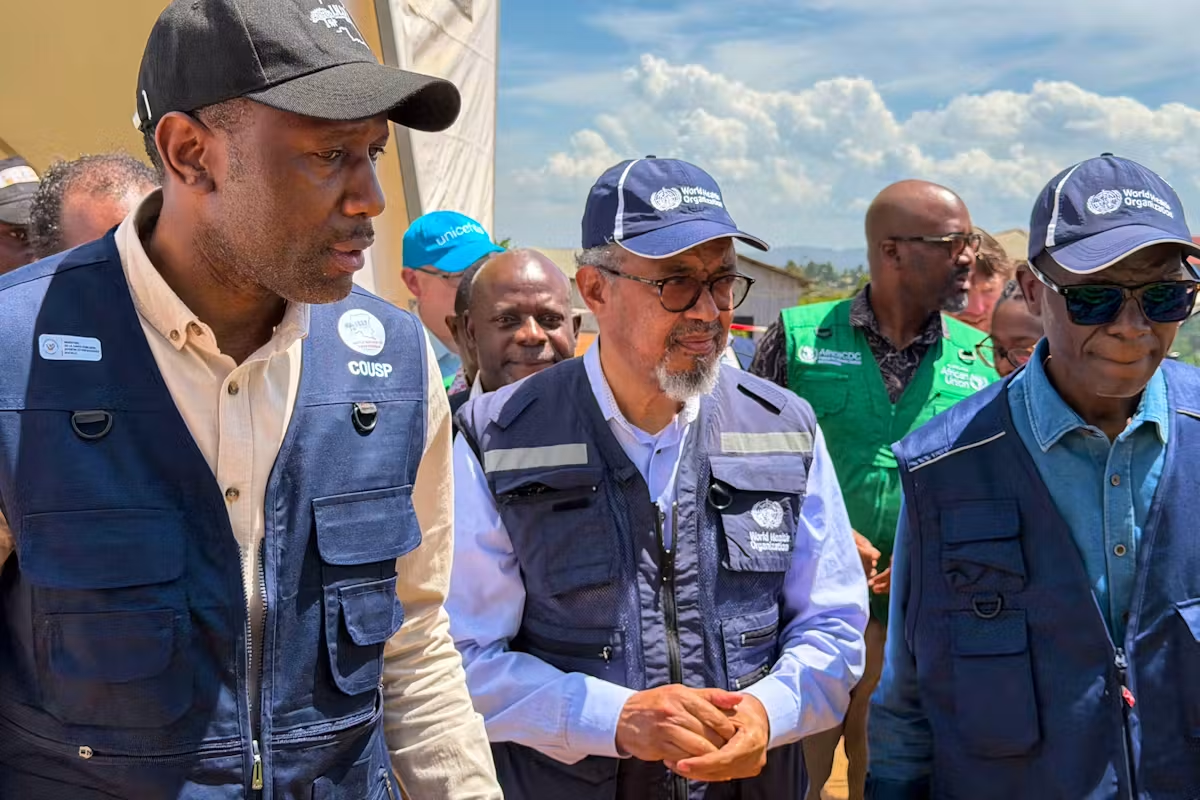
WHO Director General Tedros Adhanom Ghebreyesus, in the DRC since Thursday, landed on Saturday at Bunia international airport, closed to commercial flights due to the epidemic.
“We are here to discuss with the community, in order to understand how the response is implemented and to identify possible difficulties in order to be able to provide our support,” he declared to the press.
The DRC, one of the poorest countries in the world, declared on May 15 a new epidemic hitting its immense territory of more than 100 million inhabitants. The WHO has issued an international health alert.
The virus that causes Ebola, which causes an extremely contagious hemorrhagic fever, has already been detected in three Congolese provinces as well as neighboring Uganda, where two new cases were confirmed on Friday, bringing the number of confirmed cases in the East African country to nine.
In the DRC, 246 deaths out of more than 1,000 suspected cases were recorded, according to a report Thursday from the Africa CDC, the health agency of the African Union (AU).
Armed groups
The province of Ituri accounts for a large majority of confirmed cases in the DRC, according to the WHO.
State services are largely absent in rural areas, and the presence of armed groups who regularly massacre civilians makes access difficult.
Incidents targeting treatment centers for Ebola patients and the distrust of certain communities in eastern DRC “have recently become major operational challenges”, also underlines the WHO.
Furthermore, millions of displaced people who have fled conflicts are piling up in camps there. The arrival of the virus in these poverty-stricken spaces where promiscuity reigns and where hygiene conditions are disastrous would be catastrophic.
International health authorities believe that the extent of the epidemic is still not known and that the tolls are probably underestimated, mainly due to the DRC’s weak capacity to conduct laboratory tests to confirm cases of transmission.
“Never has an Ebola disease epidemic recorded so many cases in the first days of its declaration,” said Alan Gonzalez, deputy director of operations for the NGO Doctors Without Borders (MSF), in a press release on Saturday.
“Insufficient” support
“The number of expert medical organizations deployed on the ground remains largely insufficient, and the level of support currently provided — including ours — falls far short of what is needed,” he added.
“Even if the situation is complex, I think we can stop this thing,” Mr. Tedros reassured Thursday evening.
On Friday, the WHO confirmed that “one patient recovered, left the hospital” on Wednesday in the DRC and was able to return to his community.
Since the start of the epidemic, 225 cases have been confirmed and 142 people are currently in treatment centers, Congolese Health Minister Samuel Roger Kamba said Friday evening at a press conference in Bunia.
“We must put the alarmist cries into perspective,” he lambasted Thursday evening. “We are not in a situation as we feel it at the international level,” he continued, before adding that we cannot be told that the epidemic is out of control.”
Ebola has killed more than 15,000 people in Africa over the past 50 years. The deadliest epidemic in the DRC caused nearly 2,300 deaths for 3,500 recorded patients, between 2018 and 2020.
The current wave is caused by the Bundibugyo virus, for which there is no specific treatment or vaccine. Most previous epidemics have been due to the Zaire virus, the only one for which a vaccine is approved.
“By the end of 2026, the Africa CDC will ensure that we have a vaccine and a drug against Bundibugyo,” Jean Kaseya, head of the AU health agency, pledged on Thursday.
The WHO, for its part, announced that its advisory groups had recommended clinical trials for several potentially effective vaccines and treatments against Bundibugyo.
The health risk for countries close to the DRC is “high”, according to the WHO, but remains “low” at the global level.
