
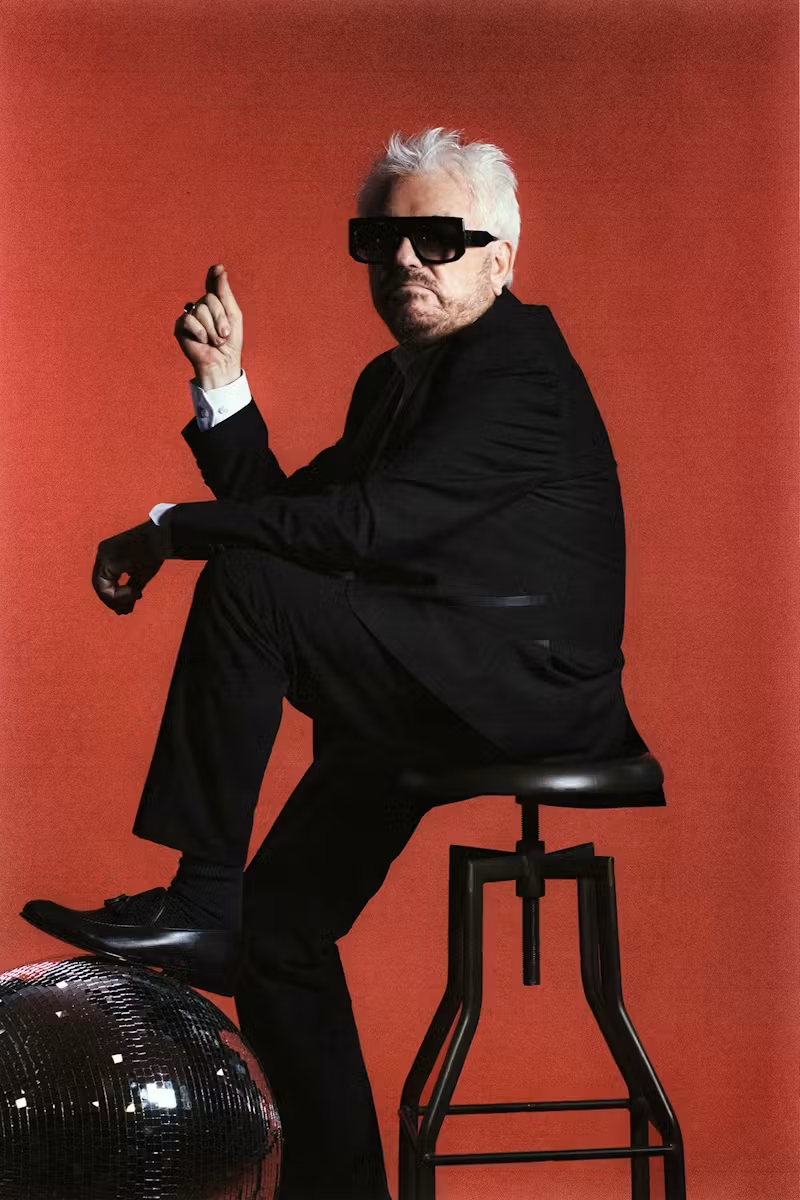
Pioneer of French disco, drummer, producer and author of classics like “Love in C Minor”, “Give Me Love” or “Supernature”, Cerrone brought the fever of the 70s into the history of music. More than 30 million albums sold, provocative covers, long nights, sweaty rhythms and his very own way of mixing groove, body, orchestra and party: in almost half a century, Marc Cerrone has never really left the dancefloor. Sampled, replayed, celebrated by several generations, it has irrigated an entire club culture, to the point of inspiring the French touch and artists like Daft Punk or Cassius. And after seeing “Supernature” return to spectacular light during the Paris Olympics, he is preparing to close the Montreux Jazz Festival with “Disco Symphonic”, between disco and symphony orchestra.
At 74, Cerrone still speaks of Montreux with swearing enthusiasm, of disco as the ultimate musical style, of the after-parties of the great era and of his current life as a “bubble of music seven days a week”. Phone call.
You will close the Montreux Jazz Festival with “Disco Symphonic”. We imagine that this is not a date like any other?
I always enjoy playing in Montreux. For me, it’s a real audience of connoisseurs. There are a few places like that: KOKO in London, Pacha in Ibiza… These are audiences who don’t find themselves there by chance, saying to themselves: “Hey, what’s on this evening?”. And then, doing it symphonically, I really like it. Everywhere I’ve played it until today, each time, we put people in a state… It’s really a big party!
You accepted this date in Montreux when your schedule was already very tight.
It’s going to be hell for me that weekend (laughs). The day before, I play in Marseille, and the next day I play again in the south, I think towards Aix-en-Provence. The dates had been booked for a very long time and I had kept this day off, but when my manager told me about Montreux, I said: “Oh fuck, I want to do it, obviously”!
You go from a symphony stage to a club, from a festival like Montreux to Pacha in Ibiza. Does the audience change depending on the location?
No difference. Of course, I can be a DJ, with a bassist, percussionists, a singer or a symphony orchestra, but the essence remains the same: you have to get people on board. In the end, what matters is not the formula, it’s the journey we took together.
In today’s audience, do you sense anything that reminds you of the great years of the night?
Yes. In the post-Covid period, I often felt flashes of the 70s. On a public level, people are really letting loose again. They don’t have to show off. Even if they take things or whatever, we mostly see the joy of living. With the times we’re living through, it’s a pretty fantastic feeling. I didn’t feel that way in the 90s or early 2000s. Today, people really need, want to get laid. And like in the 70s, they don’t care. They don’t wonder if we’re watching them. This is also what made the disco movement. The gay community infiltrated it, it went exuberant, and it was very good. She was very supportive. Today people understand that disco is not a fashion: it is a real musical style.
Since then, you have been sampled, replayed and referenced by house and French Touch artists. How did you experience this?
Like flattery. I thank everyone who mixed and sampled me. Of course, there’s always that “it only took two seconds” thing. Yes, except that by copying and pasting, two seconds can become four minutes! But what they came for was a groove, an atmosphere. This is perhaps also what allowed my sound to not age. Today, in a way, I have joined them. I work with Ableton, into which I have included a lot of my own material: strings, brass, guitars, voices, drums. It allows me to revisit myself, to recreate sounds from things I’ve done for fifty years. These are not anonymous sounds taken from a bank: it is my story that I rework with today’s tools.
So you see artificial intelligence more as a tool than as a threat?
For me, AI is an assistant. It will help a lot of people, but it will also force you to be more creative. Those who think that a machine, a drum loop and a bass are enough will quickly find themselves limited. Talent will have to evolve. I don’t believe that AI will take away creativity from artists. On the contrary: it will above all reveal those who really know how to use it.
Despite machines, turntables and Ableton, your DNA remains drums?
Drums are my DNA. Everything is based on that. Today, I play a lot less because over the years, it’s very physical. But everything I send as battery from my console, it’s me who did it. These are my batteries. This is my group. I won’t go looking for a drum loop because it has a big sound. I don’t care. What I need is to take people on a journey with me for an hour and a half, whether it’s live, DJing or symphonic. We need to take a trip.
How was the “Disco Symphonic” project born?
The story began with the city of Nice and a project called “It’s not classic”. They called my manager to ask me if I could play the game. As in my catalog there were already writings for strings, brass, orchestra, it was already there. They had done Prince, Bowie, Gainsbourg, and they told me they would like to do Cerrone. It was flattering, so obviously I said yes. The only thing is that two months before the concert, when I started rehearsing with my conductor, we had to decide what we kept from the originals and how we got as close as possible to them. And I came across “Supernature.” There, I wondered what I was going to do with the 50 guys behind, because it’s all electronic. So, I let go. I love Hans Zimmer, so I thought I’d do something in his vein.
And this symphonic version of “Supernature” ended up at the Olympic Games.
Yes! A few days before the Nice concert, a guy called me: Victor Le Masne, who was musical director of the Paris Olympic Games. He comes to see me at the studio, we talk, and he tells me that he placed one of my songs for the Olympics. At the end, he asks me what project I’m on. I tell him about this symphonic work, I talk to him about “Supernature”. He said to me: “Can you make me listen?” When he heard it he had this idea and that’s how it became the Olympics. This is how the title made the Eiffel Tower dance.
After this sequence, “Supernature” saw a huge resurgence. What did that do to you?
What really struck me was when I was told the next day that there had been over a billion clicks on Shazam. The number of people who said to themselves: “I know this title, but what is it again?” and who clicked on Shazam… That’s a facelift, but it also means that for fifty years “Supernature” has always been there. And above all, coming from France, it was important for me. So coming from them, for me, it was an honor. I’ve been lucky to have many rewards in my life, but this one counts. It counts because it comes from the public.
And have the Olympics changed your audience?
My audience has always been young. The majority of those who follow me are between 18 and 35 years old. And what touches me is that it crosses generations: after concerts, I see 20-year-olds coming with their mothers, sometimes even their grandmothers. So the Olympics didn’t really change my audience. What it has changed, perhaps, is the look. Not respect, because I have never lacked it. But it made me move upmarket in certain places where I might not have dared to go before. My life hasn’t changed: I never stopped playing. And in the street, when someone asks me for a selfie with a parent who asks: “Who is that?”, I really like it.
You had already come to Montreux in 2012, during an evening with Nile Rodgers and Grace Jones. This poster took you back to another era. What do you keep from it?
I have a lot of memories, but they’re not really relatable (laughs)! These are mostly memories of the morning, more than the evening, because we spent the night there… It wasn’t necessarily debauchery and today, it all seems very banal, but at the time, everything was hidden. Whether it was Warhol or Gaultier, we were considered crazy at the time. We kicked the anthill a bit, we weren’t taken seriously. It wasn’t serious. And what’s more, we were in a period where the thing, the hook as they say, was to do everything not to look like the other. It’s changed a lot.
After fifty years of career, we can say that you are taken seriously, but what still excites you: the stage, the studio, the public?
The whole thing. It’s a set. I find a lot of things live, with the turntables. And very often, I can’t wait until Monday to go into the studio, to rework it, to put it back the following weekend, and then to do it again. I’m in my music bubble seven days a week. It’s a pleasure, it’s pure happiness, as long as it lasts.
Montreux Jazz Festival
From July 3 to 18, 2026
Info and tickets here
