
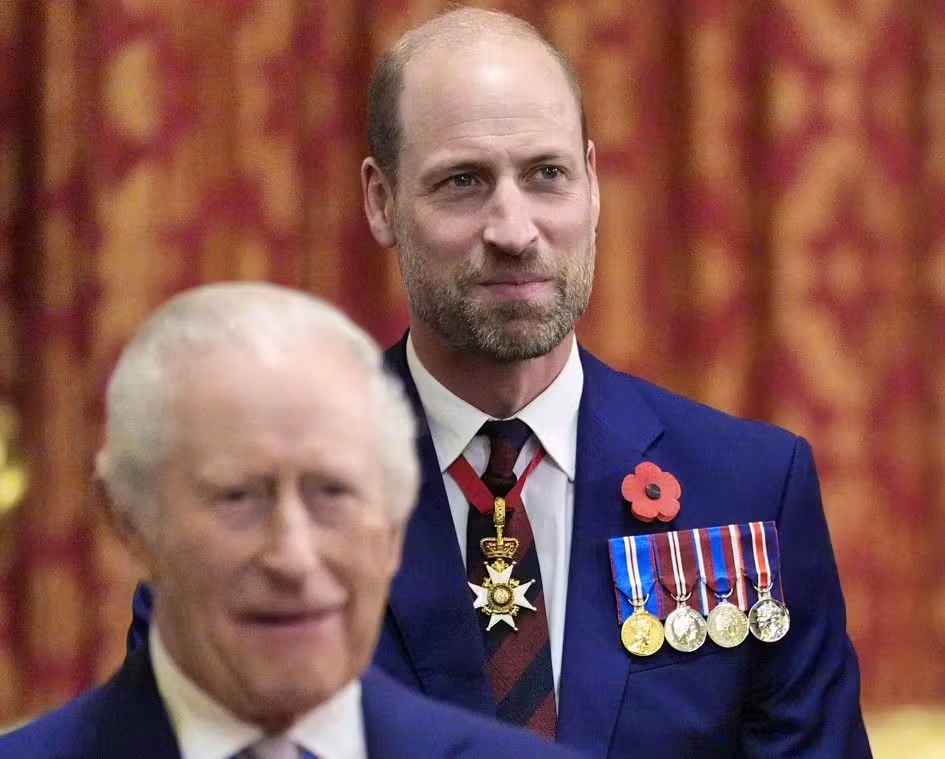
King Charles III on Thursday became the first British monarch to reveal the amount of his taxes: 30 million pounds (32 million francs) on his private income since his accession to the throne in September 2022.
Here is an overview of the royal family’s sources of income – drawn from a public subsidy, but also from its land and real estate holdings – as well as some examples of expenses.
The Sovereign Grant
The Sovereign Grant is the annual grant paid by the government to the king to enable him to carry out his official duties.
This includes the operation and maintenance of official royal residences, staff costs, but also the travel of the king and members of the royal family who act on his behalf.
The amount of the “Sovereign Grant” increased from 132.1 million pounds in 2025-2026 to 137.9 million pounds in 2026-2027, in particular to finance the end of work at Buckingham Palace. It is expected to fall to £99.9 million in 2027-28.
For the year 2025-2026, staff costs amounted to £33.7 million.
The most expensive royal trip was Prince William’s three-day visit to Saudi Arabia in February 2026 (£130,106), ahead of King and Queen Camilla’s four-day stay in Italy in April 2025 (£126,946).
However, not all royal expenses are covered by the Sovereign Grant. For example, security costs are financed separately from public funds.
The Sovereign Grant is not taxable.
How is this allowance calculated?
The “Sovereign Grant”, whose system replaced that of the Civil List in 2012, is linked to the profits of the company managing the crown’s land and real estate assets, the “Crown Estate”.
Currently, it stands at 12% of the profits made two years earlier. This rate is reviewed regularly.
The allocation has increased sharply in recent years, mainly due to the exceptional windfall from the rental of seabed rights to offshore wind turbine developers, which has boosted the profits of the “Crown Estate”.
What is the Crown Estate?
The Crown Estate is a company managing the vast land and real estate assets of the crown. Worth 16.7 billion pounds (19.3 billion euros), it includes high-end buildings in London, rural land, coastal areas, the Windsor estate as well as rights to the seabed around England, Wales and Northern Ireland.
It operates independently of the government and the royal family.
This domain belongs to the monarch but is not his private property because he does not manage it and cannot sell it.
In the year ending March 2026, the Crown Estate generated £487 million in net profit (up from £1.1 billion the previous year).
The Crown Estate assets located in Scotland are managed separately by Crown Estate Scotland, and their income is retained by the Scottish Government.
Revenues of the duchies
In the 2025–2026 financial year, the King received £25.2 million in private income from his Duchy of Lancaster, while William, Prince of Wales, received almost £21.6 million from the Duchy of Cornwall.
These two historic estates constitute the main sources of private income for the monarch and his heir, thanks to the rental of agricultural land and the management of commercial and residential real estate in particular.
The monarch and the heir do not ensure its daily management, but they define its main orientations and approve major decisions. Both domains cannot be sold.
What taxes for the king and his heir?
Since 1993, following a practice introduced during the reign of Elizabeth II, the monarch has paid income and capital gains taxes on his private income, particularly from the Duchy of Lancaster, even if he is not legally required to do so.
In an unprecedented exercise of transparency, Charles and William revealed having paid respectively 30 million pounds and 20 million pounds in taxes since the death of Queen Elizabeth II in September 2022.
The voluntary system was introduced after public pressure sparked by scrutiny of royal finances, including questions over who would pay for repairs after the Windsor Castle fire.
Personal wealth
Members of the royal family also have personal wealth. The king is thus the owner of the estates of Balmoral and Sandringham, inherited from his mother.
Property passed directly from one monarch to another is exempt from inheritance tax.
