
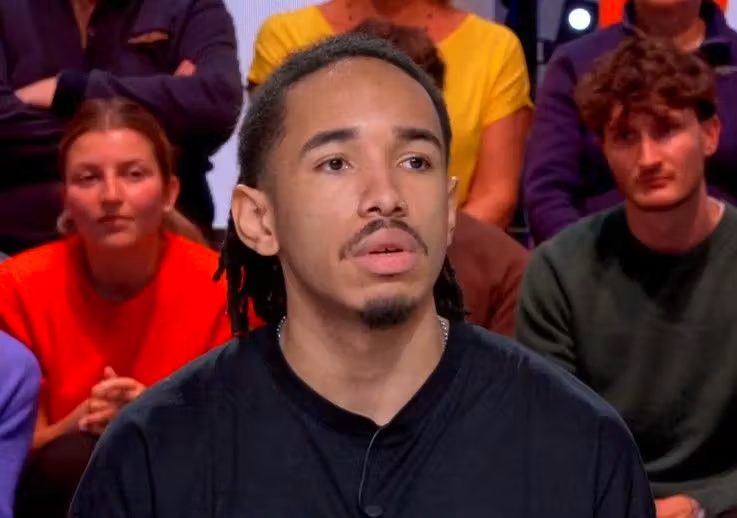
Behind the avatar of a teenager, the French streamer Finnyzyy created a buzz by unmasking an alleged child molester: a method that raises eyebrows among many child protection actors, while these “hunters” claim that “there are more benefits than anything else”.
The suspect, whose identity was revealed on the networks, surrendered and was imprisoned. The case shines the spotlight on these communities of Internet users who “hunt,” as they say, child criminals.
Finnyzyy is one of the supporters of “211 Organization”, an association created in 2025, chaired by the streamer Merogis. Pseudo chosen after the Fleury-Mérogis prison, located south of Paris, “because that’s where I fuck with pedophiles!”, he jokes to the AFP.
Merogis, in his twenties, like Finnyzyy, presents a similar profile. “It came a bit naturally because I grew up with the internet, I was able to see a little bit of all these odious people (suspected child molesters, editor’s note),” he says. “We created a group, then an association”, including “35 hunters”.
The intention “is understandable, especially since the resources allocated to the fight against sexual violence against minors remain insufficient given the scale of the phenomena”, establishes Véronique Béchu, director of the Observatory of digital violence against minors within the association e-Enfance/3018.
“But depending on how these practices are implemented, they can cause much more harm than good,” says this former head of the National Police Juvenile Office (Ofmin), interviewed by AFP.
“Circus games”
“The end justifies the means is not a good message, especially when the means constitute offenses,” agrees with AFP Me Jean Sannier, lawyer for Innocence in Danger.
“Provoking an offense is prohibited,” Agathe Foucault, spokesperson for the national police, told AFP.
“At no time does Finnyzyy ask these people to say certain things,” assures AFP Djamel Bouguessa, lawyer for the streamer who could not be contacted via his counsel.
“We do not provoke and we do not incite the alleged child offender on social networks, we just create a minor’s account,” insists Merogis.
If the identity of a suspect is “broadcast en masse on the networks”, Agathe Foucault warns against “crimes of defamation, attack on the presumption of innocence, attack on private life”, without forgetting the risks “of potential violence, as we have seen in other situations”.
Me Sannier denounces “Roman circus games with a hunt for an individual whose image, name is given”.
For Merogis, “there are more benefits than anything else” and Finnyzyy “could not have known that (the suspect) was going to put his camera on and say despicable things”.
“Penalize the investigation”
Véronique Béchu paints an overall picture: “Certain collectives have been structured, trained and provided with legal and psychological support”. “Their work is serious enough to have created links with the police and justice services. And yet, around 50% of their reports are not followed by legal action.” “Certain magistrates refuse to condone this type of practice, precisely because it can lead to the abuses that we have seen,” points out the manager.
For Agathe Foucault, certain streamers can also “penalize the investigation” if a suspect discovered “deletes all his history, the data on his computer”. “And, perhaps more importantly, prevent us from potentially identifying victims, from finding them.”
“Until proof to the contrary (the investigators) have always been able to recover deleted data or images or other,” argues Merogis.
Agathe Foucault also deplores “an undoubtedly mercantile desire to generate views on social networks”.
“On YouTube and TikTok, I am not paid (…). On Twitch, yes, I receive +subs+ (subscriptions, editor’s note). It’s monetized, but it’s not either…” Finnyzyy, a “full-time” content creator, admitted on RTL.
For Agathe Foucault, the right reflex is “this is what one of the Internet users did when he saw the video, he must report it to Pharos and there is an investigation that is underway.”
This “platform of the Ministry of the Interior was able to record the facts and refer the matter to the competent public prosecutor’s office. That’s the role of the citizen,” concludes Véronique Béchu.
