
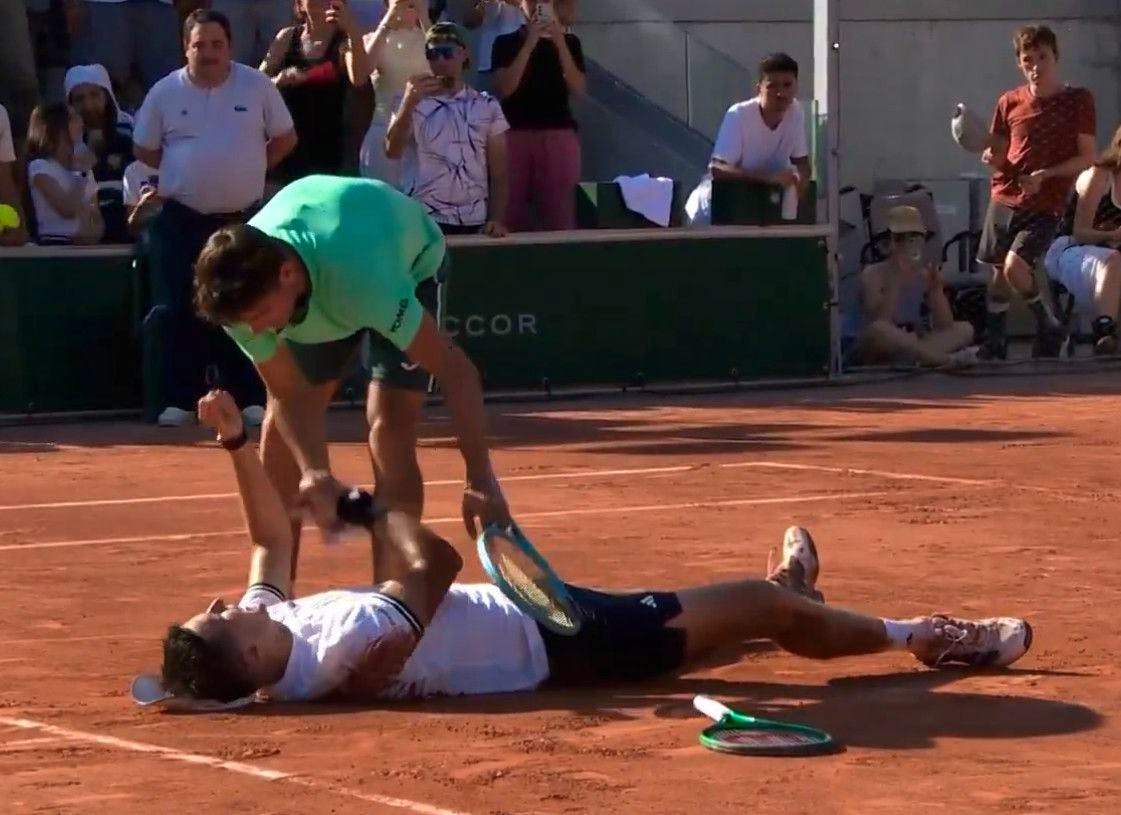
“It’s insane to play in this heat” for almost five hours: his marathon victory in five sets acquired against the Argentinian Mariano Navone in the second round of Roland-Garros on Wednesday, the Czech Jakub Mensik immediately collapsed on the court, crippled with cramps.
“It’s insane to play in this heat, to spend more than 4.5 hours under this sun,” regretted the 20-year-old Czech at a press conference, after this impressive failure following his victory 6-3, 2-6, 6-4, 1-6, 7-6 (11/13) in 4h41.
“We have little break time, the changes of sides are short, it’s complicated to bring your body temperature down. In the end, I had cramps but I managed to get off the court on my own two feet,” he continued.
While he had just concluded his match with a winning forehand on court N.6 devoid of shade, Mensik lay down on the clay court. His opponent came to greet him, he tried to get up but ultimately remained pinned with his back to the ground. The referee waited for many seconds before coming to see him. Finally, trainers came to help him, using a lot of ice, and the Czech was finally able to get up and walk.
“There are strict rules, and I respect that, but the weather conditions are crazy,” he replied. “I respect the rule but the referee… What happened after the match, I will keep it to myself, but I don’t respect his behavior,” he added, without wanting to say more.
“In the locker room I went straight for an ice bath, then I went to the gym to do a little recovery, so I feel pretty good. It’s just a matter of regaining your strength, drinking a lot and eating a little, and everything will be fine,” he reassured before his next match on Friday against Australian Alex de Minaur.
Already during the match, Mensik showed signs of exhaustion and the medical service intervened during a break. After missing six first match points, he won after a decisive game during which he was reprimanded for exceeding time during his serves.
Djokovic calls for ‘pushback’ of evening matches
After an “exhausting” second round on Wednesday in the middle of a heat wave, Novak Djokovic estimated that the organization of Roland-Garros should “push back” the matches for a few hours when such extreme conditions arise, as is done in Australia.
“In Australia, (…) for several years, sometimes we postpone the upcoming match by an hour, two hours, three hours so that the temperature drops,” commented the 39-year-old Serbian at a press conference after his victory against Frenchman Valentin Royer in four sets.
“For Grand Slam tournaments, it shouldn’t be a problem. We have so many courts, we have light, there is no problem in principle,” he continued. “We can schedule the matches at another time on other courts.”
“It’s not ideal to go past midnight, but if it happens when there is a heatwave or extreme conditions, we can perhaps think about it anyway,” he said, in what looks like an appeal to the organization.
For him, the logical response to these extreme conditions does not lie in covering a few privileged courts, such as Philippe-Chatrier and Suzanne-Lenglen in Paris, which would be “unfair”.
Like its Oceanian counterpart, which takes place during the southern summer, Roland-Garros has an “extreme heat” protocol. It is based on an indicator which synthesizes several meteorological variables such as air temperature, humidity level, wind speed and solar radiation.
A ten-minute break can be granted to singles players and matches can theoretically be interrupted if this indicator exceeds a certain threshold, which has not yet been crossed in Paris, where the humidity is much less significant than in Melbourne.
“When you play three and a half hours on dirt, it’s long and it’s exhausting. Physically, I expended energy, quite a bit, it was very hot, the conditions were difficult,” noted the man at 24 Grand Slam tournaments after his qualification in the 3rd round.
