
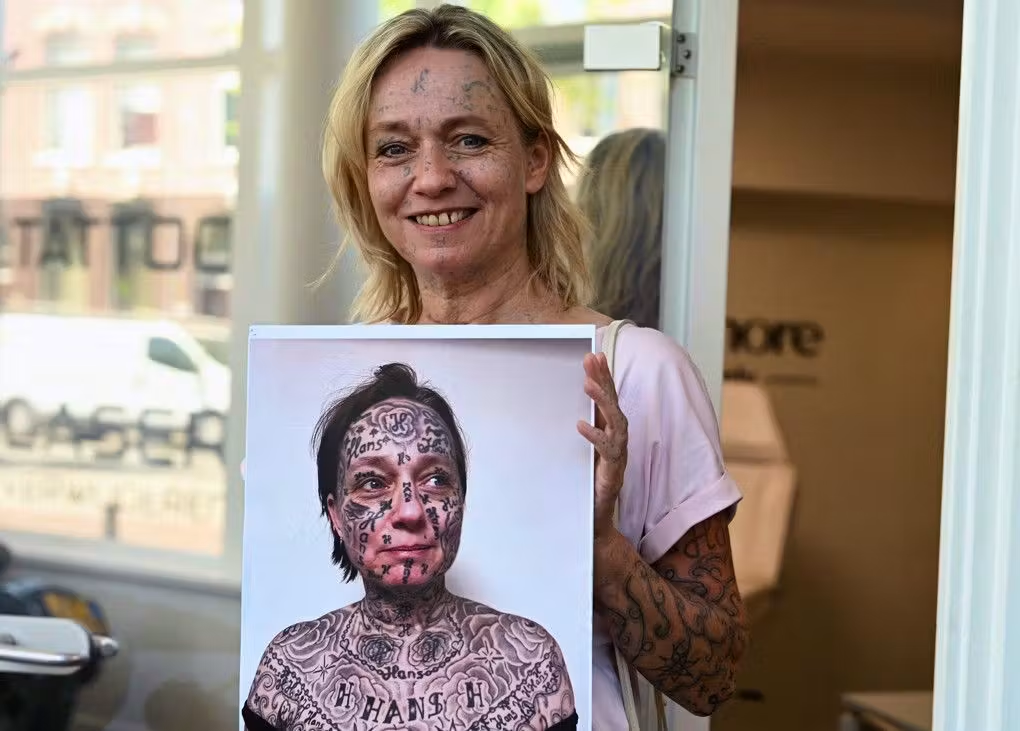
Dutch woman Joke winces as the laser blasts her skin, erasing one of the 250 tattoos her abusive partner etched across her body and face, wherever he thought another man had touched her.
The 53-year-old is one of hundreds of people helped by a foundation in Rotterdam, the Netherlands, which offers victims free laser treatments and is preparing to expand internationally.
Joke suffered years of abuse, locked in trailers and barns, forcibly tattooed at home with a dermograph, until virtually no part of her body was free of ink.
The man wrote his name on Joke’s face more than a dozen times: on his forehead, nose, cheeks, chin and even eyelids.
She fled, but the physical scars of her companion’s cruelty remained visible to all, plunging this woman into shame, terrified of leaving her home.
“Everyone looks at you and insults you. They call you stupid, crazy. And you have nothing, absolutely nothing. You feel so small,” Joke told AFP.
It was through a national organization helping victims of domestic violence (Veilig Thuis – Safe Home, in French), that Joke discovered the Spijt Van Tattoo foundation (Regret of Tattoo, in French).
Over two and a half years, Joke underwent 12 laser sessions to remove ink from his face. The pain is so intense that a plastic surgeon must anesthetize the treated area.
Today, thanks to makeup, the tattoos on his face are barely visible and Joke says he has his life back. “It hurts like hell,” she sighs. “It takes so much strength to get everything removed… But you can’t imagine the happiness it brings. I could never have imagined it,” she says.
Joke had suicidal thoughts for 18 months. She explains that she has been “liberated” since her ex-partner’s name was erased from her face. She is able to see the future in a more positive way.
“A little thing can make me happy. If the weather is nice, that’s great. Even if it rains, I feel warm inside. Everything makes me happy now,” she says. “It gives hope. And hope keeps us alive.
“Take back control of my life”
Bonnie, whose first name has been changed by AFP to protect her identity, was only 17 years old when she met her ex-partner, who quickly became violent and possessive.
Five years later, on his own birthday, as a present, he dragged Bonnie to a tattoo parlor. Just above the pubis, he had “property of” engraved on it, followed by his name.
She tried in vain to make the tattoo artist understand that she was not consenting, but the dominant presence of her companion ensured that the act was carried out.
The humiliation did not stop there. Back home, Bonnie was forced to show the tattoo to several of her partner’s friends.
“He was very proud. I belonged to him. I was now his property. And I would stay that way,” this woman, now 42 years old, confided to AFP.
“And I only felt sadness, humiliation, fear, disgust… There was this pride that shone in his eyes. I belonged to him. And never to anyone else again. I have never felt so bad, so dirty,” she remembers.
Bonnie suffered more than ten years of violence, death threats and threats to kidnap her children. When the man started hitting her son, she decided to leave. According to her, people who have never been in such a relationship cannot understand how difficult it is to escape from one.
“You are being threatened. You are being manipulated. They drive you crazy to the point where you start to doubt yourself. To believe that you are no longer capable of anything. That you are worthless. We demean you so much,” she explains to AFP.
Unlike Joke, who decided very quickly to have his tattoos removed, Bonnie only made this painful decision after several years.
She first considered covering it, before realizing that the text and ink would still be there. “I would always feel like my body is a part of him, even though it’s not.”
For a while, she couldn’t even shower because she couldn’t stand seeing her body and her tattoo. “My body was so dirty to me that I didn’t want to wash it anymore. Because we carry all these years within us,” she declares.
Just like with Joke, the tattoo removal process was an integral part of his reconstruction. “I am very proud to have taken this step,” says Bonnie. “For me, this is the first step in closing one of the most painful chapters of my life.” “It’s a step towards freedom, healing, reappropriation of my body, taking back control of my life, and towards finding myself again, without shame.”
“Extreme” case
At the origin of this foundation is a charismatic couple, Andy and Dex Han, who have been in the tattoo removal field for 30 years. In 2018, they decided to dedicate one day a week to volunteering to remove tattoos imposed on victims of domestic violence or other forms of coercion.
Interventions range from erasing an initial from a finger to the case of victims of prostitution networks whose pimp has his name tattooed on their forehead.
But even seasoned professional Andy Han was shocked when he first saw Joke. “I’ve seen things, but this was extreme. I didn’t know where to look. His chest, his face, his eyes, his nose… everything was covered with this man’s name. I didn’t know where to start,” says Mr. Han, 64.
There was also the financial question. Tattoo removal costs ten times more than the tattoo itself and its price depends on the surface to be treated. Joke had so much ink on his face that a single session would cost the equivalent of an entire year of volunteer work, Mr. Han calculated.
In total, Joke’s treatment will cost around 100,000 euros (93,000 €). A crowdfunding campaign raised more than 30,000 euros (28,000 €).
But the couple said they had to help him, whatever the cost. “We said to ourselves: listen, she’s someone’s daughter. Someone’s sister, someone’s friend. And she no longer has a life,” Mr. Han told AFP. “When you see the before and after photos, it’s extraordinary. And this is also seen in his personality,” he adds.
“Don’t be afraid”
Mr. Han believes that the dozens of requests he receives represent only the tip of the iceberg.
Kylianne Teuben, a behavioral specialist with the organization Veilig Thuis, explains that forced tattooing, like many other forms of domestic violence, is difficult to detect because the evidence is “hidden under clothing”.
She urges anyone in such a situation to seek help: “Please come out of silence, otherwise we will not be able to help you.”
“It is important that they know that they are not alone and that there is help. So try to seek help when you feel ready. There are organizations that can support you,” says Ms Teuben.
Joke and Bonnie want to convey the same message: you have to leave, even if it seems insurmountable. “It’s easier said than done, I know that very well myself… but don’t be afraid,” Bonnie said. “Because it’s about your life. And you only have one life,” she said, her voice trembling with emotion.
“Just get started. The situation cannot be worse than the one you find yourself in now,” says Joke. “Every woman can do it. Women are strong.”
