
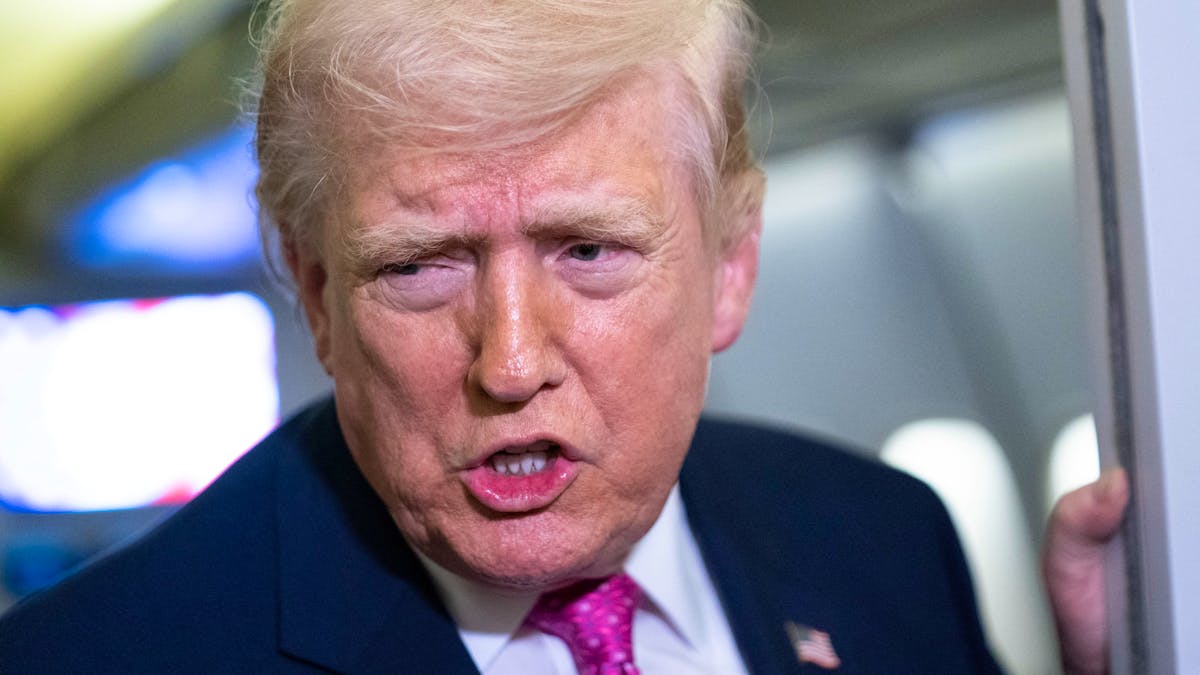
Donald Trump raised the tone vis-à-vis Iran on Monday by threatening to “annihilate” the island of Kharg, its main oil terminal, if discussions between Americans and Iranians did not succeed “quickly”, in particular to reopen the Strait of Hormuz.
The American president continues to blow hot and cold, on the continuation of military operations as on possible talks with the Iranians, not proven at this stage.
The continuation of the bombings this weekend and Monday in Iran, the Gulf and Lebanon, and the inflexible declarations of the belligerents are fueling the surge in oil prices, which have climbed by more than 50% since the start of the war. They regained 2.5% in the morning, to more than 115 $, after Donald Trump spoke on Sunday of a possible land operation to seize the Kharg terminal, which provides around 90% of the country’s crude exports, and “take Iranian oil”.
He hit the nail on the head Monday on his Truth Social network, reaffirming that the United States was talking with new Iranian leaders, whom he did not name and on whom he gave no details.
“A more reasonable diet”
“The United States of America is in serious discussions with A NEW, MORE REASONABLE REGIME to end our military operations in Iran,” he said.
“Enormous progress has been made but, if for some reason a deal is not reached quickly, which it likely will be, and if the Strait of Hormuz is not immediately open for business, we will conclude our lovely stay in Iran by blowing up and completely wiping out all their power plants, oil wells and Kharg Island (and maybe all the desalination plants!).”
On Saturday, the American military command announced the arrival the day before in the Middle East of an amphibious assault ship, at the head of a naval group comprising “some 3,500” sailors and soldiers of the Marine Corps.
Iran is waiting for the soldiers
“The enemy is publicly sending messages of negotiation and dialogue, while secretly planning a ground offensive,” denounced the Speaker of the Iranian Parliament, Mohammad Bagher Ghalibaf, on Sunday. Before warning: “Our men are waiting for the arrival of American soldiers on the ground to attack them and punish their regional allies once and for all.”
Donald Trump had already assured Sunday that “a change of regime” had taken place in Iran, after the deaths of the main leaders of the Islamic Republic in bombings.
In recent days, Iran’s neighbor Pakistan has offered to “host and facilitate” “meaningful talks” between the two countries.
The Israeli army announced Monday that it had bombed a university in Tehran run by the Revolutionary Guards, the ideological army of the Islamic Republic, claiming that “research and development activities on cutting-edge weapons” were being carried out there. It had indicated a little earlier that it had again struck military sites in Tehran, in response to a missile attack from Iran.
“All of Tehran is shaking”
After a lull last week, the bombings appear to have intensified this weekend on the Iranian capital, notably causing temporary power cuts, according to AFP journalists on site.
This weekend, the NGO Human Rights Activists News Agency (HRANA), based in the United States, counted at least 360 attacks in 24 hours in 18 provinces of the country.
For residents of Tehran, contacted by AFP journalists from Paris, nothing is normal anymore. “Going out in the evening or simply being able to go to another area of the city, do my shopping elsewhere than in the small grocery store or bakery on my street, read in a café, go to the park… I miss all these very, very simple things,” says Elnaz, a 32-year-old painter. What she misses most is “a peaceful night’s sleep”, far from those nights when the attacks are so intense that she has the impression that “all of Tehran is shaking”.
The NGO Acled, which compiles data on conflicts, reported during the first month of war nearly 2,300 American and Israeli bombings, and 1,160 Iranian strikes in retaliation.
In total since the start of the conflict, the HRANA organization has recorded nearly 3,500 deaths in Iran.
