
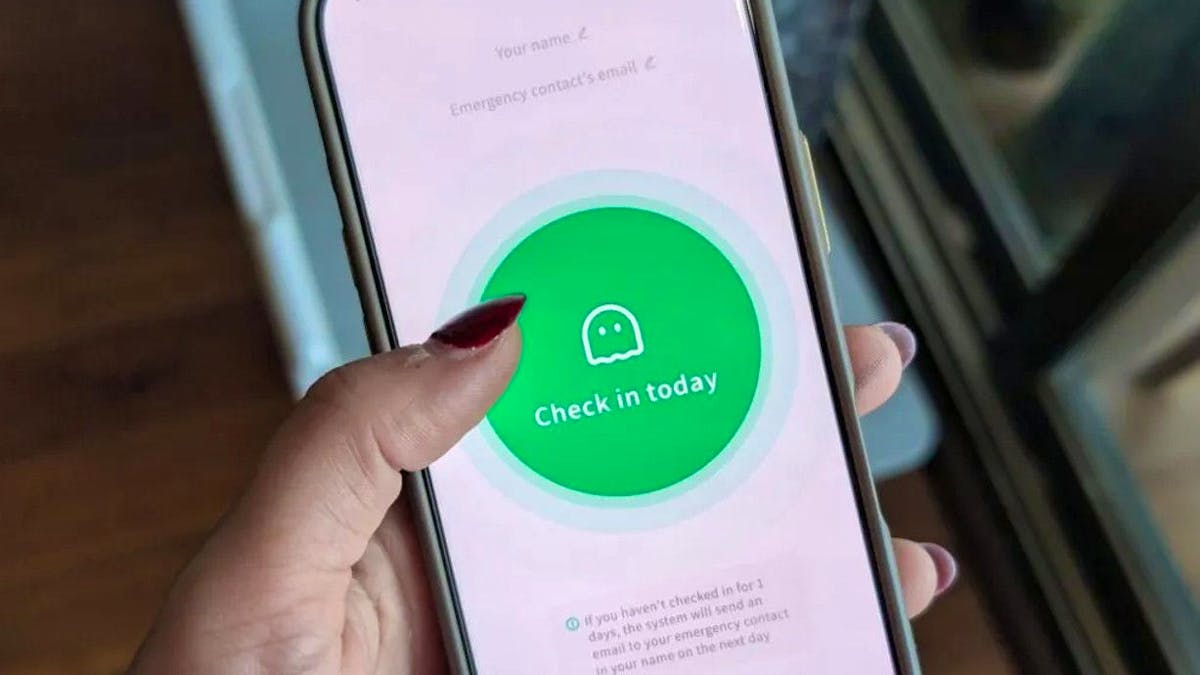
“Are you dead?”: this new application with a provocative name, which allows alerts to be sent if its user does not report regularly, is a hit in China, where there are more and more people living alone.
Chinese people once married on average in their early twenties, and older people often lived until their deaths with their children, even when the latter had married.
But marriage is clearly losing momentum and many adults now consider it unthinkable to live with their parents, social changes which have led to increasing isolation, particularly in large cities.
An ideal breeding ground for “Si le me” (“Are you dead?” or “Are you dead?”), an application designed by Moonscape Technologies, which presents it as “a security tool designed for people living alone” and wanting to reassure themselves.
With its ghost-shaped icon, it invites the user to enter their name and the email address of a person to contact in the event of an emergency.
“If you have not reported for two days, the system will send an email on your behalf the following day” to this contact, explains the application.
“A little too violent”
“Are you dead? rose to the top of the ranking of paid applications on the Apple App Store in mainland China (excluding Hong Kong and Macau) on Sunday.
Some young people, although the product’s core target, however, doubt its usefulness.
27-year-old Yaya Song, who works in IT and lives alone in Beijing, told AFP she was intrigued. But she considers the price excessive for the service provided.
“If it was free, I would download it and try it. Even at one yuan (0.12 euros), it would be acceptable, just to test! But eight yuan (0.98 euros) is a bit expensive,” she believes.
In any case, employers, well before family or friends, are often the first to notice a possible problem, for example if their employee does not come to the office, underlines Yaya Song.
She also finds that the name of the application is “a little too violent”.
An opinion shared by Huang Zixuan, a 20-year-old student.
“If I wanted my grandparents to download this app (for their safety), I wouldn’t be able to tell them its name” because the latter is too “gloomy” and seen as a bad omen in China, she confides.
Change of name?
Others believe the app can be useful.
“I imagine that when we approach forty, we all start to worry a little about what will happen after we die,” Sasa Wang, a 36-year-old office worker, told AFP.
In 2024, people living alone represented a fifth of Chinese households, compared to 15% ten years earlier, according to official statistics.
On Saturday, Hu Xijin, former editor-in-chief of the official “Global Times” newspaper and media figure, praised the potential of this application in helping isolated people on the social network Weibo.
“At the same time, I suggest renaming it “Huozheme” (“Are you alive?”), which would be a little more comforting for the seniors who use it,” he emphasizes.
Founded by three young entrepreneurs, the company responded on Weibo that it would “seriously review and consider” a name change.
But several Internet users urged developers to keep it.
“It’s good to face the question of death,” says the comment with the most likes.
