
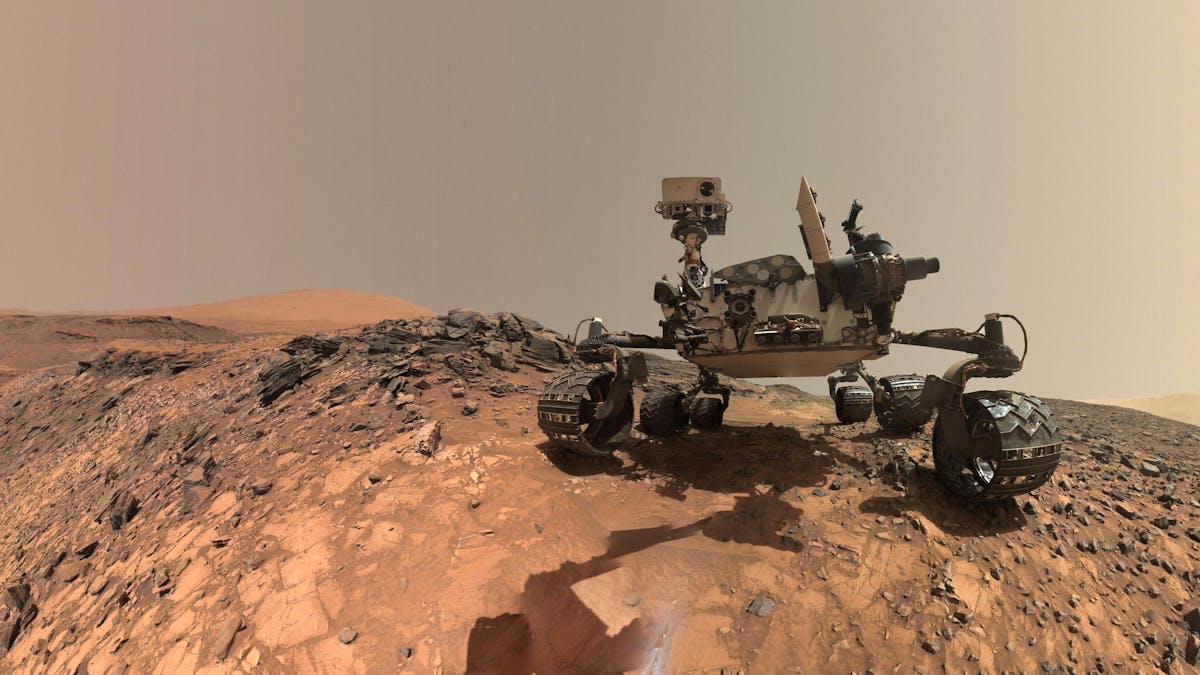
New building blocks of life on Mars have been discovered by a NASA rover, following unprecedented chemical experiments, researchers announced Tuesday. These organic molecules do not constitute definitive proof of the presence of life in the past on Mars, however, underlines the team led by NASA, because they can also come from the crash of meteorites on the red planet.
But these important clues to Martian history have been preserved on its surface for more than three billion years. At that time, the surface of Mars was covered in large lakes and rivers of liquid water, a key ingredient for life.
Curiosity, a NASA rover, landed in an ancient lake called Gale Crater in 2012, and has since searched for signs of life. The machine, the size of a car, carried with it two tubes of a chemical called TMAH, capable of breaking down organic matter to determine its composition.
“This experiment has never been done before,” Amy Williams, an astrobiologist working on the Curiosity mission, told AFP. The team was under pressure because they only had “two cartridges to aim correctly,” adds the lead author of the study published in “Nature Communications.”
The same as on Earth
The experiment, conducted in 2020, detected more than 20 organic molecules. For several of them, their presence on Mars has never before been confirmed, such as benzothiophene, which has however already been found in meteorites and asteroids.
“The same elements that fell on Mars in the form of meteorites are those that fell on Earth, and they probably provided the building blocks for life as we know it on our planet,” explains Amy Williams. Another molecule that contains nitrogen “is a precursor to the final structure of DNA,” she adds.
But this is not enough to prove that life once appeared on Mars. One potential way to achieve this would be to bring stones from Mars back to Earth in order to analyze them more precisely, explains the researcher.
Another NASA rover, Perseverance, has already collected rocks with a view to such a mission, called Mars Sample Return. But this mission is on hold, after a vote by the American Congress in January.
Future missions will, however, benefit from Curiosity’s work, in that it has proven that TMAH-based experiments can work on other planets, the study writes.
The European Space Agency’s (ESA) rover Rosalind Franklin, which has a much longer drill than Curiosity, will take this chemical to Mars.
After years of delays, NASA announced last week that the ESA rover should leave for the Red Planet at the end of 2028.
