
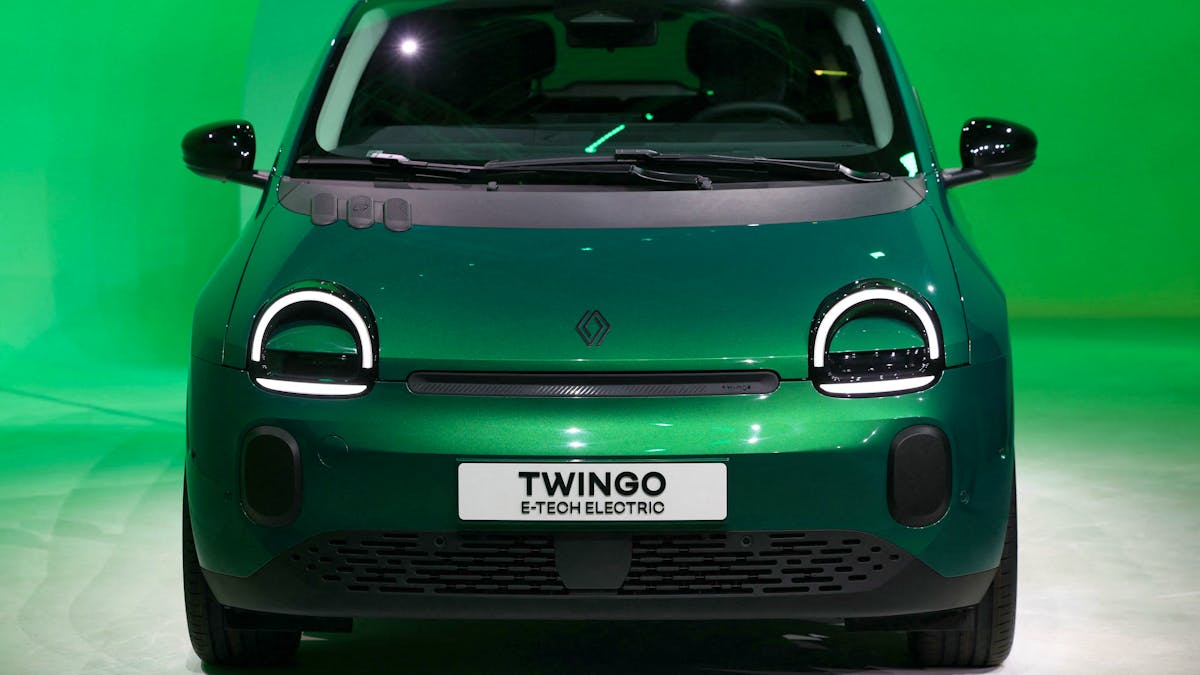
Renault unveiled its new Twingo on Thursday, the fourth generation of the model launched more than thirty years ago, which this time will be sold exclusively in an electric version, a bet for the manufacturer which wants to show that the small electric car market can finally take off.
The new Twingo takes on the striking features of its ancestor: four bright colors (red, green, yellow and starry black), sliding rear seat, rounded stern and half-moon headlights which have earned it the nickname “the frog”.
“Neorétro design has worked well for several years,” notes Olivier Hanoulle, automotive partner at the Roland Berger firm. But a car now electric, with today’s technology.
Range of 263 km
Marketed at the start of 2026, for less than 20,000 euros in France (excluding state aid), the Twingo E-Tech will have a range of 263 km according to WLTP standards. A low level assumed by Renault, which intends this vehicle above all for daily journeys.
Segment A (which designates the smallest vehicles) “has been almost deserted by manufacturers, due to regulations” which impose expensive safety devices, according to Fabrice Cambolive, director of the Renault brand. The margins are also lower on these small cars. “But it is a key segment for the democratization of electrification,” he says.
Thermal and hybrids banned from 2035
The European Union (EU) plans to ban the sale of new thermal or hybrid vehicles from 2035. A flagship measure for the EU to meet its greenhouse gas emissions reduction targets, but contested by the automotive sector which is calling for relaxation.
Electricity has represented 19% of sales of new vehicles in France since the start of 2025 (and 24% for the month of October alone), according to the Automotive Platform, which brings together French manufacturers in the sector. In the EU, the share was 16% over the first nine months of the year, compared to 13% over this same period in 2024, an insufficient level to achieve the 2035 objective, according to ACEA, the European equivalent of the Automotive Platform.
For Christophe Michaëli, automotive market director at Cetelem, the new Twingo “is a major challenge for Renault and for the electrification of the car fleet” in France. “Today, 70% of new electric cars are purchased by 20% of the richest French people. We need popular models to succeed in the ecological transition,” he adds, recalling that this is a public health objective.
The R5, R4 or even the Citroën C3 and the Fiat 500 are also city cars with electric versions, but in segment B (a little larger than the A), at more than 20,000 euros.
Chinese methods
To get below this bar, Renault was inspired by the methods of Chinese car manufacturers. The group opened a research and engineering center near Shanghai at the end of 2023, where the new Twingo was designed in less than 24 months, compared to three to four years for a European car.
Some 45% of the new car’s parts are designed or partially manufactured in China. Assembly takes place at the Renault plant in Novo Mesto (Slovenia), where the last two generations of Twingo were already produced.
