
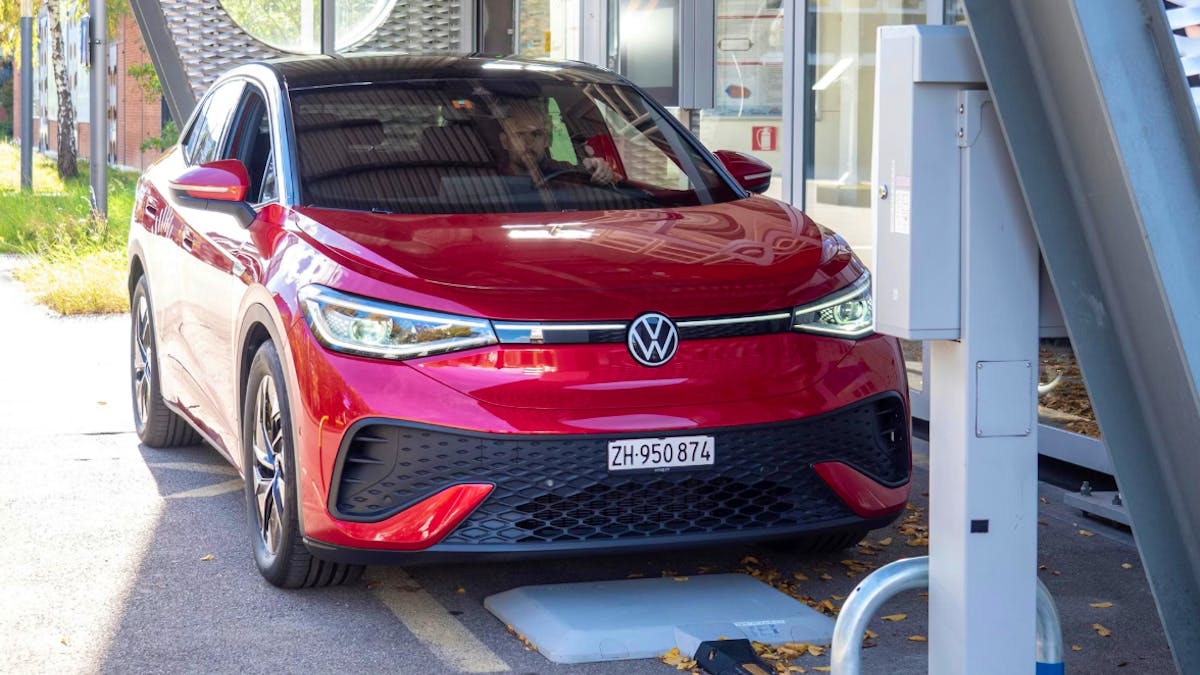
What has long been commonplace for cell phones or electric toothbrushes could soon become reality for electric cars: inductive charging without any cables. A transmitter coil embedded in a floor plate transmits energy via magnetic field to a receiver coil in the car.
This significantly increases convenience: the charging process starts automatically as soon as the car is properly parked. This also opens up completely new possibilities: parked electric cars would be automatically connected to the grid and could in the future contribute to the energy transition as mobile electricity reservoirs.
As part of the “INLADE” pilot project, the federal laboratory (Empa), under the leadership of the energy supplier Eniwa AG, tested wireless charging for the first time in Switzerland under real conditions, together with other partners. The project was supported by the Federal Office of Energy (SFOE) as well as the cantons of Zurich and Aargau. “The aim was to test existing technology in everyday life, clarify technical and regulatory issues and demonstrate its potential for the energy transition,” explains Mathias Huber from Empa’s Department of Chemical Energy Sources and Automotive Systems.
Park with precision
With the new inductive charging station of Empa’s “move” mobility demonstrator, the converted electric car must be parked precisely. A display shows the optimal position – in future, parking assistants will take care of this automatically. Once the vehicle is correctly positioned, the system detects its position above the plate installed at ground level and initiates the charging process. He first checks that no object or living being is between the coils.
As part of this project, AMAG and other partners equipped existing vehicles for wireless charging. To do this, receiver coils were installed and interfaces to the charge management system and the high voltage system were integrated. Extensive electromagnetic compatibility (EMC) measurements and safety tests were then carried out. “This was to ensure that the magnetic field generated by inductive charging did not affect other devices inside and outside the vehicle, nor people,” explains Mathias Huber.
Cable charging still possible
The transformed vehicles then obtained individual approval for Swiss roads. They are among the first electric cars in the world equipped with an induction charging system suitable for daily use. Classic cable charging remains possible.
Empa researchers also studied the impact of inductive charging on the battery and efficiency. Tests carried out in real conditions – with snow, rain, temperature differences and slight parking variations – have shown an efficiency of around 90%, comparable to that of cable charging. “In practice, this technology works very reliably and is as efficient as conventional charging systems,” concludes Mathias Huber.
Like other vehicles, electric cars remain stationary for an average of 23 hours a day. If they were permanently connected to the electricity grid in parking lots or garages, their batteries could serve as electricity reservoirs, dampening fluctuations and thus promoting renewable energy. Bidirectional charging is also technically possible with inductive charging technology. “The great advantage of an inductive system is that vehicles are connected to the network much more often without the need for active intervention, which is a plus, both for comfort and the energy transition,” explains Mathias Huber.
This also results in economic benefits: smart charging helps reduce electricity costs, for example by charging at times when the share of renewable electricity is high, especially during the day, when more and more photovoltaic installations will supply energy to the grid in the future.
