
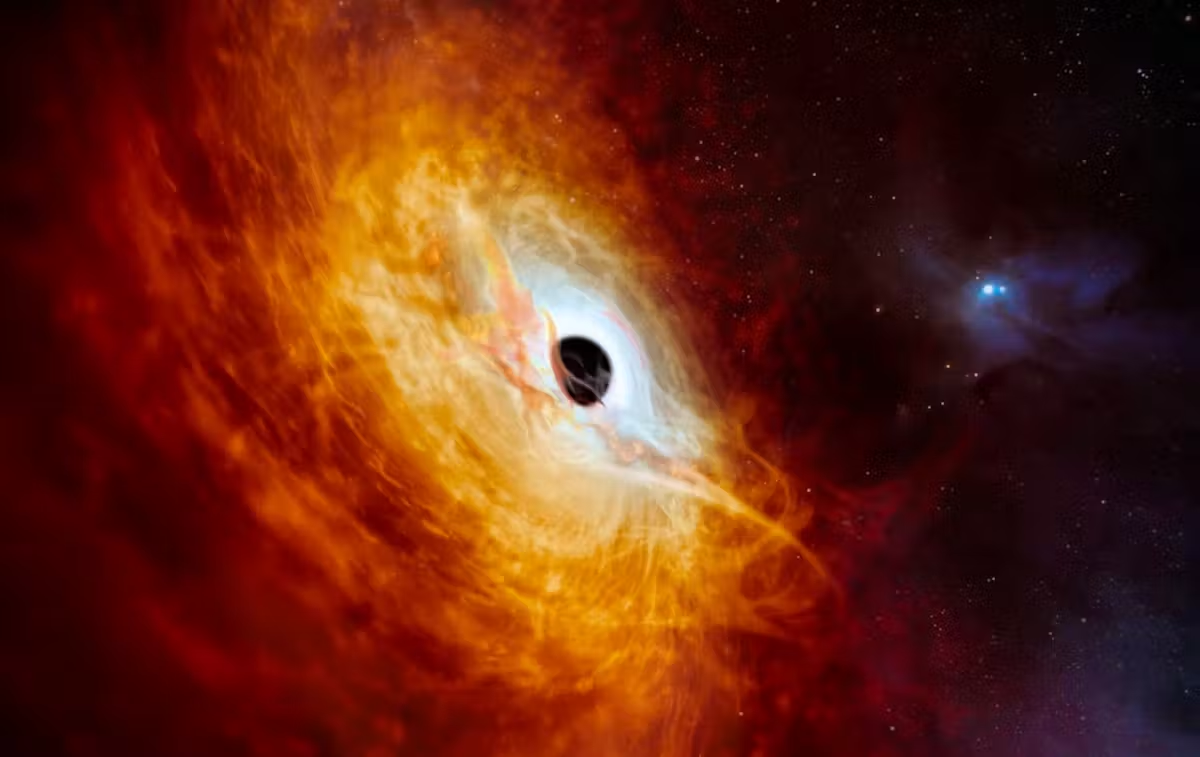
Scientists say they have detected for the first time imprints of the “event horizon,” the boundary beyond which nothing can escape from a black hole, in a study published Wednesday.
The event horizon is considered to be the point of no return of a black hole, from which even light is swallowed up by its gravitational force. Which makes studying it incredibly difficult.
However, a cataclysmic event allowed an international team of astrophysicists to learn more about this extreme phenomenon: the merger of two black holes.
Their collision creates gravitational waves that travel through the Universe. Scientists have only been able to detect these space-time undulations predicted by Einstein’s theory for around ten years.
In a study published in “Nature”, astrophysicists analyzed the most powerful gravitational waves ever detected. An event called GW250114, recorded in January 2025 by the LIGO observatory in the United States.
By isolating the last burst of waves emitted during black hole mergers – known as “forward waves” – scientists say they have been able to extract information from regions closer to the event horizon than ever before.
“The concept of an event horizon generally appears in science fiction,” Sizheng Ma, lead author of the study and researcher at the Perimeter Institute for Theoretical Physics in Canada, told AFP.
“But today, we are really able to ‘touch’ the region around this horizon thanks to gravitational data,” he adds.
Whirlwind
The final phase of the merger of two black holes is like a spoon stirring water in a glass, explains Sizheng Ma.
The swirl thus produced in space-time creates gravitational waves that travel at the speed of light in all directions.
If this “spoon” is close enough to the event horizon, “this gives us a chance to decode the physics at work in this region,” continues Sizheng Ma.
The authors emphasize that further research is needed to determine what this method can reveal about the event horizon.
But they detected information about how black holes distort the space around them when they rotate, a phenomenon called “frame drag.”
In the future, the team of researchers hopes to detect signs of quantum fluctuations.
“In this way, we can actually probe this region near the horizon to search for new physics,” including possible deviations from general relativity, enthuses Sizheng Ma.
Caution
Questioned by AFP, scientists who did not participate in the study, however, called for these results to be taken with caution.
Francesco Sannino, an Italian black hole specialist, calls it “remarkable” that scientists have been able to show that gravitational waves carry the “imprints” of the event horizon. But if it is a “convincing analysis”, it must still be confirmed by other researchers, tempers this theoretical physicist.
This work is “promising”, believes Maximiliano Isi, astrophysicist specializing in gravitational waves at Columbia (United States). “More generally, understanding the physics of black holes and their mergers is important, because it could shed light on how space and time are woven together at a more fundamental level,” he points out.
Sean McWilliams, an astrophysicist at West Virginia University (United States), is skeptical about the fact that the frequency of the gravitational waves analyzed is really “determined” by the event horizon.
For this reason, “the observed signal does not really tell us anything about the horizon or the properties directly linked to it,” he judges.
“There is often significant resistance and criticism in the early stages of promoting a new concept,” Sizheng Ma responded, adding that he was working on another article to “clarify” “possible misinterpretations.”
