
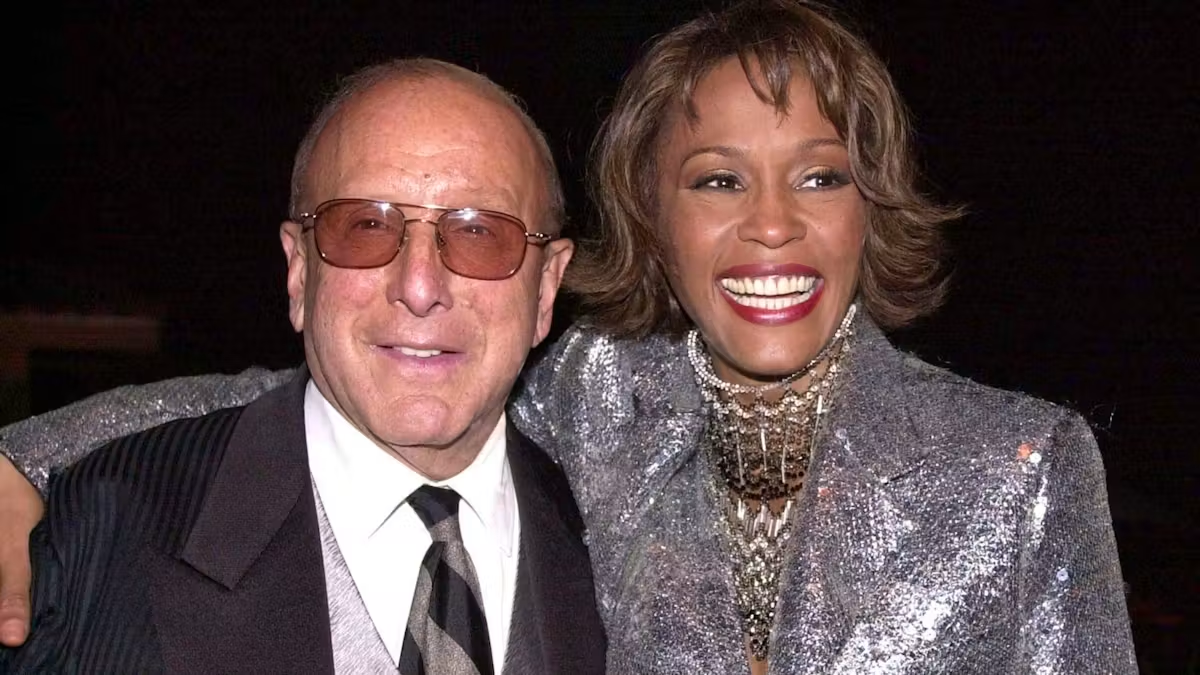
Aretha Franklin had elevated him to the rank of “greatest record producer of all time”: the American Clive Davis, architect of the successes of Whitney Houston, Bruce Springsteen and Santana, died Monday at the age of 94.
This leading figure in the music industry, who worked in genres ranging from folk to pop, rock and hip-hop, died of an “illness linked to his age,” his spokesperson said in a statement. He died at his home in New York, according to the same source.
“Today we celebrate not only a major figure whose influence changed music forever, but also the man who guided our family with grace, generosity and kindness,” responded those close to him.
From Janis Joplin to Earth, Wind & Fire, from Aerosmith to Billy Joel, from Patti Smith to Alicia Keys, he discovered, mentored and propelled to success many of the most famous artists of the second half of the 20th century and the beginning of the 21st century.
“I thank Clive Davis for transforming music, and, on a very personal level, for believing in me,” reacted Patti Smith on Instagram.
Born on April 4, 1932 in the New York neighborhood of Brooklyn, Clive Davis loved music but did not originally consider making it his career.
“In Jewish families without money, the idea was that you had to become a lawyer or a doctor,” he explained in the documentary “Clive Davis: The Soundtrack of Our Lives.”
Ears of a teenager
Educated in law at Harvard, he entered the recording industry as a lawyer at Columbia Records, before moving into management and becoming its boss in 1966.
Accused of having embezzled funds for personal purposes – which he denied – and fired in 1973, he founded another label, Arista, the following year.
He subsequently worked, until an advanced age, at Sony Music Entertainment.
“Clive has the mind of a banker and the ears of a teenager,” said his protégé Barry Manilow, author of the famous “Copacabana.”
When his death was announced, the latter said he was “honored to have been part” of the producer’s musical “family”.
Among her first discoveries, we will remember Janis Joplin, signed during the Monterey Pop Festival in June 1967, a founding event of the hippie counterculture.
He worked with Bob Dylan as well as Simon and Garfunkel, convincing the duo that the ballad “Bridge Over Troubled Water” could become a radio hit.
Tragedy
To the young Bruce Springsteen, who he felt was missing a hit single, he inspired “Blinded by the Light” and “Spirit in the Night”.
“At 22, he changed my life by signing me to Columbia Records. He treated me with the same respect and kindness when I was just an unknown 22-year-old as he did later, after all my success,” The Boss posted on Instagram.
Clive Davis also encouraged jazz legend Miles Davis to play rock venues, helping to shape the album “Bitches Brew.”
He was also the co-founder of Bad Boy Records, one of the first hip-hop labels, alongside Sean Combs, aka P. Diddy, now imprisoned for crimes related to prostitution.
But it is his collaboration with Whitney Houston, who alongside him became one of the best-selling artists of all time and one of the greatest voices of her generation, which is perhaps the most striking.
The latter’s premature death in February 2012, at the age of 48, was a tragedy for the producer, likened to the loss of his parents during his studies. “She reminded me in a profound way how people essential to your life can disappear in an instant,” he said.
Married and divorced twice, Clive Davis had four children and publicly revealed his bisexuality in his autobiography.
The music industry praised his talents but also laughed at his ego. A joke has it that he thought the CD (compact disc) was called that in homage to his own initials.
