
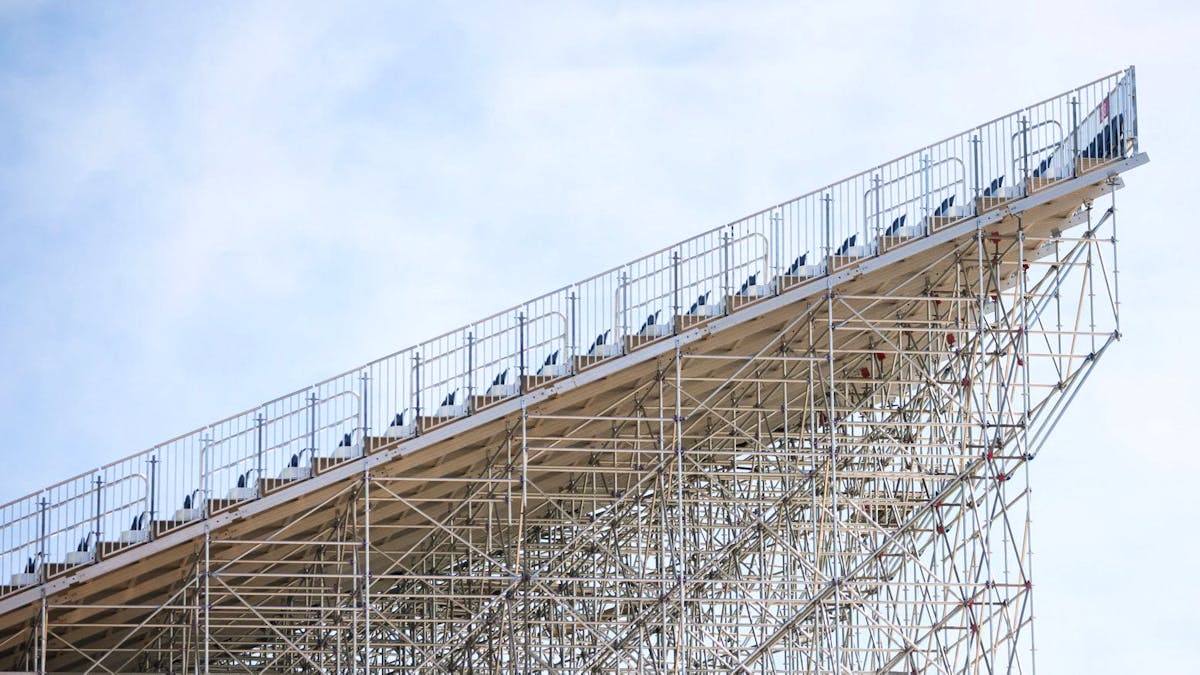
“The stands will be completely safe”: the managers of the Toronto stadium, which will increase its capacity for the 2026 World Cup matches with temporary stands, are trying to reassure the public who are worried about the solidity of the building.
BMO Stadium, renamed Toronto Stadium during the tournament, is the smallest of the 16 World Cup stadiums with a capacity of 28,000 seats. To meet the standards established by Fifa, it was necessary to add around 17,000 seats by building two stands behind the goals: 7,000 seats for the South and 10,000 for the North.
But their construction led to worried or mocking comments on social networks. An Internet user said on Another assured that “very respectfully, even if they pay me, they will not make me come up and sit on this”.
The images posted on the networks of these metal structures several tens of meters high in fact remind some observers of the Furiani stadium in Bastia, in XXL mode.
First big test on May 9
In May 1992, a few minutes before the start of the Coupe de France semi-final between Bastia and Marseille, the North stand – hastily erected and opened despite security alerts – collapsed under the weight of supporters. The disaster left 18 dead and more than 2,300 injured, causing trauma that is still vivid today in the country.
“The stands will be completely safe,” Nick Eaves, director of operations for Maple Leaf Sports and Entertainment, the stadium’s managing company, responded Tuesday during a press tour of the facilities.
Considering the controversy unfounded, he stressed that the work had been entrusted to Arena Group, the world leader in the construction of temporary stands.
The first big test will take place on May 9, when Lionel Messi’s Inter Miami will face Toronto FC in a sold-out MLS match.
“Multiple visits” from Fifa
“We plan to test and use every piece of this new infrastructure,” explained Nick Eaves.
Fifa will take control of the stadium on May 13, a month before Canada enters the World Cup in the Ontario capital.
But the world football body is already monitoring the work very closely, said Sharon Bollenbach, executive director of the local organizing committee for the World Cup.
Fifa inspectors “count all the seats, look at each seat, they determine their visibility” on the lawn, she explained. “There have been multiple visits from Fifa who have approved the work.”
According to Ms. Bollenbach, Toronto will not exceed the budget of $277 million in work allocated to host six matches of the tournament. And this despite the difficulties encountered, such as the polar cold and the heavy snowfall which fell on eastern Canada this winter.
It was also necessary to protect the lawn, made of 95% natural grass and 5% synthetic fiber, a recommendation from FIFA.
The turf was covered during the coldest months this winter, but the roots grew thanks to a system combining heat and light, explained Chris Shewfelt, vice-president of business operations at Toronto FC.
“At the beginning of March, when we uncovered the pitch, it was green,” he said happily, affirming that the Toronto stadium would have “one of the best pitches in the 16 host cities.”
