
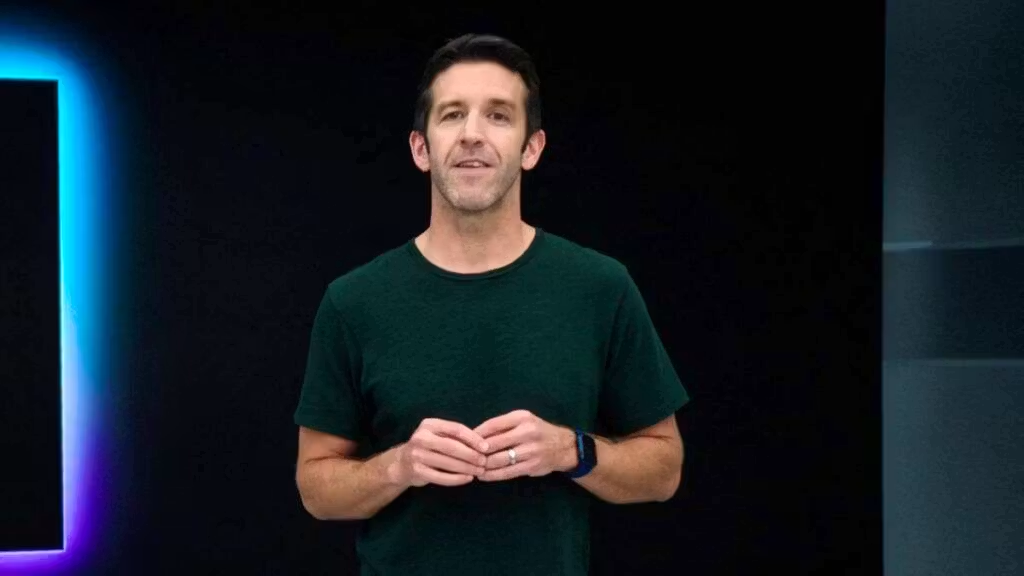
A synthesis between the stability of Tim Cook and the passion of Steve Jobs for products, the new boss of Apple John Ternus will have to find his way in the face of the challenges of AI, which are putting the group under pressure.
In his fifties, athletic, with no white hair, the figure of John Ternus has appeared more and more regularly in presentation videos or podcasts filmed in recent months, a sign of his growing importance.
“It was telegraphed,” observes Avi Greengart, analyst at Techsponential, regarding the appointment, effective September 1, of the man who invariably wears dark colors, from T-shirt to shoes.
Currently vice president of physical product engineering, John Ternus (50 years old) is a man of the inner circle, who has not left the company since his arrival in 2001, at just 26 years old.
“I am a mechanical engineer by training,” he said during an interview with CNBC in 2023, “and I have had the great fortune to work on all the products we manufacture.”
He notably participated in the design of the iPhone, which has become Apple’s flagship product, which has sold nearly 250 million in 2025 alone.
Behind the scenes, he also pushed, with others, the company to develop its own components, in particular chips, with a first generation for the iPhone in 2007.
“This is one of the most profound changes, if not the most fundamental, at Apple in the last twenty years,” this former competitive university swimmer said in 2023.
“I’m excited to see what a product guy like John Ternus does after Tim Cook, who was an operational genius but never claimed to be a product specialist,” says Avi Greengart.
A skillful manager, Tim Cook guided the group onto the launch pad offered by the iPhone, to make it the third largest market capitalization in the world.
Promised to become executive chairman of the board of directors, the sixty-year-old will notably continue to “dialogue with leaders around the world,” Apple said.
In recent years, he has, among other things, managed to protect his company from the crisis between the United States and China.
“John will also have to deal with these issues,” warns Avi Greengart, “but he will be helped by Tim Cook.”
Back to basics
Apple has changed scale and continues, despite everything, to grow, but embodies innovation and disruption less than in the past.
More than three years after the launch of ChatGPT, the group is significantly behind the flagships of the sector and has still not presented a redesign of the artificial intelligence (AI) assistant Siri.
“The Apple brand no longer has the same weight as it did in the days of Steve Jobs,” according to Marcus Collins, formerly of the house and professor of marketing at the University of Michigan.
A contemporary of Steve Jobs and Tim Cook, John Ternus “will be able to synthesize the best of each of them, in his own way,” he says, and allow the company “to return to its roots, those of hardware.”
Some questioned the relevance of an internal candidate when the brand could have benefited from the arrival of a legitimate figure on AI, a major issue.
But for Carolina Milanesi, analyst at Creative Strategies, “it is the equipment that will be decisive” in the race for AI, more than the artificial intelligence models themselves.
“It’s their capabilities that bring AI to life,” she says, “and Ternus brings this vision. (…) A fresh, younger look at the world and an appetite for success.”
For Dan Ives of Wedbush Securities, “it’s time to move from defense to offense.”
After having worried about seeing Apple incapable of developing its own competitive generative AI model, analysts now tend to put things into perspective.
For the moment, no telephone or IT equipment manufacturer has managed to offer an example of AI integration so successful that it becomes a flagship product for this reason.
“It has not yet been demonstrated that having control of your models offers a long-term competitive advantage,” emphasizes Avi Greengart. “The question remains open.”
