
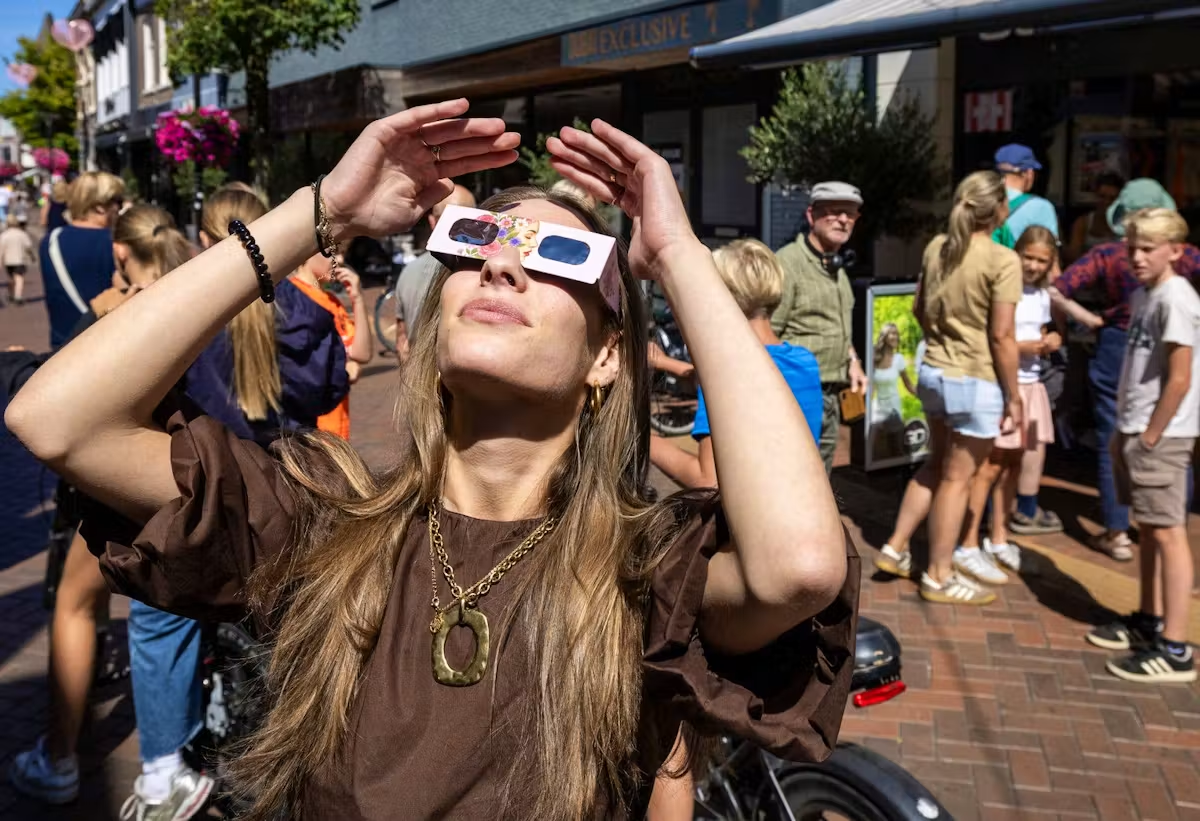
Millions of Europeans and enthusiasts around the world will gaze into the sky in wonder on Wednesday during a rare total solar eclipse that will very briefly plunge northern Spain into darkness in broad daylight.
“It’s the first time and it’s the last time, the only time that I’m going to see an eclipse,” Yenny Guevara, a 50-year-old Peruvian living in France, told AFP in Burgos, north of Madrid.
This rare astronomical phenomenon, the first of its kind in Europe since 2006, will start in Russia around 7 p.m. (Swiss time), then cross the Northern Hemisphere and pass over Greenland before crossing the Atlantic Ocean.
In addition to part of Iceland, the eclipse will be especially total in a band crossing Spain, from Oviedo to Palma de Mallorca via Burgos, north of Madrid, before disappearing around 8:30 p.m.
Beyond this band, it will only be partial, which will be the case for Switzerland – with a sun obscuration rate of around 91% and up to 91.8% in Geneva –, France, but also in Canada, in the north of West Africa and the United States.
The perfect alignment of the sun and the moon plunges the world into a disturbing purplish darkness, temperatures plummet. Disoriented, the animals adopt unusual behavior.
“Exceptional phenomenon”
“Everyone would like to be here, it’s like a gift for us,” rejoices Mario Alejos, 44. This professor living in Burgos remembers very well the previous eclipse that he saw “at 7 or 8 years old, at home with my parents”, and he can’t wait to relive that moment with his family this evening. “We are aware that this will probably be the last time, so we have to take advantage of it.”
But the spectacle will be fleeting: the duration of the eclipse in the totality phase, i.e. when the moon completely covers the sun, will last a little less than two minutes in Spain.
As a whole, however, it will be much longer, around two hours. Because it will start with a partial eclipse, before the total eclipse, then a partial eclipse again.
The phenomenon should allow scientists to study the sun’s atmosphere and its outermost layer, in the hope of unlocking the secrets of the solar winds and the magnetic field of our star.
It’s like “a Christmas that only comes once every 100 years,” Diana Morant, the Minister of Science, commented on Spanish public radio RNE. “This is a scientific event, an exceptional phenomenon, which should help us become aware of our tiny size, but also of the impact we have on (the) Earth.”
In recent days, considerable enthusiasm has gripped Spain in the run-up to the event, with the last latecomers having difficulty in places obtaining the famous certified protective glasses allowing them to observe the sun in complete safety.
“I’ve been looking since Friday, but I can’t find any anywhere,” laments Mabel, a resident of Barcelona, to AFP.
The sky will be “not very cloudy over most of the Iberian peninsula,” confirmed Ruben del Campo, spokesperson for the Spanish meteorological services (Aemet), on Wednesday, except in the northwest, where “low clouds” could hamper observations.
Spain, the world’s second largest tourist destination, also expects the eclipse to give a boost to its economy in the middle of the summer period, particularly in the rural regions of the North which have been suffering the effects of demographic decline for decades.
The net contribution to the economy is estimated at 347 million euros, with almost 450,000 additional tourists expected in key areas affected by the eclipse, according to the Ministry of Economy in Madrid.
Large influx of tourists
But the prospect of a large influx of foreign tourists also arouses concern among the unaccustomed authorities, who are calling for caution.
In the midst of a heatwave, temperatures are expected to exceed 35°C in most of Spain and could rise above 40°C in some areas of the northeast, posing a health risk to those who stay outdoors for several hours waiting for the eclipse.
Aemet also mentioned a “very high” or “extreme” fire risk, at the heart of a summer marked by devastating forest fires, a danger amplified according to experts by the announced presence of hundreds of thousands of people in very arid areas and clogging up small country roads with their vehicles.
Up to 1.5 million additional road trips to the totality strip are expected by the authorities.
In order to avoid massive traffic jams and any other disturbances to public order, several regions and municipalities have set up dedicated observation points, while increasing the number of security and emergency services for what will be the first total eclipse in mainland Spain in more than a century.
