
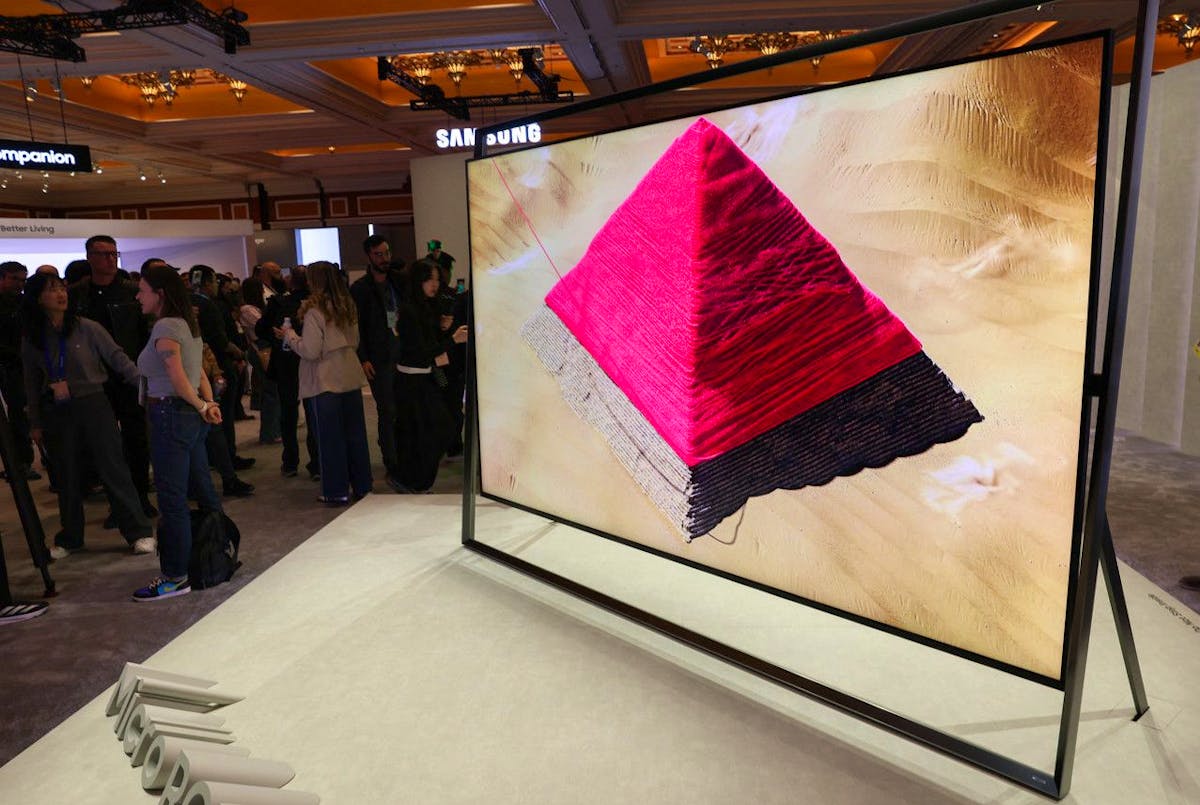
A few days before the hundredth anniversary of television, manufacturers in the sector have launched an onslaught of new products at CES in Las Vegas, a huge American consumer technology show, to try to stay in the race against smartphones and computers.
On January 26, 1926, the Scotsman John Logie Baird demonstrated, in London, his “television”, in which appeared the distorted but recognizable face of a man in the next room.
Since then, several billion jobs have been lost around the world, including 230 million in 2024, according to Counterpoint Research.
However, the proportion of video content watched daily on a television screen fell from 61% in 2017 to 48% last year, according to the Ampere Analysis firm. At the same time, the share of telephones doubled, reaching 21%.
“It’s a battle between big screens, traditionally popular with older viewers who grew up with a television, and younger people, consumers on phones, tablets or laptops,” describes Patrick Horner, head of research at Omdia.
The number of television owners is stable or declining depending on the region of the world, a decline that manufacturers seek to compensate for by selling more expensive televisions, an inflation justified by that of the size of screens and the integration of generative artificial intelligence (AI).
After flat screen LCDs, popularized at the start of the 2000s, and “Smart TVs”, connected to the internet and appearing at the turn of the 2010s, the industry brought down a new card this year, “Micro RGB”, a technology unveiled last year.
Always bigger
Concretely, it is based on LEDs, the now famous light-emitting diodes which have replaced conventional lighting methods almost everywhere.
These next-generation TVs include tiny red, green and blue LEDs of less than 100 microns each that enrich the colors of the picture and make it more vibrant.
The world’s leading television seller every year for twenty years, Samsung was already the first to market, last August, a 115-inch “Micro RGB” screen.
The South Korean giant arrived at CES this year with a 130-inch version, a whopping 3.30 m diagonally, also a first. The price has not been communicated, but it should be higher than the 30,000 $ that the 115-inch version costs.
In addition to the enhanced quality of its image, Samsung justifies the staggering cost of this screen with its AI features.
“We are going to put AI in all areas, all products and all services,” proclaimed, during a presentation, TM Roh, the head of the group’s consumer electronics division.
In particular, it is possible to carry out a program search, just by speaking, to generate a screensaver corresponding to a user description or to browse the internet thanks to a partnership with the start-up Perplexity.
Faced with “Micro RGB”, competitor LG has chosen to stick with OLED technology, very popular since the 2010s. It relies on pixels which light up on their own and do not need backlighting, the latter method being used by Samsung’s Micro RGB or another rival, TCL.
