
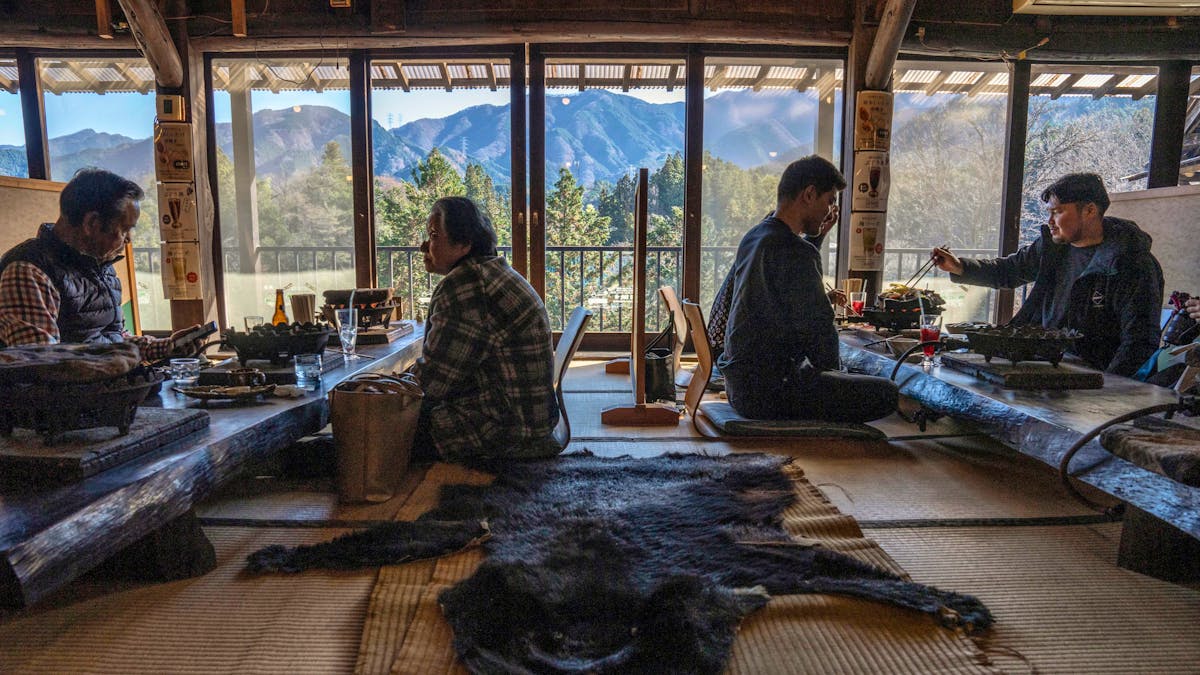
“Juicy and tasty” meat: at a time when Japan is trying to reduce the number of bears after a series of deadly attacks, Koji Suzuki is cooking grilled pieces of the animal, struggling to satisfy the many curious gourmets.
The meat, simmered in fondue with wild vegetables, comes from bears killed with the approval of the authorities to stem attacks which have left a record number of 13 dead across the archipelago this year.
The Koji Suzuki establishment, located in the hilly town of Chichibu near Tokyo, also serves venison and wild boar, but the popularity of its bear dishes has exploded after months of widely publicized incidents: plantigrades breaking into homes, prowling near schools, causing panic in supermarkets…
“With all this information about bears, the number of customers who want to eat them has increased a lot,” explains Koji Suzuki, 71, also a hunter. “It is better to use your meat in a restaurant like this rather than bury” your carcass, he believes.
“It’s so juicy.”
His wife Chieko, who manages the restaurant, says she regularly refuses customers, but remains discreet about the extent of the additional attendance.
Takaaki Kimura, a 28-year-old composer who struggled to get a table, tastes bear meat for the first time, with undisguised pleasure. “It’s so juicy, and the more you chew, the tastier it is!” he says with a smile, sitting around a pot with friends.
By culling the bears – which can weigh half a ton and run faster than a man – authorities hope to stem the threat in parts of northern Japan. The number of attack victims who have died this year is already twice the previous annual record, while there are still four months until the end of the Japanese financial year which ends at the end of March.
Scientists attribute the phenomenon to a rapidly growing bear population, a shortage of food and human depopulation of some areas. To respond, Tokyo deployed soldiers and riot police units. The number of 9,100 bears killed over the year 2023-2024 has already been exceeded in six months.
At the same time, authorities hope that meat can become a source of income for rural villages. “It is important to turn these pests into something positive,” the Agriculture Ministry insisted earlier in December.
Local authorities will receive 100 million euros to control bear populations and promote “sustainable” consumption.
Some restaurateurs hardly need convincing, like Katsuhiko Kakuta, 50, who has been running a restaurant in Aomori prefecture since 2021, one of the regions hardest hit by the attacks. He says he sold out his entire stock of bear meat earlier this month: “This year, our establishment attracted a lot of attention, especially after an influencer talked about us.”
In Sapporo, on the northern island of Hokkaido, chef Kiyoshi Fujimoto now offers bear meat at his chic French restaurant. “More people want to taste it, and I have stocked up,” he told AFP. “Most people who eat it say it’s delicious!”
Bears have doubled in 30 years
Brown bears only live in Hokkaido, where their population has doubled in the space of three decades to exceed 11,500 individuals in 2023. Black bears are common in a large part of the country.
But last year, the government added bears to the list of animals subject to population control, reversing protection that had encouraged their proliferation. The region plans to slaughter 1,200 per year for the next decade. However, a large part of the flesh of slaughtered bears is often lost, in particular because of the lack of approved facilities for its processing.
Bear curry
Japan has 826 slaughterhouses specializing in game, but only a few in the northern departments most affected by the attacks.
Katsuhiko Kakuta has its own butcher shop, which supplies bear curry and other dishes to a nearby farmer’s market and hotel. “Bear meat is a tourism resource for us,” he says. “We’re using something that would otherwise be buried as waste.”
