
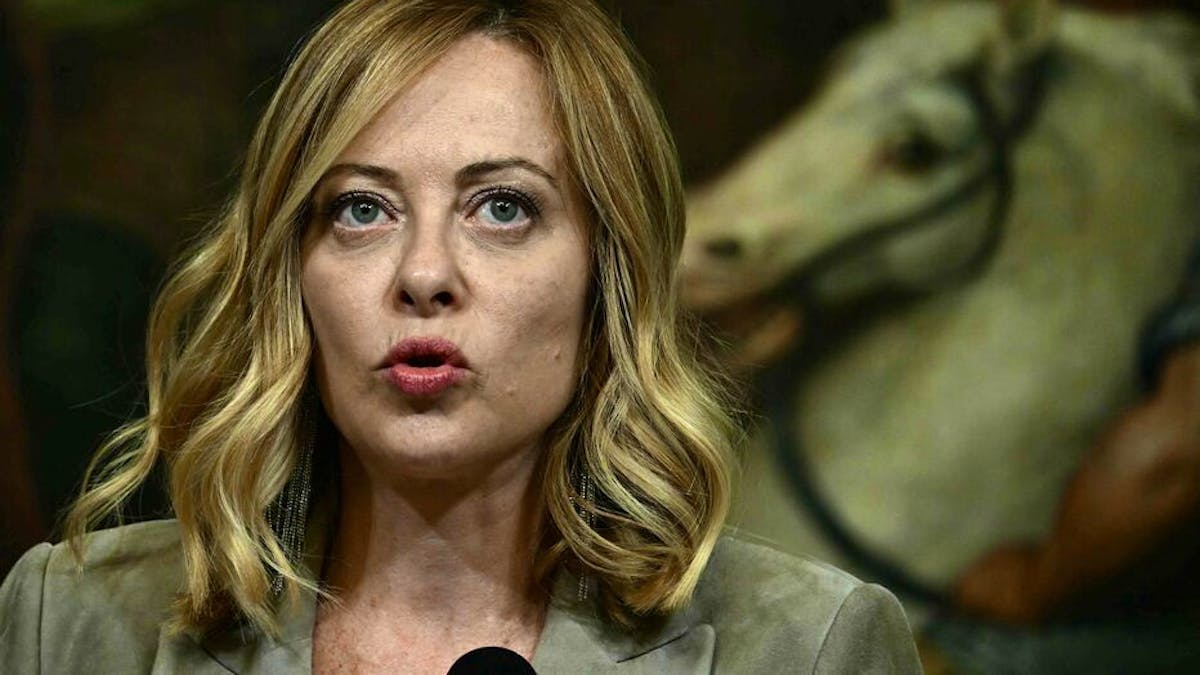
Shaken by her defeat in a referendum on justice in mid-March, Italian Prime Minister Giorgia Meloni is seeking to revive herself with a new reform presented to Parliament on Tuesday.
She wants to turn the page by changing the voting method, which could increase her chances of remaining in power after the 2027 legislative elections.
The government coalition still has a comfortable majority in parliament, but the first real setback since coming to power in 2022 has undermined Giorgia Meloni’s authority and destabilized her allies.
“Meloni is in difficulty and shows undeniable signs of weakness,” analyzes Giovanni Orsina, political scientist at Luiss University in Rome, for AFP.
The resignations of two ministers were not enough to stem speculation about the future of the government. Some commentators believe that Giorgia Meloni could even be forced to call early elections, even though she has repeated that she will complete her mandate.
If she resigned once the electoral law was adopted, she could call a vote in October and take advantage of a divided left.
Deputy Prime Minister Matteo Salvini, head of the far-right League member of his coalition, promised Monday that the government would “go to the end of the legislature without any doubt or hesitation”, even if he himself is weakened by a split within his party.
Forza Italia, the center-right party of Deputy Prime Minister Antonio Tajani, the driving force behind the referendum, is also under pressure.
When contacted, the head of government’s services refused any comment.
Boomerang effect?
A resignation of the Prime Minister remains “highly improbable”, judges Giovanni Orsina, however, but the challenge is now to stop the “snowball effect” triggered by the defeat in the referendum.
The president of the council needs a new project to remobilize her camp. But his Fratelli d’Italia party (far right) is divided on the advisability of pushing for electoral reform, commentator Ilario Lombardo wrote Monday in the daily La Stampa.
“On the one hand, they see reform as the only way to avoid a potentially irreversible decline,” he writes. “On the other, they fear that insisting on election law rings hollow at a time of global uncertainty, with war, soaring energy prices, a cost-of-living crisis and an ally in Washington that cannot be counted on.”
And even if the government coalition parties remain ahead in the polls, the new voting method could turn into an electoral boomerang.
The current system allocates seats by first-past-the-post majority vote but also by proportional representation, in the Chamber of Deputies and in the Senate.
The reform would move Italy to a fully proportional system, with a bonus of seats in both houses for the coalition that obtains more than 40% of the vote.
A simulation carried out in February by polling firm YouTrend showed that, under the current system, neither the center right nor the center left would obtain a parliamentary majority in the 2027 elections.
Heavy load
Under the new system, the center right would likely win the bonus seats.
But a simulation published Monday by pollster Nando Pagnoncelli showed that the center-left could also recover these bonus seats if the right-wing bloc lost the support of the brand new far-right dissident party Futuro Nazionale.
The left does not form a united front on major issues and lacks a unity candidate at the head of the government, but it was reinvigorated by its victory in the referendum.
Salvatore Vassallo, professor of Political Science at the University of Bologna, believes that Giorgia Meloni’s main problem is her proximity to American President Donald Trump, also considered by pollsters as a growing handicap.
This relationship “risks becoming a serious handicap, both because of the embarrassment caused by Trump’s choices and methods, and because of their potentially devastating impact on the Italian economy,” he told AFP.
