
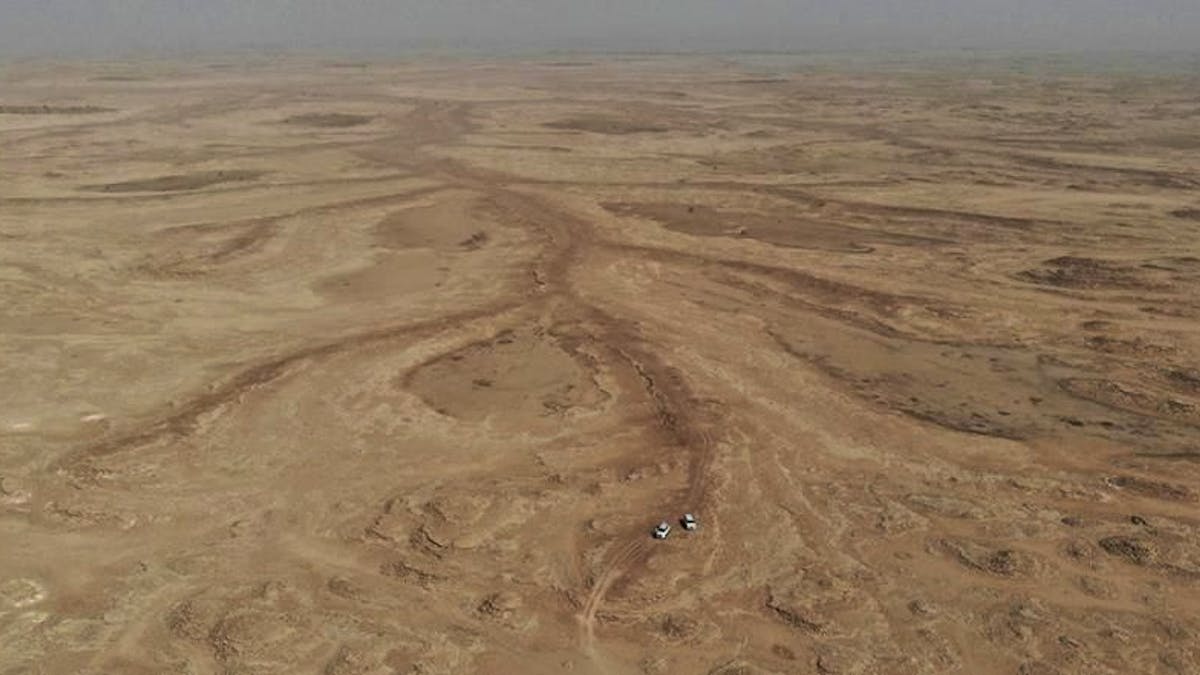
The empty quarter, or Rub al-Khali in Arabic, is one of the largest deserts in the world. Occupating nearly 650,000 km², mainly in the territory of Saudi Arabia, it dominates the Arabian peninsula with dunes that can rise up to 250 meters. This uninterrupted extent of sand, very arid, has not always been so inhospitable. This is revealed by the recent study of an international team led by the University of Geneva (Unige).
“Our work highlights the presence of an old lake, which reached its peak approximately 8,000 years ago, of rivers and a large valley formed by water,” explains Abdallah Zaki, the first author of the study published in “Earth & Environment Communications”, former researcher in the Earth and Earth and Environmental Sciences of the Faculty of Unige. These water points appeared during “green Arabia”, a period of strong precipitation which extended less than 11,000 to less than 5,500 years, at the end of the quaternary era.
A lake almost twice the surface of Lake Geneva
“It is estimated that the lake was massive, measuring 1,100 km² – almost twice the surface of the Lake Geneva – and 42 m deep. Due to the increase in precipitation, he ended up giving in, causing a large flood and digging a valley 150 km long in the soil of the desert, “explains Sébastien Castelltort, professor in surface process in the Earth and Earth and Environmental Sciences section of Unige, which led this work with Abdallah Zaki.
On the basis of sediment and reliefs drawn over a distance of 1000 km, scientists estimate that heavy rains, which have fueled these old water points, come from the expansion to the north of African and Indian monsoons. These wet phases, linked to orbital cycles, varied in duration depending on the region: several millennia in the south against a few centuries in the north. They favored the formation of meadows and savannas, thus facilitating human expansion in the Arabian peninsula.
Expansion of the human population
The formation of lakes and river landscapes, as well as meadows and savannas, would have led to the expansion of hunter and pastoral populations in what is today a dry and sterile desert. The presence of abundant archaeological proofs in the empty quarter and along its old lakes of lakes and rivers confirm this, “said Michael Petraglia, professor at Australian Research Center for Human Evolution of Griffith University.
6000 years ago, this region experienced a sharp drop in precipitation, which would have created dry and arid conditions, forcing these nomadic populations to move to more hospital environments.
These results underline the crucial role that a African monsoon played in the rapid transformation of the landscape in the desert of the Arabian peninsula, as in population movements. This account of climate disturbances and human migration, inscribed in rocks and landscapes, is fundamental to understanding and predicting the possible consequences of current climate change.
