
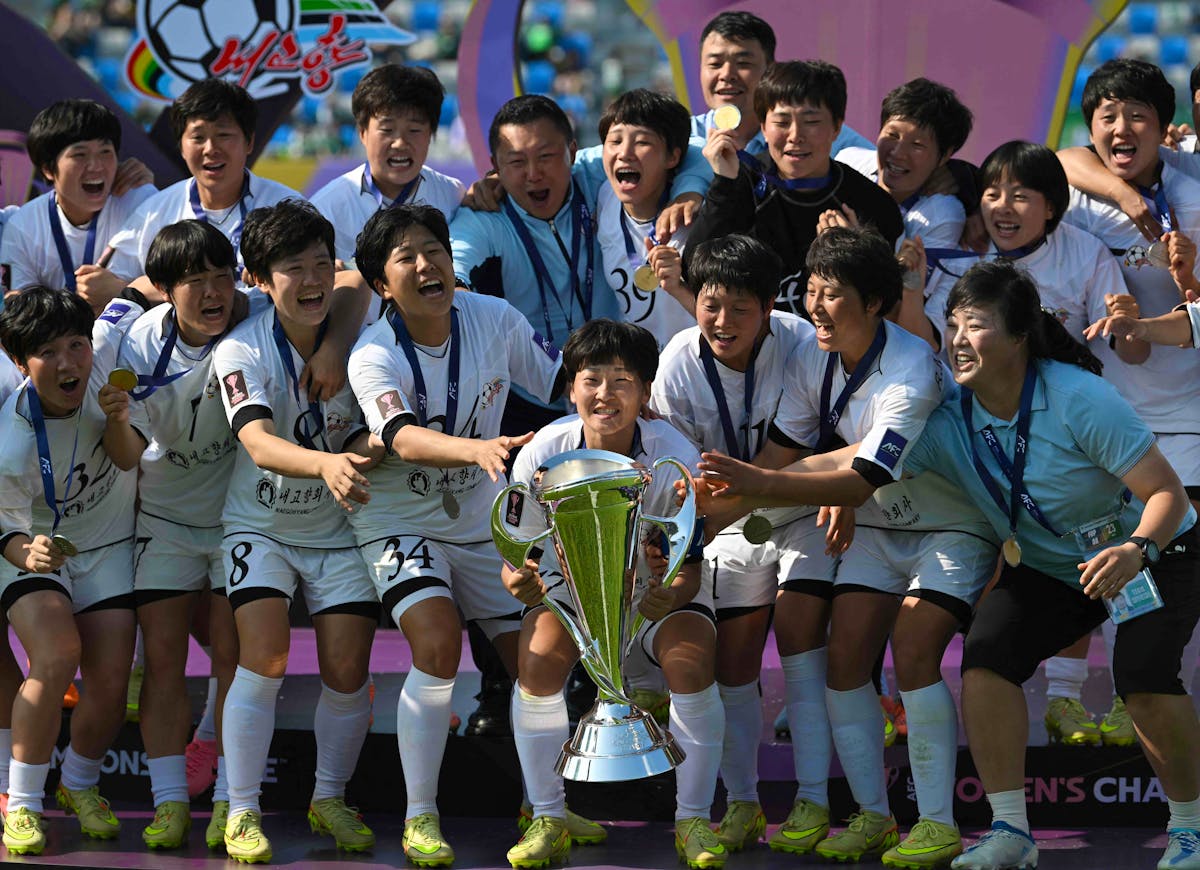
Their captain Kim Kyong Yong, named best player of the tournament, scored the only goal of the final played in the Suwon stadium just before half-time.
This success qualifies them for the next organized FIFA Women’s Champions Cup, bringing together champions from six continents and whose final tournament will take place in Miami, Florida.
Women’s football teams are one of the major sporting assets of North Korea, a diplomatically isolated and economically poor state (North Korea is 11th in the world ranking of the best FIFA women’s teams, while the boys are in a distant 118th place).
After their title, the North Koreans displayed their national flag, a gesture long taboo in South Korea under the National Security Law.
Naegohyang FC coach Ri Yu Il expressed his gratitude to Kim Jong Un, thanking the North Korean leader for the “warm love, care and trust” he showed them. “On this day, as we experience a historic moment in becoming the best team in Asia, the emotions and passion that drives us are simply indescribable,” he continued.
The coach and his captain then left the press room after a South Korean journalist had just asked them a question calling North Korea the “Northern part” – when the official name of the country is Democratic People’s Republic of Korea.
In the previous round, the North Koreans dismissed the local Suwon FC (2-1) in the same stadium. This semi-final marked the first trip since 2018 for a North Korean team to the South. Some 7,000 tickets were sold for the semi-final. The final, in the same stadium, was played in front of 2,670 spectators.
Founded in 2012 and based in Pyongyang, Naegohyang FC (“My hometown” in Korean) has been the subject of strong media coverage and strong enthusiasm since its arrival in South Korea last weekend.
“We have long been the closest neighbors but also the most hostile towards each other. I hope these football events will help change that, even if it may seem too idealistic,” said Cheong Wook-sik, director of the Peace Network, a South Korean peace NGO.
The two Koreas are technically still at war since their 1950-1953 conflict concluded with an armistice and not a peace treaty.
