
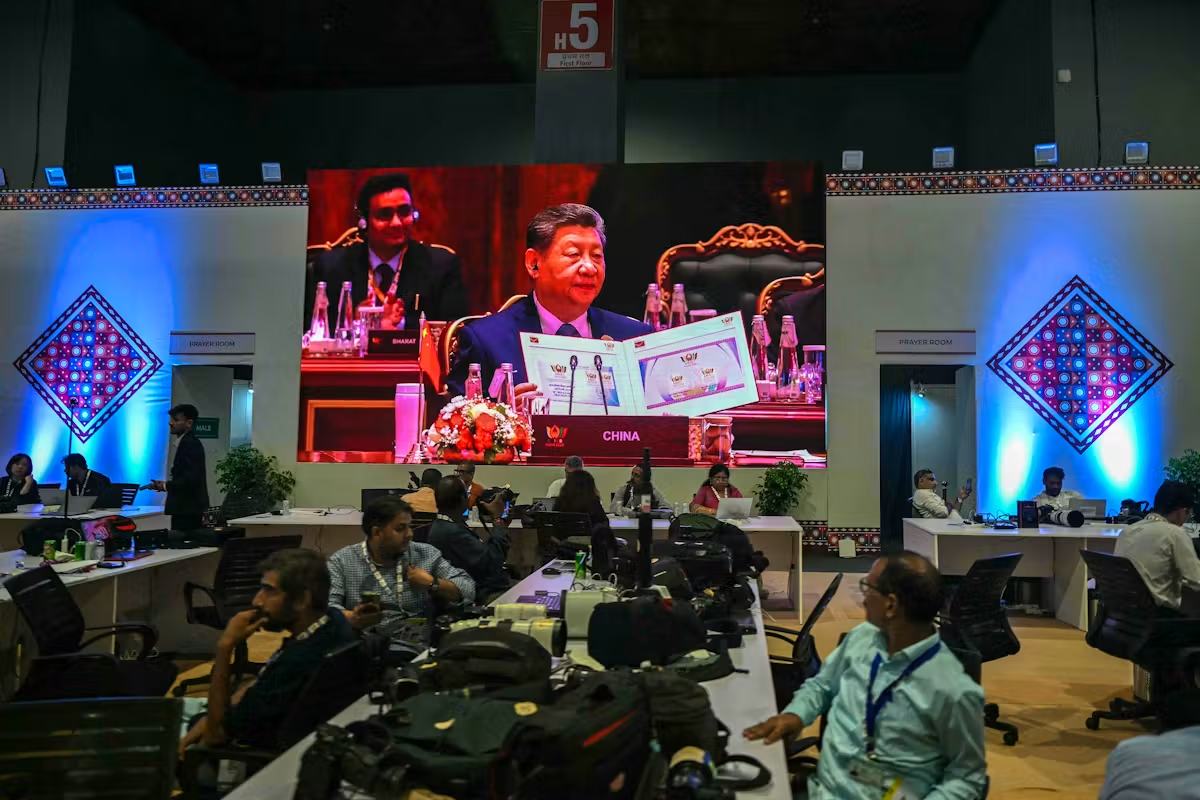
Their particular objective was to reach a common position on the war in the Middle East which divides them.
Meeting in May in the Indian capital, the foreign ministers of these major emerging economies failed to agree on a joint declaration on this conflict.
Russia and China, determined to counter American hegemony, continue to trade with Iran despite repeated threats of sanctions from Donald Trump.
But the United Arab Emirates suspended their commercial and financial exchanges with Tehran in August after being targeted by Iranian missiles.
A “major diplomatic breakthrough” made it possible to draft a text which could obtain the agreement of all member countries and be published on Saturday, a diplomatic source told AFP.
Upon his arrival in the Indian capital, Chinese President Xi Jinping declared, according to Chinese state media, that “the war in the Middle East does not serve “common interests” and called on the Brics countries to oppose “violations” of sovereignty and work to preserve peace.
“No need for a policeman”
For his part, his Iranian counterpart Massoud Pezeshkian estimated that the Middle East had “no need of a policeman”, in reference to the United States.
“The territorial integrity and security of the region can only be guaranteed by its main actors and the countries that make it up,” he added during a meeting with Malaysian Prime Minister Anwar Ibrahim.
In his opening speech, Mr. Modi called on “the global South, on the front line of global crises” but “on the last line of decision-making” to “change this pyramid structure into a partnership structure”.
The arrival of Mr. Xi is one of the events of this meeting, the Chinese number one having not visited India since 2019.
In 2020, a deadly military clash opposed the two countries at their disputed border in the Himalayas.
Beijing and New Delhi have since slowly put their relationship back on track, but mistrust remains between the two Asian giants.
“China is ready to work with India (…) by strengthening communication and cooperation,” Beijing assured Friday.
Mr Xi is due to hold talks with Mr Modi on Saturday on the sidelines of the summit.
Rejecting “protectionism”
The Brics forum was created in 2009 to bring together large emerging economies (Brazil, Russia, India, China, then South Africa) outside institutions dominated by the United States and Western powers such as the G7.
The bloc has since expanded, notably to Iran, and these member countries “represent half of the world population, 40% of the planet’s GDP and more than a quarter of international trade, recalled the Indian leader.
“When a country undergoes political and military pressure on its trade, its energy, its infrastructure and its financial system, the repercussions go beyond its borders,” underlined the Iranian head of state.
In retaliation for the bombings on its territory, Iran blocked the Strait of Hormuz, through which 20% of the world’s oil passed before the war. This blockage continues to cause crude oil prices to soar: the barrel of Brent once again exceeded the threshold of 100 $ this week.
Six months after the last visit of the Russian president to the Indian capital, this summit was also an opportunity for MM. Modi and Putin to “share perspectives” on conflicts in the Middle East and Ukraine, according to New Delhi.
The weekend meeting could also be an opportunity for tight discussions on Chinese economic domination, which is flooding its BRICS partners, starting with India, with its exports.
Less than two weeks before his planned visit to Washington, a major trade rival of Beijing, Xi on Saturday called on the BRICS to “reject all forms of protectionism” and “support the multilateral trading system with the World Trade Organization (WTO) at the center.”
India’s trade deficit with China reached a record high of $112 billion in the 2025-26 fiscal year.
Xi Jinping takes center stage
Chinese President Xi Jinping has made numerous appeals to his counterparts. He notably urged the 11 Brics member countries to “reject all forms of protectionism,” reported the official Xinhua news agency, less than two weeks before his planned visit to Washington, a major commercial rival of Beijing.
“We should uphold the multilateral trading system with the World Trade Organization (WTO) at the center and reject all forms of protectionism,” the Chinese president said at the summit in New Delhi, according to Xinhua.
Chinese President Xi Jinping also declared on Saturday that BRICS member states must oppose “violations” of sovereignty and work to preserve peace, reported the same official Xinhua news agency.
The president indicated during this summit in India that the BRICS should “oppose violations of the sovereignty of other countries and interference in their internal affairs, and participate constructively in the resolution of burning issues”, according to Xinhua.
Chinese President Xi Jinping finally asserted that the war in the Middle East, sparked by US-Israeli strikes against Iran in late February, did not serve “common interests”.
“As the situation in the Middle East and the Gulf region continues to evolve, the war taking place there has caused heavy losses to the populations of the entire region,” declared the Chinese president in New Delhi, according to Xinhua, while the Indian capital is hosting a Brics summit in which Iranian President Massoud Pezeshkian is participating. It “does not serve the common interests of the international community,” he added.
