
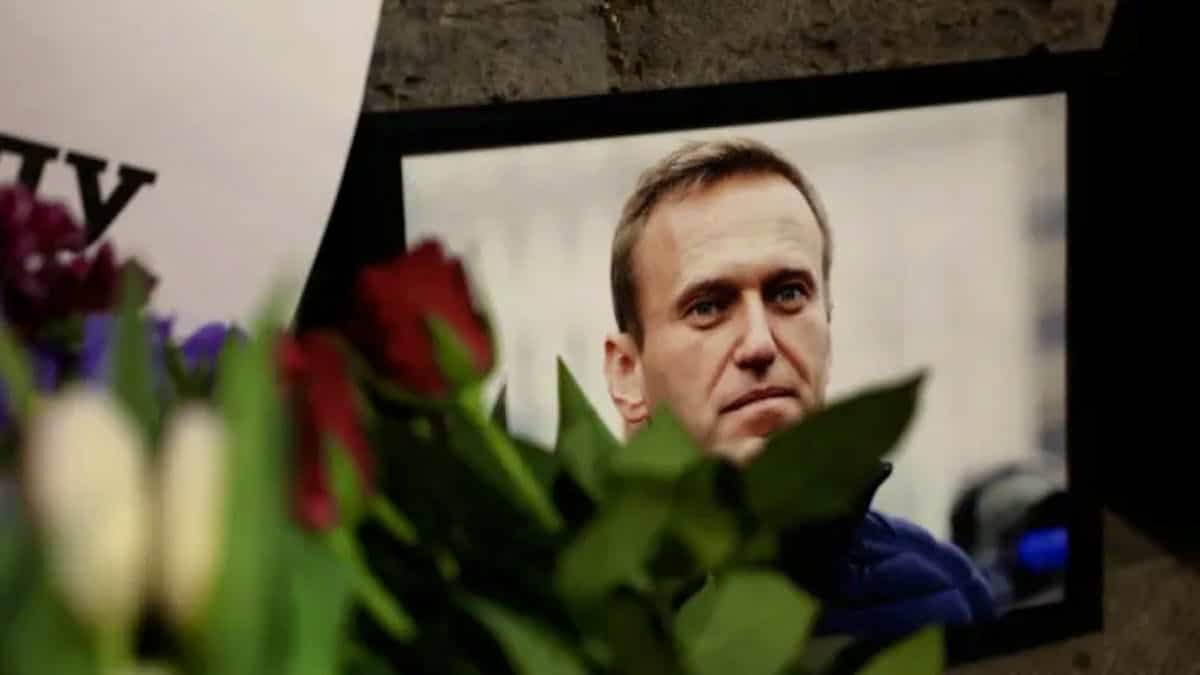
Yulia Navalnaïa, the widow of the main Russian opponent Alexeï Navalny, who died in prison in Russia on February 16, 2024, claimed on Wednesday that her husband had been “poisoned”, saying she was basing this on analyzes carried out by Western laboratories.
Charismatic anti-corruption activist and fierce opponent of the Russian invasion of Ukraine launched in 2022, Alexeï Navalny died at the age of 47 in unclear circumstances in a penal colony in the Arctic, while he was serving a 19-year prison sentence for charges he denounced as political.
After his death, the authorities refused for several days to hand over his body to his relatives, which aroused the suspicions of his supporters who accuse the authorities of having “killed” him and of seeking to disguise his murder, which the Kremlin denies.
On Wednesday, Ms. Navalnaïa, who took over the reins of the movement from her late husband, reaffirmed the thesis of poisoning, saying this time to base it on the analysis of “biological samples” collected from her husband after his death and transmitted to laboratories located in Western countries.
“Two laboratories from two different countries came, independently of each other, to the conclusion that Alexei had been poisoned,” Mr. Navalnaya said on Telegram and in an explanatory video.
Asked about these new accusations, Kremlin spokesperson Dmitri Peskov responded Wednesday that he had “nothing to say.” “I don’t know anything about it,” he added during his daily briefing.
A “horrible” death
Ms. Navalnaïa did not make these analyzes public and specified that she could not “obtain the official results indicating exactly what poison had been used” against her husband.
She nevertheless specifies that her team had access to the testimonies of five prison officers from the colony of Kharp, in the Arctic, where Alexeï Navalny died. “These testimonies contain inconsistencies between them. But they give a general idea of what happened,” explained Ms. Navalnaïa.
A close collaborator of Navalny, Maria Pevtchikh, affirmed on Telegram that the opponent was, at the time of his death, “lying on the ground, vomiting and screaming in pain” but that “instead of saving him, the guards left him there, closed the bars and the door” of his cell.
She published photographs of a cell, she said were taken just after the death of the opponent, in which we see what appears to be vomit and blood on the floor.
Alexei Navalny’s former right-hand man, Leonid Volkov, accused Russian President Vladimir Putin on Telegram of having “assassinated” the opponent.
“He was killed in a horrible way, poisoned. And even if the data was erased from the medical files and the traces concealed, we know everything about his last day and how he was murdered,” he said.
Severe repression
Considered the number one opponent of the Kremlin, Alexeï Navalny was poisoned for the first time in 2020 in Siberia with the nerve agent Novichok and remained convalescing for several months in Germany.
He was arrested upon his return to Russia in January 2021, then sentenced to several increasingly harsh prison sentences. His supporters in Russia have also been targeted by a severe crackdown and many have been forced to flee the country.
His widow, Yulia Navalnaïa, was included by the authorities in the register of “terrorists and extremists” and former lawyers of Navalny, his doctor and even journalists who collaborated with his organization were investigated by the courts.
Alexeï Navalny and his team made themselves known in the 2010s by publishing investigations denouncing the corruption of political elites in Russia, including in circles close to Vladimir Putin.
Since the invasion of Ukraine in February 2022, the Russian authorities have further strengthened the repression of voices critical of power and denouncing the war, with hundreds of prison sentences and thousands of fines.
Most of the opposition figures still alive are either in prison or in exile abroad.
