
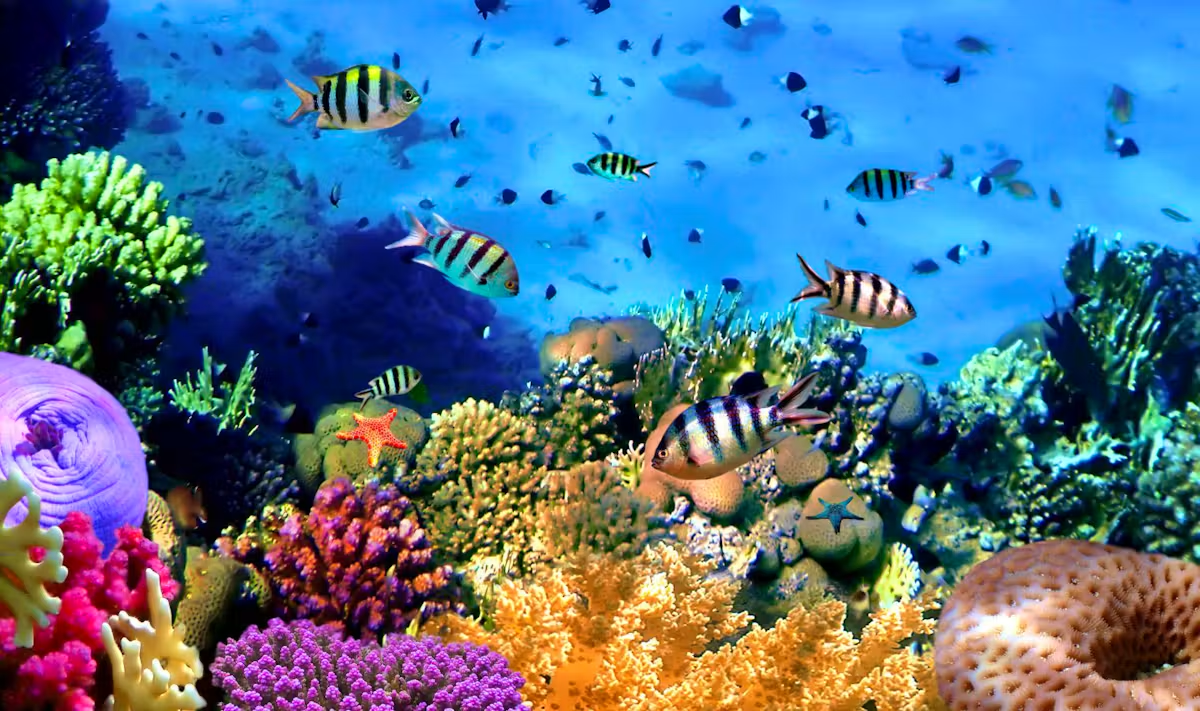
Almost all of the world’s shallow-water coral reefs are at “extremely high risk” of disappearing by 2075 due to climate change, the International Union for Conservation of Nature (IUCN) warned on Thursday.
As part of the first global assessment of its type, this international reference authority on threatened fauna and flora has classified 96% of coral reefs, distributed in more than 80 countries and territories, in the category “critically endangered”, the highest level of threat defined by the organization.
“A wake-up call rather than a source of despair”
Corals, rich ecosystems that shelter a quarter of all marine species, are sensitive to heat and particularly vulnerable to climate change, which leads to warming of the oceans and increases the frequency and intensity of bleaching episodes, with devastating consequences.
“The risk of coral reef collapse is increasing, but this should be a wake-up call rather than a source of despair,” said Mishal Gudka, lead scientist for coral ecosystem assessment for the IUCN Red List. Mr. Gudka recalls that certain “coral reefs have demonstrated a remarkable capacity to recover after devastating bleaching episodes”.
“Intermediate” scenario
However, the risk of seeing some of the largest and most biodiverse coral ecosystems in the world disappear is real. Among the most threatened are the Great Barrier Reef in Australia, the Coral Triangle in the Western Pacific Ocean and Southeast Asia, the Mesoamerican Barrier Reef in the Caribbean, as well as the coral reefs of the Red Sea.
The IUCN analysis, published as governments from around the world gathered in Yerevan (Armenia) for COP17 Biodiversity, focused on 127 tropical and subtropical coral ecosystems, covering an area of 188,362 km². For this assessment, the researchers relied on the “intermediate” scenario of the UN climate panel, which predicts a rise in global temperatures of 2.7°C compared to pre-industrial levels by 2100.
“It’s not too late”
On Wednesday, the United Nations warned that, given countries’ current commitments to reduce greenhouse gas emissions, the world is heading for 2.6°C of warming this century. Even if pollution, overfishing or overtourism also contribute to degrading coral health, “thermal stress linked to climate change constitutes the most constant threat causing the decline of coral reefs on a global scale”, underlined the IUCN in a press release.
Nevertheless, “it is not too late to give coral reefs a chance to recover, but it requires decisive action to combat climate change and halt ocean warming,” says Grethel Aguilar, director general of the IUCN. During this “critical 50-year window” for conservation actions, “we know what needs to be done: ambitious emissions reductions, increased protection and restoration efforts, as well as sustained investment in resilient coastal ecosystems and the communities that depend on them,” said the official.
