
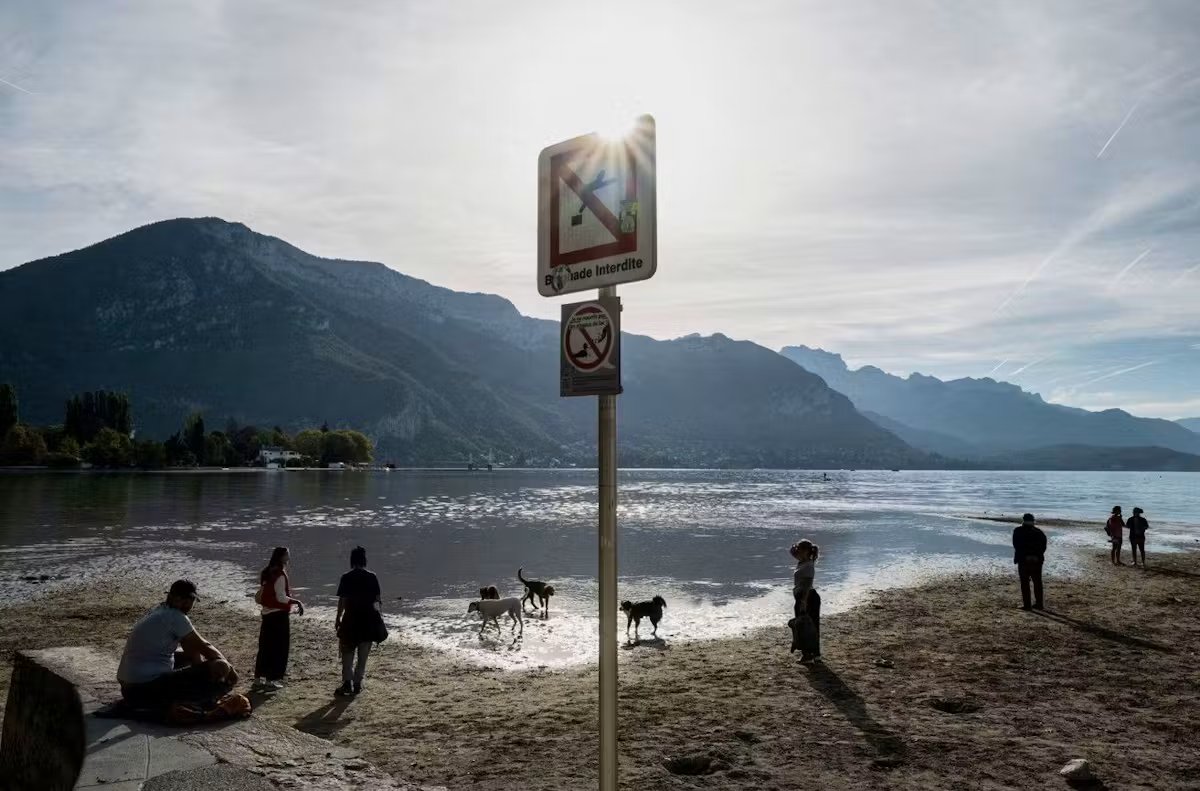
Banks of white sand are revealed and the boats remain at the dock, for lack of sufficient bottom in the crystal clear waters of Lake Annecy, in the French Alps, under a persistent blue sun, falling by one centimeter per day and approaching its lowest level.
“It’s the first time I’ve seen a beach, and people walking so far into the lake,” notes Jean-Marc Djian, a resident of the Venice of the Alps who takes advantage of the new sandy areas to walk his dog.
Compared to normal, “the lake has lost 60, 70 centimeters,” notes Céline Fournel, operations manager of the Compagnie des Bateaux d’Annecy. And with no rain forecast in the coming days, the situation is not about to improve for the body of water about forty km from Lake Geneva, which is 20 times larger.
“The channel is full, all the places are occupied, it’s a bit sad,” she told AFP, pointing to many boats at the quay. “It hurts my heart.”
Her company had to resolve to immobilize its restaurant boat: with a minimum draft of around 40 cm, the Libellule risks running aground and damaging the hull if the captain attempts the slightest crossing.
“I was very disappointed at first,” regrets Sylvie, a Parisian seated on board the ship for a romantic experience with her companion, ultimately reassured by financial compensation.
“Off the coast”
After a particularly dry summer, almost no rain fell in France in September, maintaining soil dryness at a historic level for this time of year.
Haute-Savoie, normally well watered, is no exception and the city of Annecy is placed on heightened alert on the VigiEau site, which imposes restrictions on the consumption of drinking water.
The lake, fed by mountain springs, supplies the water networks of 34 municipalities, which is not in question.
But its reference level, around 60 cm at low water, is currently at 20 cm and continues to fall. “We lose about one centimeter per day,” says Pierre Bruyère, president of the Syndicat Mixte du Lac d’Annecy (Sila).
“We are on the trend of 2018”, when the level was close to zero, the lowest since 1947, he continues.
If the sunshine still allows canoes and kayaks to be taken out on the lake, since August 15, “we have to push the boats about 150 meters further,” laments Nathan Nous, 24, who rents pedal boats.
“Now we have to take customers even further out to sea,” he continues. “It’s complicated…”
Biodiversity
“Aside from the aesthetic aspect, it is a very good thing that there is a variation” for the well-being of the fauna and flora, puts the president of Sila into perspective.
On the surface, towards a canal near the city center, swans and coots wade near the seaweed.
As for aquatic plants such as reeds and bulrushes, they take advantage of fluctuations in the lake level in order to “regenerate”, continues Mr. Bruyère.
This phenomenon, when it is generated by human actions, is called tidal range, he explains, delighted to see the process taking place naturally.
He notes, however, that this beneficial aspect occurs more around level 60, a minimum which would allow “everyone to carry out their activity in good conditions”.
