
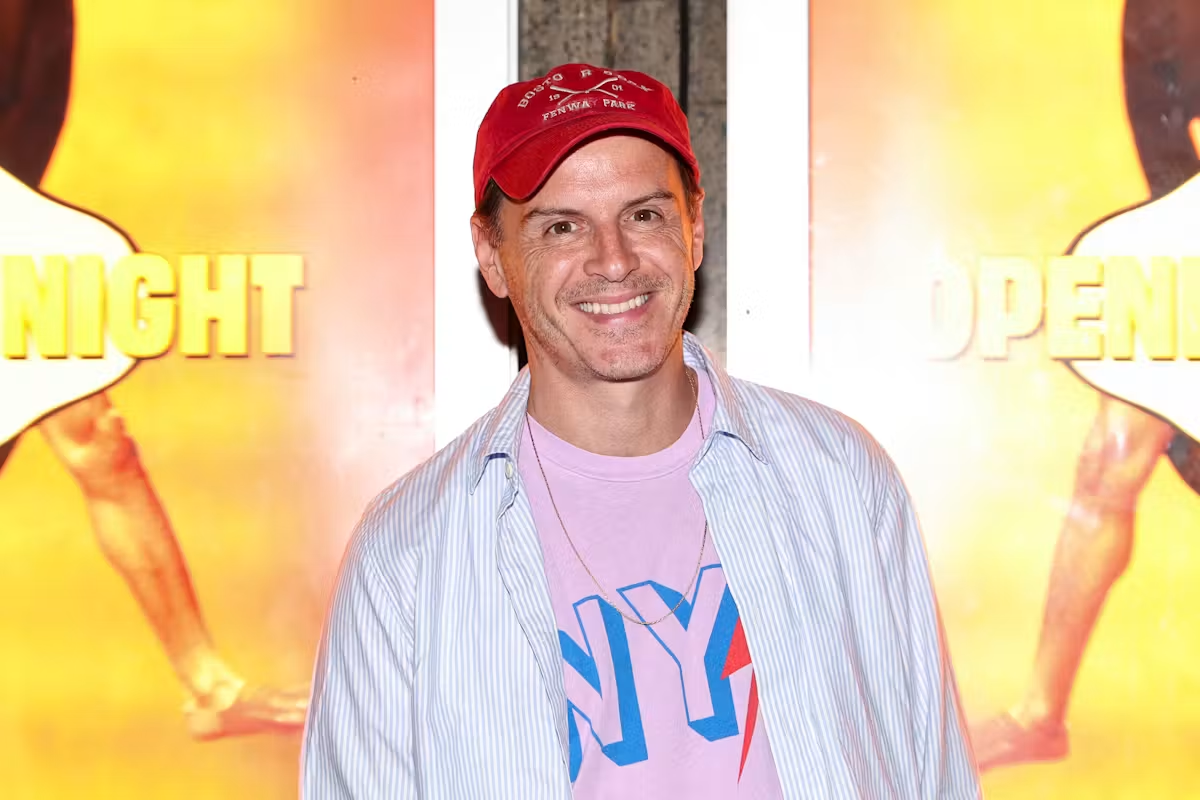
He distinguished himself in the roles of dangerous individuals: Jim Moriarty in the series “Sherlock” or, more recently, the talented Tom Ripley in “Ripley”. But Andrew Scott has more than one string to his bow. The excellent Irish actor also distinguished himself in the role of a solitary screenwriter in the gay fantasy romance “Without Ever Knowing Us” or as a writer on the decline in the third part of the “Knives Out” saga.
We find him in “Pressure”, in theaters on September 9, a fascinating war film which makes us discover, in the form of a thriller, the crucial role of the weather during the Normandy Landings. He plays Captain James Stagg, an eminent meteorologist in the Royal Air Force. At 72 hours before D-Day, the awkward Scot is convinced that a violent storm will derail the military operation led by Eisenhower (Brendan Fraser).
Despite the opposition from those around him, he will do everything to convince the American general to postpone the Landing. Andrew Scott spoke to matin.ch in a London palace.
What attracted you to this project?
Mainly, my character seemed to me to be an extraordinary cinema character. James Stagg was a man who really existed, and who seemed able to maintain his authenticity and integrity in a situation under absolutely enormous pressure. The script was also very funny and witty, yet extremely tense, and provided great opportunities for the actors. The cast was brilliant and so was the director, Anthony Maras. I loved his film “Attack on Mumbai”.
Was there anything about James Stagg’s personality that you found particularly difficult or, conversely, surprisingly easy to portray?
It’s quite nice to play someone who doesn’t care about being liked. Someone a little dogmatic, who enters a room, maintains attention and does not try at all costs to be charming, as is often required of cinema heroes. There’s a lot of talk about “approachable” and “likeable” characters, two words that leave me cold when you’re offered a challenge like this. This is precisely what I found very pleasant. I don’t know if I found it easy, but I liked not being afraid of making the character less approachable or less likable at first. Then, little by little, we begin to understand this man better.
The film places meteorology at the heart of a military operation. Has this changed the way you think about the role of weather in history?
Yes. I suppose the weather must have a huge influence on any historical event, since it affects every person in the world, every day of our lives. We ask ourselves: “What am I going to wear? How do I feel today?” Someone is said to have a sunny temperament, to be in a stormy mood or to be brooding. Many of our psychological states refer to the weather. It’s important to me too. I’ve always thought of psychology, especially emotional psychology, as a form of weather, in a way.
But yes, it definitely changed my relationship with the weather, because we often talk about it as an unimportant topic of conversation. When in reality, when you look at what people do and how important weather is, when you see how it shapes things in so many different industries, it’s absolutely fascinating.
Before playing James Stagg, you played an inexperienced soldier in “Band of Brothers”, then a very cynical and disillusioned officer in “1917”. You have played all kinds of characters in different contexts linked to the world wars. Does playing these different characters enrich your vision of these historical events?
Yes, I think that is the case. When I was 19 or 20, I played a soldier on the beach in Saving Private Ryan. This experience was truly extraordinary because it gave, to a certain extent, a physical representation of what the Landing could have been like.
The film was filmed on Curracloe beach. The scale of the operation, this gigantic dimension that Mr. Spielberg had so brilliantly captured, made me realize what was at stake. This is psychological warfare, but it was great to have that visual image in mind and to be able to understand, to some extent, what these young men had been through. It was simply unimaginable.
You’ve played characters capable of being charming one moment and deeply disturbing the next. What attracts you to this ambiguity?
Well, I think that’s the way people are. Human beings are full of contradictions, they are capable of a lot of heat, and then something happens and they change. People are extremely fluid and very surprising. Someone who may appear extremely stoic may actually be deeply romantic. These contradictions in human beings interest me enormously. It’s actually one of the most fascinating aspects of my job.
The film addresses many themes that particularly resonate with the times in which we live. What would you like viewers to think about when they leave the theater?
What I like about this film is that it is inspiring and gives me hope. It shows that people from very different cultures, with very varied working methods and very distinct personalities, can confront each other and have the humility to say: “Okay, there is a higher interest. Even if I don’t agree, even if I don’t like this person, I will accept that they have a point of view that perhaps deserves to be heard more in order to serve this greater interest. This is what happened in this situation.
It’s worrying that because of social media, we can somehow live in an echo chamber, never being confronted with opposing opinions. And when we are, those people should just be eliminated, deleted, unsubscribed, blocked or whatever. I think it’s dangerous for the world. We need to be able to say to ourselves, “Okay, this person just has a different opinion than I do. That doesn’t make her the devil incarnate.”
At this point in your career, how has your definition of a good role evolved?
I think a good role takes you to a very different place than where the character is at the beginning of the story. There has to be a path. With any great character, you want them to be, in one way or another, transformed by the end of the story. I think, for me, it’s as simple as that. And there has to be a certain amount of humor, because I think that’s how human characters are. Human beings are always seeking, as far as I can tell, to move towards the light. They always try to see the positive side or, at least, the funny side of things. It’s a great human quality. So those might be the two things I’m looking for.
You became known with the character of Moriarty in “Sherlock”. You have also been part of numerous choral castings, notably in the last part of “Knives Out”. And with “Without Ever Knowing Us,” “Ripley” and this film, you are truly the headliner. Has the studios’ view of Andrew Scott changed? Are you being offered more leading roles today?
I don’t really know. We should ask the studios the question. All I can say is that I don’t necessarily want to always play the leading role. And you know, 10 or 15 years ago, I was already playing leading roles. Then you’re part of an ensemble cast, you play a role in something else… What really matters is the writing. Again, it’s the quality of the writing. And sometimes it’s nice to come into a project for three weeks and be like, “You know what? I’m going to be part of an ensemble.” I have just worked with Justine Triet in a choral casting, and it was an immense pleasure. I couldn’t imagine it any other way.
Could you tell us a few words about your collaboration with Justine Triet?
Oh, I just loved it. We filmed in France. The film is called “Fonda”. It’s a wonderful story, with Allison Janney and Mia Goth, and an absolutely incredible cast. I loved working in France. Justine has a truly unique personality. She’s very interested in actors, and I think this is her first English-language film. I think it will be very special. I can’t reveal too much. I don’t even remember everything I’ve ever said about him. But it’s definitely a very human film, which talks about the human spirit. I would love to work with her again. He is a truly special person.
Many films have been made about the Second World War, but telling the D-Day landings through the prism of meteorology makes “Pressure” an original proposition in the genre. Why do you think audiences keep coming back to war films, and what makes “Pressure” stand out?
I guess it’s because history actually changes after a war. And people like to be reminded that history could have taken a completely different direction. This allows us to celebrate human effort, but also, in a certain way, the terrifying dimension of History: the fact that we can overcome these terrible things that we are going through. I myself wondered why this film was made. But these questions quickly disappeared when I read the script. “Pressure” is so unique. He talks about humility in a wonderful way. He talks about leadership. He approaches the environment in an extremely subtle and brilliant way. And it deals with human integrity and courage in a very beautiful way. This is why I think it stands out from other films.
