
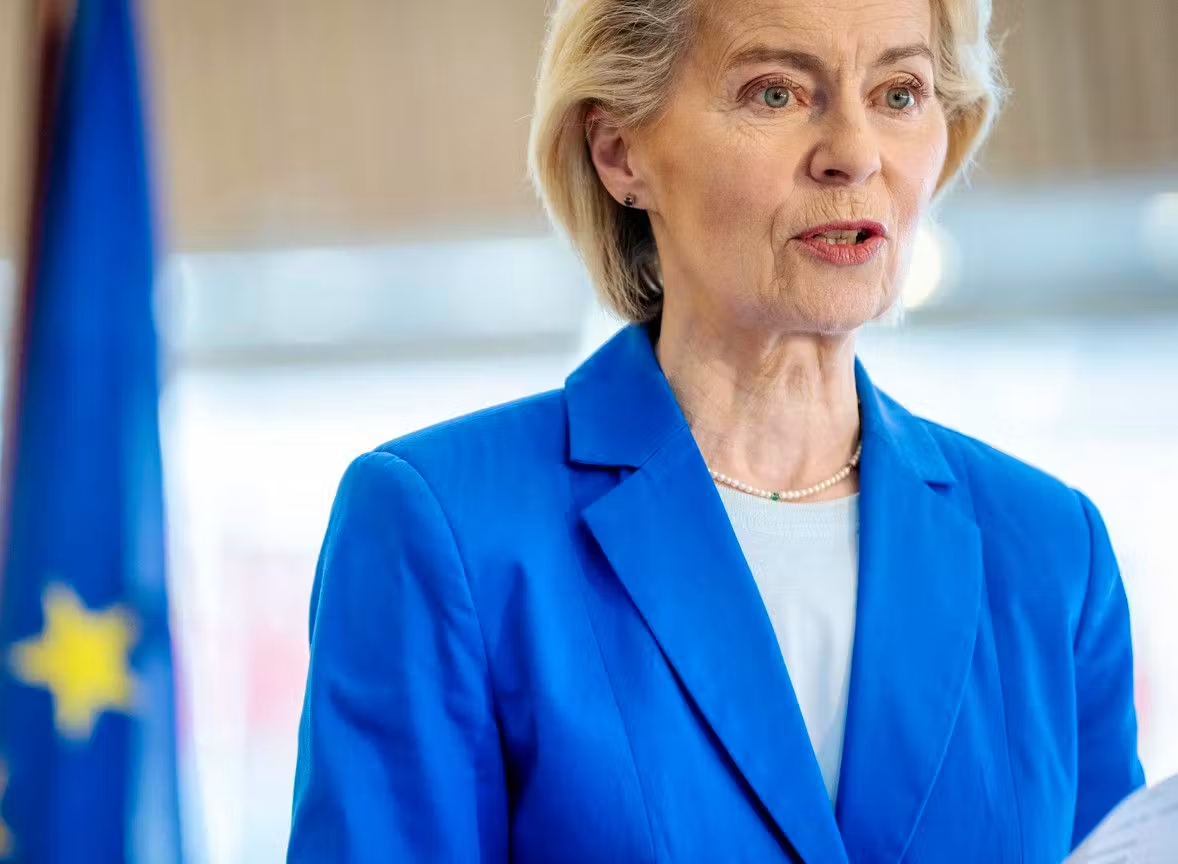
Ursula von der Leyen unveiled long-awaited proposals on Wednesday to protect children and adolescents online in Europe: a ban on social networks for under-13s and “mini-accounts” with limited functions for under-15s.
“No social networks before the age of 13” and “no personal account before the age of 15,” declared the President of the Commission in a solemn speech to the European Parliament.
“Thus, children between 13 and 15 years old will only have mini-accounts, installed and monitored by their parents, with restricted functionality and a limited duration of use. And for 15-18 year olds, platforms will be required to adopt a secure design,” she added.
These measures, which will require the agreement of MEPs and the 27 EU countries, will be detailed on Thursday in a European bill, the “EU Kids Act”, which will be presented in Strasbourg by the president of the European executive, alongside the commissioner responsible for Digital, Henna Virkkunen.
Addiction to screens, harassment, lack of sleep, eating disorders, not forgetting solicitations of a sexual nature: minors are exposed to numerous risks online. And existing EU legislation, such as the Digital Services Regulation (DSA), is not enough.
As a result, political pressure is mounting on all sides to better protect children and adolescents within the EU, and initiatives are multiplying at the national level, with France in the lead.
Ursula von der Leyen took up this issue personally a year ago. Its proposals are largely inspired by a report by child protection experts, scientists and child psychiatrists, submitted in July.
According to documents consulted by AFP, the bill which will be presented on Thursday will apply to different categories of online platforms: social networks, artificial intelligence assistants and conversational robots (chatbots), and other online games.
Age-related restrictions, valid across the EU, will be coupled with new constraints for operators if they want their services to remain accessible to minors. With fines that could reach up to 6% of their global turnover in the event of an infraction.
Among these obligations, platforms will have to remove their most “addictive” functions (unlimited scrolling of content, ultra-personalized recommendations, etc.), and systematically verify the age of their new users.
On this subject, the organization 5Rights published a study showing that addictive features are omnipresent on the platforms used by children, including online games, and that some deploy “emotional manipulation tactics” to push them to connect.
Gradual access
The system advocated by Ms von der Leyen promises to be more flexible than the complete ban on social networks for under-16s introduced last year in Australia, which has however been largely circumvented by adolescents.
The gradual access envisaged by the EU, on the other hand, closely resembles the new French bill, announced Monday by President Emmanuel Macron.
This new French text, submitted to Brussels to ensure that it complies with European law, aims to prohibit networks for those under 15 years of age if they present harmful functionalities, while providing for exemptions from 13 years of age.
A new formula taking into account the reservations of the Constitutional Council, which opposed a general ban in August.
Many other countries have imitated Australia and announced or implemented restrictions on access to social networks for young people, or even bans.
Among them, Canada, whose Prime Minister Mark Carney attended Ursula von der Leyen’s solemn speech on Wednesday, a great first for a foreign leader.
The Canadian government announced in June a proposed ban on children under 16, but with exceptions for platforms offering “sufficient protection measures for children”.
The Commission can expect intense debates within the Parliament and the Member States, in particular on the modalities of application and age verification systems, which arouse a lot of mistrust among Internet users.
