
The days pass and the scale of the disaster becomes clearer as the relief efforts slowly progress: the toll from the flood which devastated Nepal on Wednesday, and Tibet in China, worsened further on Monday to stand at more than 950 dead and nearly 4,500 missing.
There are 939 dead and 3,925 missing in Nepal, and Chinese state media reported 16 dead and 546 missing on the Tibetan side.
“Our country is facing a natural disaster of unimaginable and heartbreaking magnitude,” said Nepalese Prime Minister Balendra Shah, “but we are moving forward with determination to protect the lives of citizens.”
In perilous conditions and under the constant threat of further rising water levels, rescuers are redoubling their efforts to try to rescue possible survivors from the sea of mud which has buried this isolated region of the Himalayas.
“The difficulties are considerable”, summarized for AFP their deputy head for the disaster-stricken district of Nuwakot, police officer E. Hawadi, listing destroyed roads and infrastructure, lack of personnel and resources, particularly air.
Nepalese police have shared the story of the miraculous rescue of a 6-year-old girl on Friday. “We found her under the rubble (…) only her head was emerging,” one of her officers, Bahadur Karki, told AFP. “She is now out of danger and is recovering in a hospital surrounded by her family.”
Despite their efforts, the Nepalese authorities were still unable to contact around a hundred workers on Monday who they believe were trapped in a tunnel on a construction site in the disaster-stricken region.
“The opening of the tunnel has been located, air is injected (…) and water evacuated,” the army wrote in its latest situation update.
“Like a tsunami”
Other ongoing operations in tunnels in the same valley, on the site of hydroelectric power stations or dam construction, made it possible to find the bodies of three victims, according to the army.
Several dozen Nepalese soldiers, police and guides are working day and night on these difficult-to-access sites, assisted by specialists from India, China and South Korea.
Hospitalized in the capital Kathmandu, an employee of the Upper Trishuli hydroelectric power station, Shibu Giri, 44, described to AFP on Monday how he miraculously escaped the wave that submerged everything.
“It was like a tsunami, with a huge noise and a huge cloud of dust,” he said. “We fled to the heights (…) we couldn’t see anything anymore, I really thought I wouldn’t make it.”
On the Chinese side, rescuers are exploring with the same difficulties the heart of the disaster zone in Tibet, in particular the Gyirong border post whose building has been completely destroyed by water.
Experts and scientists attribute Wednesday’s devastating flood to the collapse of a huge glacier, which transformed a peaceful river into a raging river.
According to the latest official reports, which are still very provisional, a total of 955 bodies – 939 on the Nepalese side, 16 on the Tibetan side – were exhumed.
Authorities in both countries also remain without news of nearly 4,500 people – 3,925 in Nepal and 546 in China. Among them, hundreds of foreigners, tourists, pilgrims or workers.
Burials
On the Chinese side, some have expressed doubts about the veracity of the official report. Ten Internet users who suggested that he was deliberately understated were punished, police announced, without giving details.
The president of the NGO International Campaign for Tibet, Tencho Gyatso, demanded “verified and complete information” from Beijing.
Six days after the disaster, the families of the missing continue to flock to hospitals and morgues across Nepal in search of information on their loved ones.
This is particularly the case in Bharatpur, in the south of Nepal, where the power of the waves deposited some 250 corpses more than a hundred kilometers downstream. In a building, relatives are invited to try to identify them on video images.
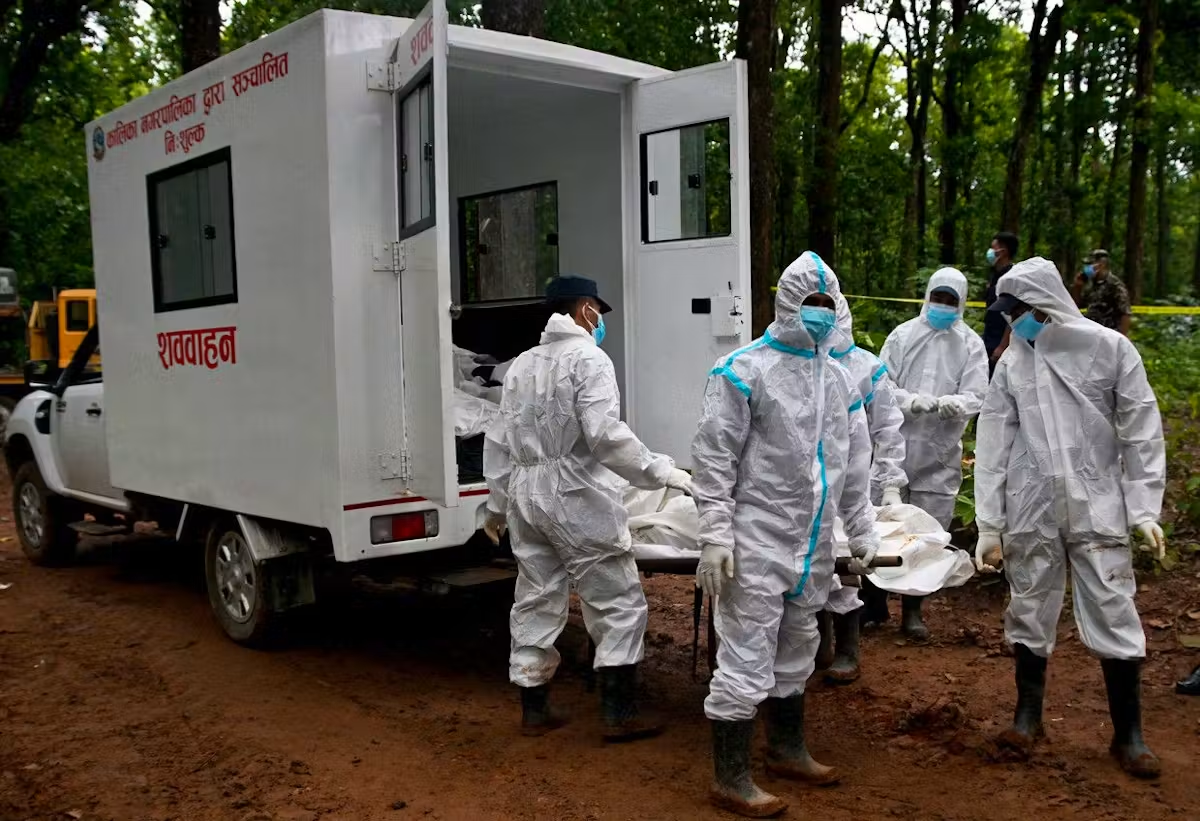
A long and difficult job carried out under time pressure. While the Bharatpur morgue is overflowing with remains, the authorities have started burying some of them without even waiting for identification, for health reasons.
No precise assessment of the damage has yet been carried out, but the damage is probably in the “billions of $”, the government of Nepal, facing its deadliest disaster since the 2015 earthquake, has already said.
An AFP calculation based on satellite analyzes from the European Copernicus observatory made it possible to estimate the number of destroyed buildings in the Nepalese Trishuli river valley at more than 2,500.
“It’s a disaster in progress,” Abiodun Banire, from the Nepalese branch of the United Nations Children’s Fund (UNICEF), summarized for AFP.
