
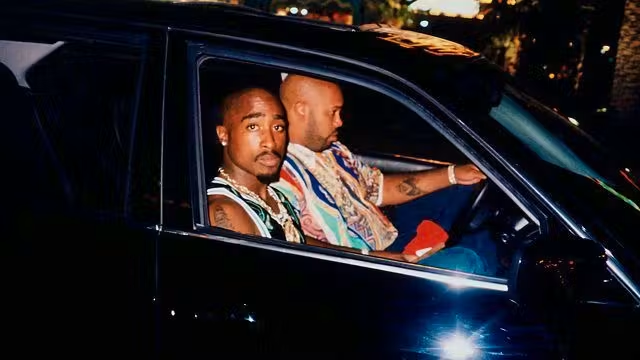
Closing arguments began Monday in Las Vegas at the trial of a former American gang member accused of orchestrating the 1996 murder of rapper Tupac Shakur. Thirty years after the never-solved death of the rap legend, the trial of Duane “Keffe D” Davis, former figure of the South Side Compton Crips, a gang from a sensitive neighborhood of Los Angeles, is entering its final phase, before the jury’s deliberations.
At the opening of the hearing, Judge Carli Kierny read detailed instructions to the jurors to guide them in their deliberations, then gave the floor to prosecutor Binu Palal, representing the state of Nevada (southwest), where the facts occurred.
“Two weeks ago, I stood before you and told you that this case was about gang retaliation and revenge,” Mr. Palal said at the start of his indictment. The prosecution’s theory is that Duane Davis organized the retaliation for the beating of his nephew, Orlando Anderson, in which Tupac Shakur participated, in a cycle of revenge between two music labels, Death Row Records and Bad Boy Records, founded by Sean “P. Diddy” Combs, each resorting to a rival gang to ensure the protection of their artists.
Incompressible perpetuity
“Duane Davis, in the gang culture, could not let this pass,” insisted the prosecutor, in reference to the public humiliation of his nephew a few hours before the shooting against Tupac Shakur. “So what did he do? He got a gun, gathered his group and went on a hunt to find Mr. Shakur,” he added. Duane Davis, 63, a former drug trafficker who has pleaded not guilty, faces an irreducible life sentence.
Shrouded in mystery, the crime is one of the most famous “cold cases” in the United States. On the night of September 7, 1996, shots from a white Cadillac injured Tupac in Las Vegas, after he had just attended a Mike Tyson boxing match. The rapper died six days later, at the age of 25.
