
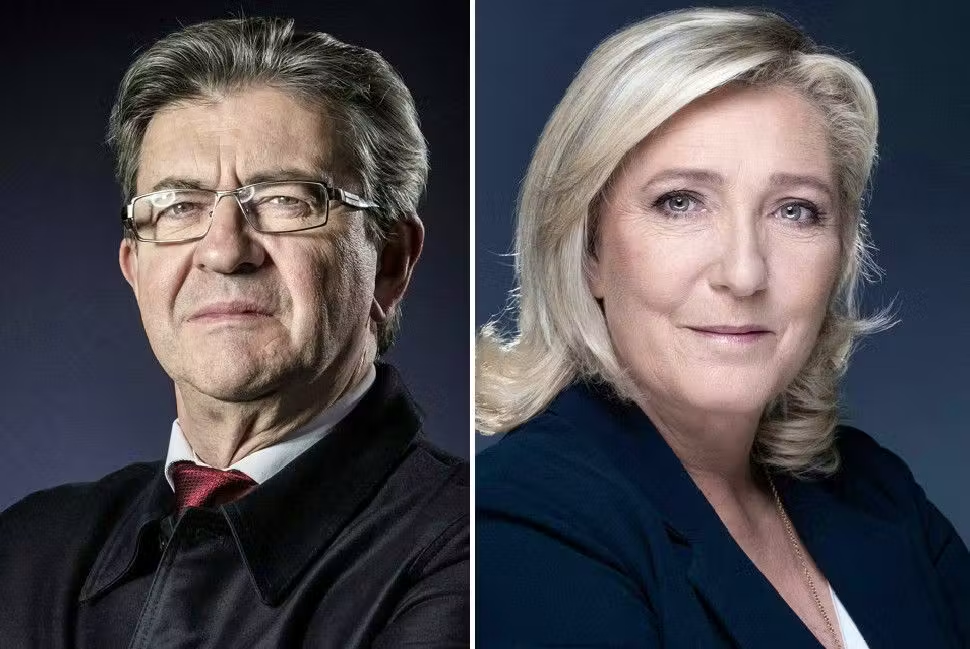
Around thirty candidates declared or anticipated: eight months before the French presidential election, there are numerous ambitions to invest the space between the far right and the radical left who are attacking the campaign united around a strong personality.
In this profusion, the leader of the National Rally Marine Le Pen, 58, is the big favorite in opinion studies.
Unhappy candidate of the far right in the last three presidential elections, she has never seemed so close to power, despite her conviction on appeal for embezzlement of public funds from the European Parliament. She appealed to the Court of Cassation.
The polls, which still have time to evolve, today give her a clear lead in the first round (around 34% of the vote) and a winner in the second, regardless of her opponent.
Behind, two figures shoulder to shoulder: former prime minister Édouard Philippe, 55, who wants to unite right and center around his name, and the leader of France Insoumise (radical left) Jean-Luc Mélenchon, 75.
With this election, scheduled for April 18 and May 2, which is being held at the end of the “Macronian era”, a period of “chaos, from which we do not really know what will emerge”, analyzes for AFP Emilie Zapalski, expert in political communication. These ten years have “reshuffled the cards, erased the very structuring left-right divide in politics and in the minds of the French,” she says.
The multiplication of candidates is not unusual at this “pre-campaign” stage which allows everyone “to show themselves and be able to express themselves” before primaries, polls and withdrawals do the sorting, she adds.
Professor of political science at the University of Lille, Rémi Lefebvre sees in this proliferation of candidates a “syndrome” Macron “who had no chance and was elected” in 2017 without the support of a powerful political party.
“It stimulates ambitions,” he told AFP, especially in an “uncertain election,” and among voters who are now less loyal to a party and more mobile.
“Crumble”
For the moment, there is division right and center.
In addition to Édouard Philippe, Gabriel Attal, also former Prime Minister of Emmanuel Macron, Bruno Retailleau, boss of the right-wing Les Républicains (LR) party, the president of the Hauts-de-France region Xavier Bertrand, also LR, or the mayor of Cannes, David Lisnard, declared themselves.
Faced with the risk of missing the second round due to a dispersion of votes, several personalities are now campaigning for a primary, a scenario rejected by the favorite, Édouard Philippe.
On the left, facing Mr. Mélenchon who stands out with his fourth candidacy and a divisive profile, even among his former voters, around fifteen candidates have already declared themselves.
A real “crumbling”, judges Rémi Lefebvre. There have “never been so many parties, and never so weak,” explains the specialist on the left, emphasizing that France is the country in Europe where this camp is the most fragmented.
To decide between some of them, a primary will be held in October in which, after long procrastination, the Socialist Party (PS) and Place Publique, the party of MEP Raphaël Glucksmann, will participate.
The latter formalized his candidacy at the end of the summer and is progressing in the polls. Today he would garner 10 to 15% of the votes. He will notably face Olivier Faure, the boss of the PS, who declared himself this weekend and caps between 3.5 and 5% of voting intentions.
In ambush, others are considering an application, hoping to appear as an appeal within a few months. This is the case of the socialist François Hollande, President of the Republic (2012-2017) before Emmanuel Macron.
Among the other candidates declared on the left, the leader of the ecologists Marine Tondelier is credited with less than 5%. His camp is divided between the temptation of an alliance with Mr. Mélenchon, support for Raphaël Glucksmann or an independent candidacy, after a summer marked by extreme heatwaves and devastating fires in France.
