
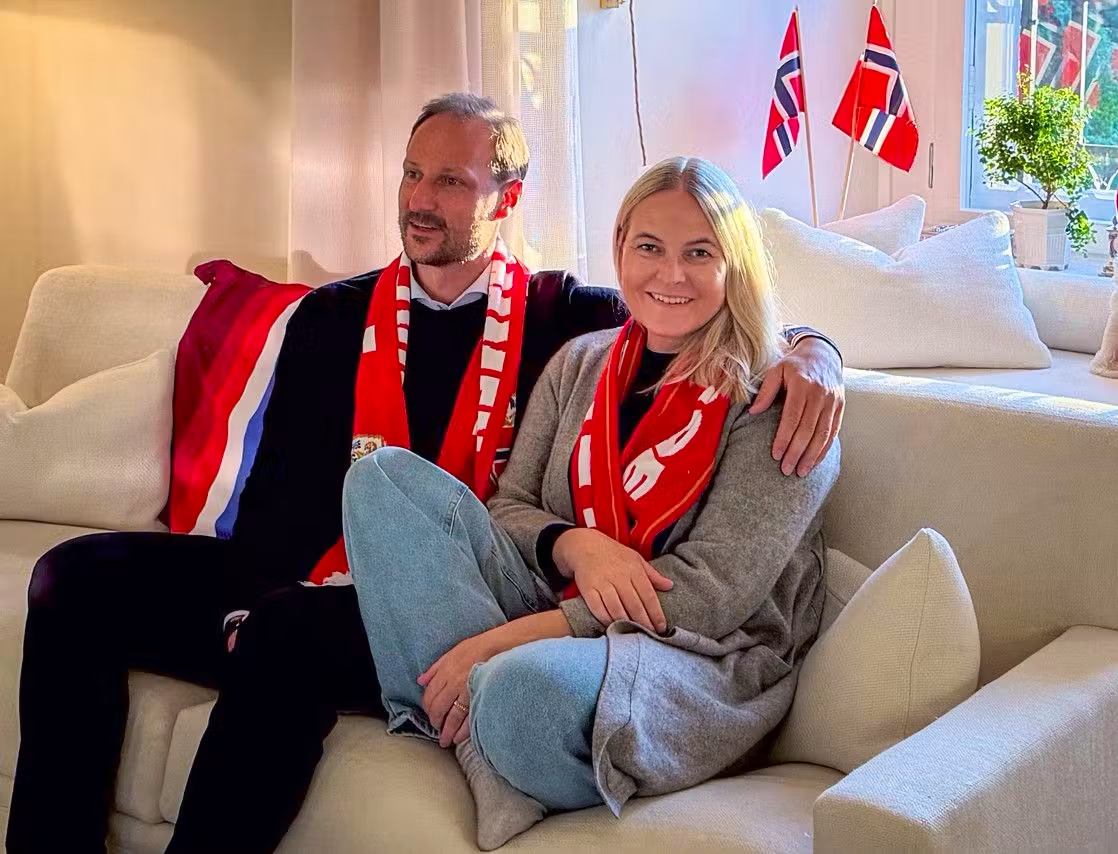
Princess Mette-Marit experienced the journey of a modern-day Cinderella: that of a modest single mother who became Queen of Norway after a spectacular social climb but also embarrassing scandals.
Long the incarnation of a modern Norwegian monarchy capable of shaking up conventions, this tall 53-year-old blonde, in fragile health, acceded to the throne alongside her husband Haakon with a tarnished image, following the death at the age of 89 of King Harald V.
Born on August 19, 1973 in Kristiansand (south), to a father who was a journalist and a bank employee, Mette-Marit Tjessem Høiby grew up in the Protestant “Bible Belt”.
“The most conscientious” teenager in the world, “very kind” and “conformist” until she was 16, in her own words, she broke the mold during a school exchange in Australia.
Back in the antipodes, she shaved her head, got engaged to a man who introduced her to the world of “house” in Oslo – she experimented with hashish and ecstasy there, according to an unofficial biography – and gave birth to a son, Marius, from a brief relationship.
“My teenage rebellion was stronger than for a lot of people,” she said at an apologetic press conference before her marriage to Haakon. “I was in an environment where many limits were (…) exceeded.”
The frankness and simplicity of the young woman with a very meager CV won over initially reluctant public opinion. From her union with Haakon two children were born, Ingrid Alexandra, now crown princess, and Sverre Magnus.
“Error of judgment”
But the fairy tale takes several tragic turns.
In October 2018, the princely couple announced that Mette-Marit had been diagnosed with a rare form of pulmonary fibrosis, a serious illness that makes breathing more difficult and has sometimes forced her to suspend her official commitments in recent years.
She underwent a successful lung transplant in June. Added to these medical weaknesses are legal and media turbulence.
The princess had to deal with the legal troubles of her son, Marius Borg Høiby, 29 years old. He was sentenced in June to four years in prison for two rapes and 32 other charges, including violence against a former partner. He appealed.
In early 2026, the publication in the Norwegian press of email exchanges between Mette-Marit and the American sex criminal Jeffrey Epstein – who died in prison in 2019 – also revealed a sustained relationship in the early 2010s.
In 2011, when Epstein was convicted of soliciting a minor three years earlier, she said she “Googled” him and that this search “did not make a very good impression”, but punctuated her sentence with a smiley.
The following year, when Epstein said he was in Paris “looking for a wife”, Mette-Marit replied that the French capital was “good for adultery” but that “the Scandinavians (make) better women”. And in 2013, she stayed for four days at his home in Florida.
The sovereign will apologize, recognizing “an error of judgment” and claiming to have been “manipulated and deceived” by the financier with whom she severed ties in 2014.
She “did nothing illegal,” her father-in-law, the late King Harald, said in her defense. “Unlike some others in Norway, she broke off these contacts very early, and I think she should be given credit for that.”
But, within public opinion, the damage is done. Several polls show that a majority of Norwegians believe she should not become queen, a blow to the monarchy.
Especially since his eldest son, Marius Borg Høiby, who has no official status, was tried and then sentenced in June to four years in prison for two rapes and 32 other charges.
The young man, who rejects the most serious accusations, is placed under house arrest in an estate owned by the princely couple. Publicly, Mette-Marit observed the greatest discretion on this affair, torn between her role as mother and that of future queen.
