
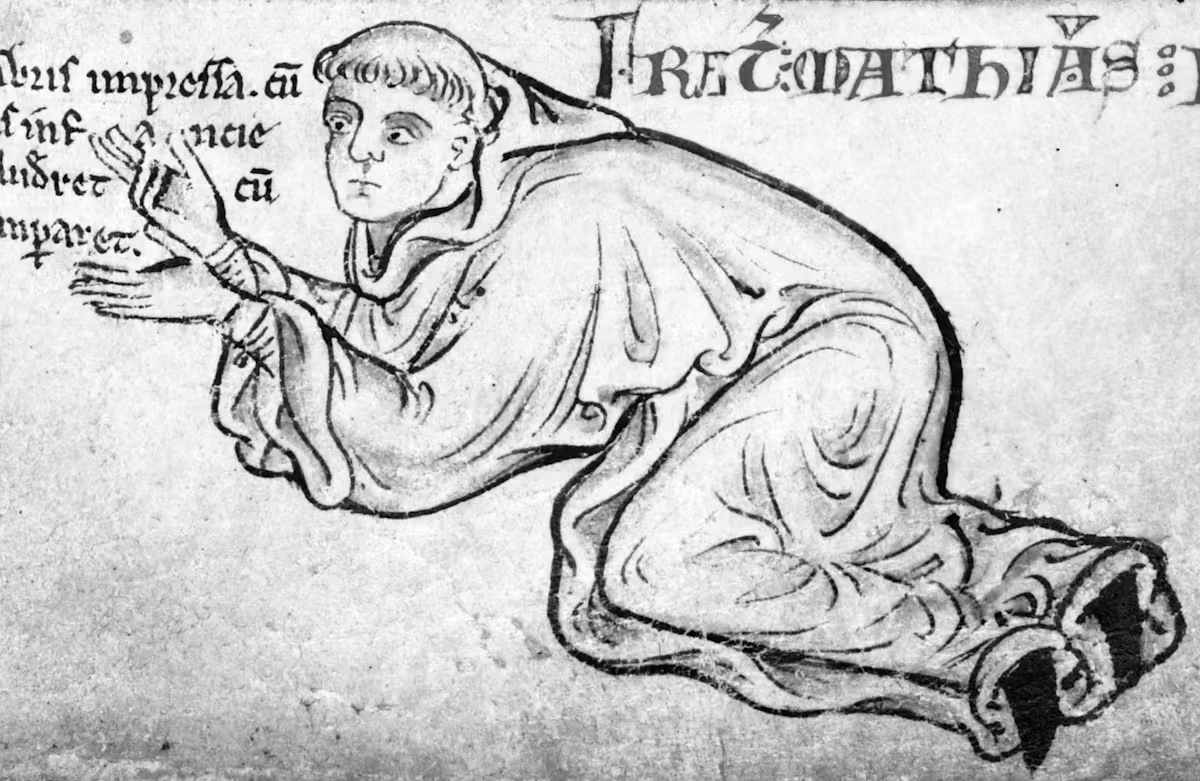
England, from March to July 1252 after Jesus decided to take a look at things outside the Blessed Virgin. Far from the gloomy, rainy and chilly weather that makes the British Isles so charming, it is unusually hot and dry. And it lasts, it lasts…
“The heat of the sun was so intense that the whole earth became so dry that no fruit grew on the trees, nor any harvest in the fields”: so speak the Welsh chronicles delicately named Brut y Tywysogion, delivering a weather report that is imprecise but unequivocal as to the general trend. Written at the same time by a band of Benedictine monks from Gloucestershire who probably had little else to do, the Annals of Tewkesbury confirm the failure: “Drought reigned for four months, causing the grass to disappear”; the said monks say that the vegetation is so dried out that it is enough to grab a tuft of it and rub it between your fingers so that it falls into dust.
Near Winchester, the bishopric reports that the land is so hard that it cannot be plowed for six weeks. Another Benedictine from another English convent, Matthæus Parisiensis alias Matthew Paris, gives a ladle: he testifies in his chronicles that from March to July, we experienced four months of “unbearable heat and drought, without the slightest rain or even dew.” And it’s not funny, the monk continues: the green pastures being destroyed, the livestock, cattle in the lead, are wasting away badly; fleas, flies and midges abound, favoring the growth of various sanitary filth. At low altitudes, cases of swamp fever, that is to say malaria, are reported. The parasites proliferate, covering the leaves of gallbladders and people with unsightly pimples, when it is not more serious. In short, things are bad.
Are these the exaggerations of religious people inclined to mystical nonsense by dint of rehashing those of the Bible? No, for once: recent scientific data attest to this exceptional drought of 1252. And to make matters worse, it is not isolated. It is part of the “medieval climatic anomaly” which affects part of the northern hemisphere and which rages roughly from the 10th to the 13th century. If this warming made it easier for the Vikings to navigate to Greenland and then America, it allowed the English to cultivate vines, the wine thus obtained undoubtedly adding to the numerous calamities linked to the climatic ramblings of the time: fires, epidemics, famines and other joys. In 1212, a terribly dry summer had already ravaged the British countryside and reduced much of London to ashes. That’s how things were definitely going badly, and that’s what people said.
To individuals who say with a triumphant air “ah, so, eh, this story of an anomaly in the Middle Ages clearly shows that climate change has always existed, it is proof that these current stories of disruption caused by man are rubbish invented by ecologists”, we will politely respond: “Shut up.” Because it has absolutely nothing to do with it. The medieval anomaly was a natural phenomenon, linked to solar and volcanic activity. It was less marked than today’s disruption due to human-caused greenhouse gases. And above all, unlike him, it has only affected certain regions of the planet, in very variable ways. Not to mention another small difference: the English of the Middle Ages did not have scientific studies to predict climate change decades in advance, sound the alarm and encourage people to stop polluting stupidities. And that changes everything. Except of course in Washington or Bern, where the people in power are still in the Middle Ages.
This text and this drawing can be found with a host of others in issue 717 of “Vigousse”, the little French-speaking satirist, on newsstands (or in the mailbox, for subscribers) every Friday.
Your opinion deserves more than a comment? Submit an article!
Your voice deserves to be heard. Expand your views here.
