
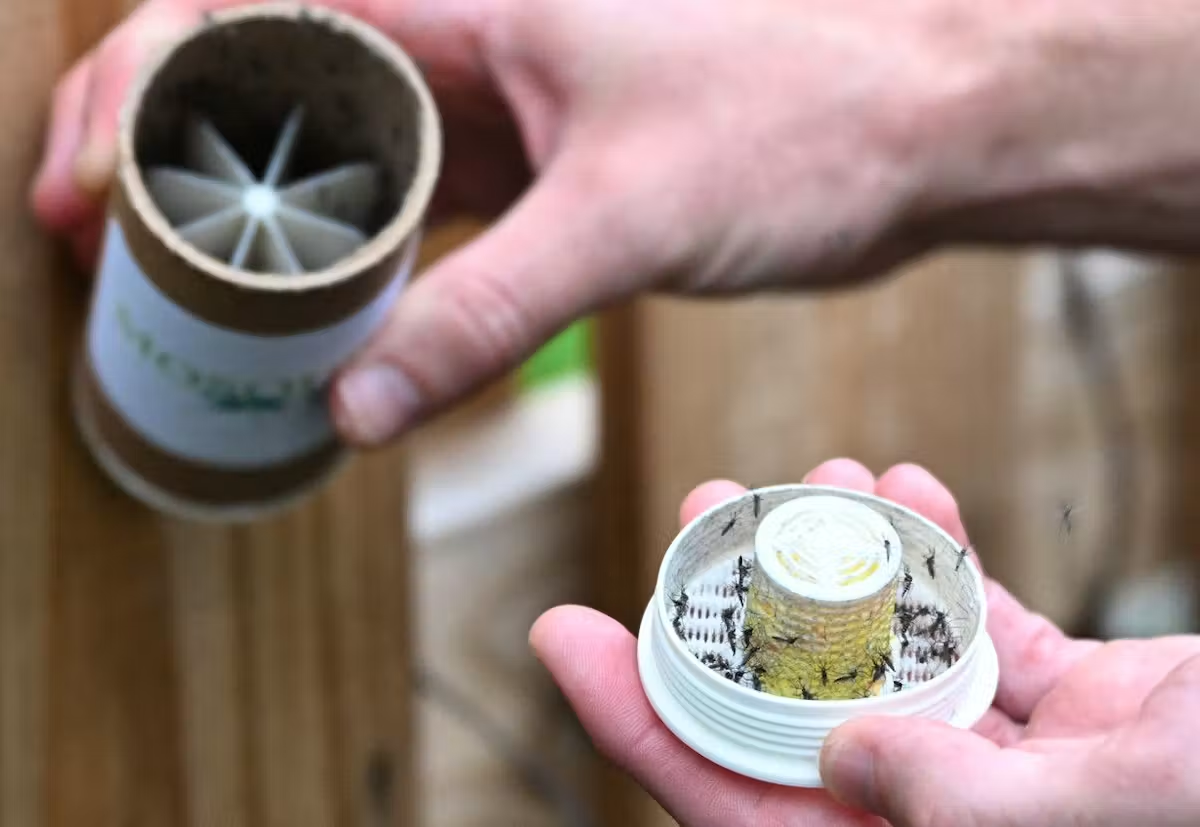
Todd Montgomery opens the cap of a small tube and releases hundreds of mosquitoes into the garden of a house in the Washington suburbs.
But these male mosquitoes do not bite. They carry a bacteria called Wolbachia, which prevents eggs from hatching when they mate with non-carrying females.
This initiative is the first of its kind for individuals in the United States. By the end of summer, 600,000 tiger mosquitoes (Aedes albopictus) will be released throughout the region.
“With climate change, we are sitting on a time bomb,” the founder of Bee Safe Mosquito Control, the company behind the project, told AFP.
Indeed, rising temperatures prolong mosquito season and increase the hot, humid days in much of the United States that these disease-carrying insects need to proliferate.
The treatment, sold under the name “ZAP Males,” only targets tiger mosquitoes, a species not native to the region but which spreads diseases like dengue. A threat that is being taken seriously by the authorities after the appearance this week in northern Virginia of the first case of locally contracted dengue fever in the state.
A former electrical engineer from Kentucky, Todd Montgomery moved to the area to take a job in the defense sector. He founded his company in 2023, with the aim of reducing the use of pesticides.
“It all started from my interest in native plants and my attachment to pollinators, seeing the spraying (of pesticides) so close to my home and wanting to eliminate this risk,” says the 32-year-old man who is now studying for a master’s degree in entomology.
A concern shared by its customers, keen to protect themselves from conventional pesticides such as bifenthrin, classified as a possible carcinogen for humans.
“We have a beautiful garden. I planted between May and June then I hardly set foot there until October,” says Sandra Marquardt, 67, who adds that she has never used a pesticide, although she sometimes wanted to when she saw her neighbors doing it.
“It’s disconcertingly efficient,” she says, now happy to be able to dine on her terrace with her husband and take care of her garden without being “terrorized” by mosquitoes.
Twenty-five clients signed up for the program, each receiving 1,500 mosquitoes per week for 16 weeks. Todd Montgomery says they are fully booked this year and are taking reservations for 2027.
Diseases
Singapore has the largest public program of its kind: “Project Wolbachia”. Launched in 2016, it now releases more than 10 million mosquitoes per week.
A study published in the New England Journal of Medicine showed that this method could significantly reduce the Aedes aegypti population and reduce the risk of dengue fever by more than 70%.
In May, Google applied for permission to release 32 million mosquitoes as part of a similar project in Florida and California.
Wary of chemicals as the mother of a young child, April Chunko, 44, explains to AFP that she “immediately embraced the idea” of Todd Montgomery’s company.
“We have a sandbox that he (his son, editor’s note) loves and it’s hard to enjoy this space because we are literally devoured by mosquitoes,” she assures. “I haven’t seen a big difference yet, but I also have wood behind me.”
Marcelo Jacobs-Lorena, professor of entomolgy at Johns Hopkins University, says the variable results may be explained by different local conditions.
Also, it depends on the scale of the intervention carried out. But, according to him, such a strategy risked becoming “a never-ending enterprise”.
It thus favors another use of the Wolbachia bacteria. Instead of reducing the mosquito population, his approach involves releasing both males and females carrying the same strain, so that their eggs hatch normally and the bacteria spreads through the population.
“So there will still be mosquitoes to bite people, but they will no longer transmit diseases,” he adds.
