
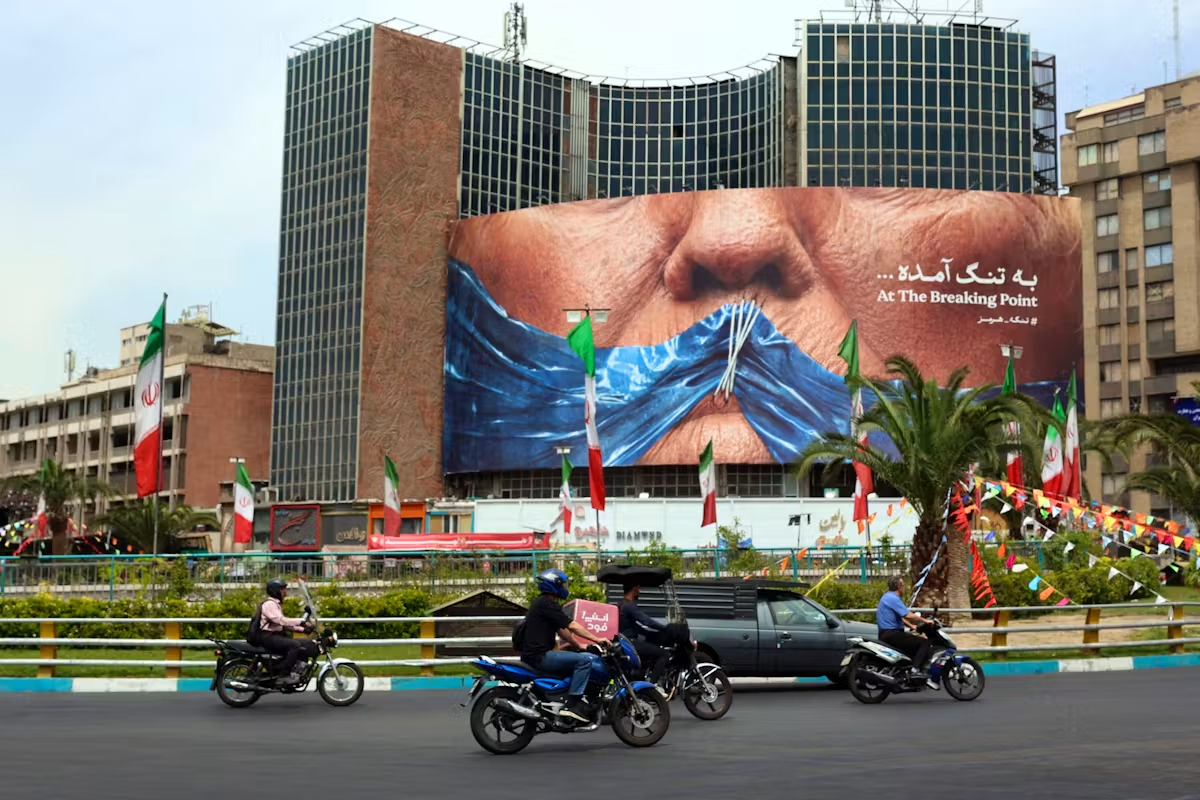
Tehran and Washington have been engaged for weeks in indirect discussions with a view to putting a lasting end to the war in the Middle East but their outcome is uncertain, particularly after this week’s clashes, the most serious since the truce came into force on April 8.
Sources in Washington had mentioned on Thursday a framework agreement providing for a 60-day extension of the ceasefire, but the talks are still stumbling on several points.
“Iran must accept that they will never have a nuclear weapon,” President Donald Trump wrote Friday on his Truth Social network. He also called for Iran’s stockpile of highly enriched uranium to be “DESTROYED.”
The United States and Israel, whose joint attack on Iran on February 28 triggered the war, accuse Tehran of wanting to acquire atomic weapons, which it refutes.
Open Hormuz “immediately”
Iran, for its part, insists on tackling the nuclear issue later, after signing the memorandum of understanding currently under discussion.
Another point of dispute: the Strait of Hormuz, a strategic passage for global hydrocarbon trade which has been virtually blocked by Iran since the start of the war.
It “must be opened immediately” and Tehran must commit to demining it, Mr. Trump said on Friday, while his country for its part imposes a blockade on Iranian ports.
According to contacts of Iranian sailors cited by the Tasnim news agency, the United States continues to prevent Iranian commercial ships from circulating.
On Friday evening, a White House official asserted that “President Trump will only sign a deal if it is good for America and his red lines are met.”
Reacting to Mr. Trump’s remarks, the spokesperson for the Iranian Foreign Ministry, Esmaïl Baghaï, indicated that “exchanges continue” with the United States.
He also defended “the special situation” of the Strait of Hormuz, due to its location in the territorial waters of Iran and Oman.
As a result, Iranian MP Alireza Salimi told the Isna news agency that only Iran and Oman were “authorized to decide” on its management.
In this context, American Defense Minister Pete Hegseth affirmed that the United States was “fully capable” of resuming hostilities against Iran “if necessary”.
“Our stocks are largely fit for purpose,” he told a defense forum in Singapore.
IMF concern
The war has left thousands dead and is shaking the global economy by pushing up oil prices.
Several international organizations, including the International Monetary Fund (IMF) and the World Bank (WB), also warned on Friday of a risk of an oil shortage this summer if maritime traffic via the Strait of Hormuz does not quickly return to normal.
Among its demands from Washington, Iran calls for an end to fighting on all fronts, particularly in Lebanon where its ally, Hezbollah, and Israel are clashing. A truce has been in effect since April 17 but it is not respected.
The Israeli army, whose troops are advancing deep into southern Lebanon, has intensified its strikes in its neighbor in recent days, where it says it is targeting Hezbollah which is firing on Israeli positions.
Lebanese and Israeli military officials held a meeting in Washington on Friday which, according to the Pentagon, should serve as the basis for a new session of political negotiations to reach a security agreement, on June 2 and 3 in Washington. But Hezbollah is fiercely opposed to these talks.
According to the latest official report, Israeli strikes have killed 3,355 people in Lebanon since the start of the war.
