
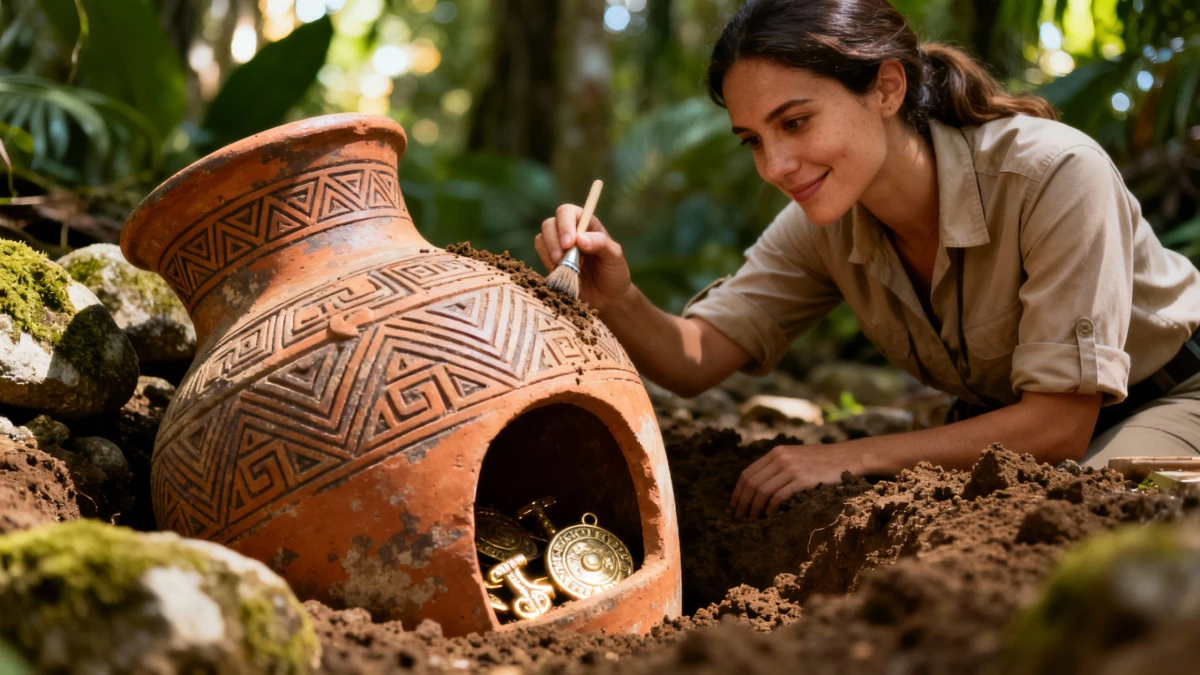
A Tree Falls—and History Emerges
Sometimes, all it takes is a twist of fate (or gravity) to change history. At the beginning of 2025, in the remote community of São Lázaro do Arumandubinha in the Middle Solimões region of Amazonas, Brazil, a tree toppled over, exposing a secret hidden beneath its roots. Locals spotted two large ceramic vessels among the tangled mass. Walfredo Cerqueira, who manages the community’s pirarucu (a giant Amazonian fish) resources, immediately recognized the importance of the find. He alerted the local priest, who in turn contacted the Mamirauá Institute in the city of Tefé, Amazonas.
The Journey to Discovery
No adventure in the Amazon would be complete without a bit of boating, a dash of canoeing, and a good hike through dense greenery. After this challenging trek, a team of archaeologists finally reached the Lago do Cochila site in the municipality of Fonte Boa. What they found was beyond their wildest archaeological dreams: seven funerary urns, some tipping the scales at up to 770 pounds (about 350 kilograms), buried at a depth of roughly 16 inches (40 centimeters).
Preliminary analysis revealed not just fragments of human bone—but also fish and turtle remains inside the urns. These details point to burial rites that combined spiritual traditions with elements of food, offering a glimpse into rare funerary practices of the region’s Indigenous peoples, long before the arrival of Europeans.
The Ingenious World of Amazonian Ancestors
The archaeological site belongs to a network of ancient artificial islands constructed by Indigenous peoples within flood-prone zones. As archaeologist Márcio Amaral explains, these raised islands were engineered from earth and ceramic shards, allowing people to live and gather even during high-water seasons.
“This is sophisticated Indigenous engineering, revealing mastery of the land and suggesting a significant population density in the past.”
The urns, likely buried beneath ancient dwellings, reinforce the idea that the floodplains of the Amazon were continuously inhabited—not just used as temporary stopovers or for seasonal activities.
The ceramics themselves are impressive. Large in size and with no apparent lids, they may once have been sealed with organic materials that have since decomposed. Their greenish clay and reddish slip point to a ceramic tradition never before documented in the Amazon, distinct from known styles in the region.
The Power of Community in Archaeology
This discovery wouldn’t have happened without close cooperation between scientists and locals. Community members took an active hand in the digs, crafted suspended wooden structures to safeguard the finds, and helped transport the hefty urns—a process that required several days of river navigation (and a gentle touch to boot).
“We used plastic film, plaster, bubble wrap, and wooden supports. Nothing was left to chance: every detail was planned,” described archaeologist Geórgea Layla Holanda.
The urns are now under careful examination at the Mamirauá Institute laboratory. The team is still seeking funding for carbon-14 dating, which could reveal whether these materials are 500, 1,000, or even 3,000 years old. Regardless of their precise age, this discovery is already transforming our understanding of ancient Amazonia: a land of deep knowledge, technological innovation, and enduring spirituality, whose legacy lives on in the hands of its direct descendants.
