
The drought continued to rage exceptionally in early August in Europe and around the Mediterranean, with more than half (51.3%) of the soils affected, according to the analysis Monday by AFP of the latest data of the European Drought Observatory (EDO). A rate so high had never been noted for the period of 1er As of August 10 since the start of the observations in 2012.
Since mid-April, about half of this area has been affected by drought, an episode in gravity over the heavy drought of summer 2022. The drought indicator of the European Copernicus program observatory, made up of satellite observations, combines the level of precipitation, soil humidity and the state of vegetation. It breaks down into three levels of drought: surveillance, warning and alert.
7.8% of Europe on alert
In early August, 7.8% of Europe and the Mediterranean perimeter were on alert, the most serious level, 38.7% in warning, and 4.9% in surveillance.
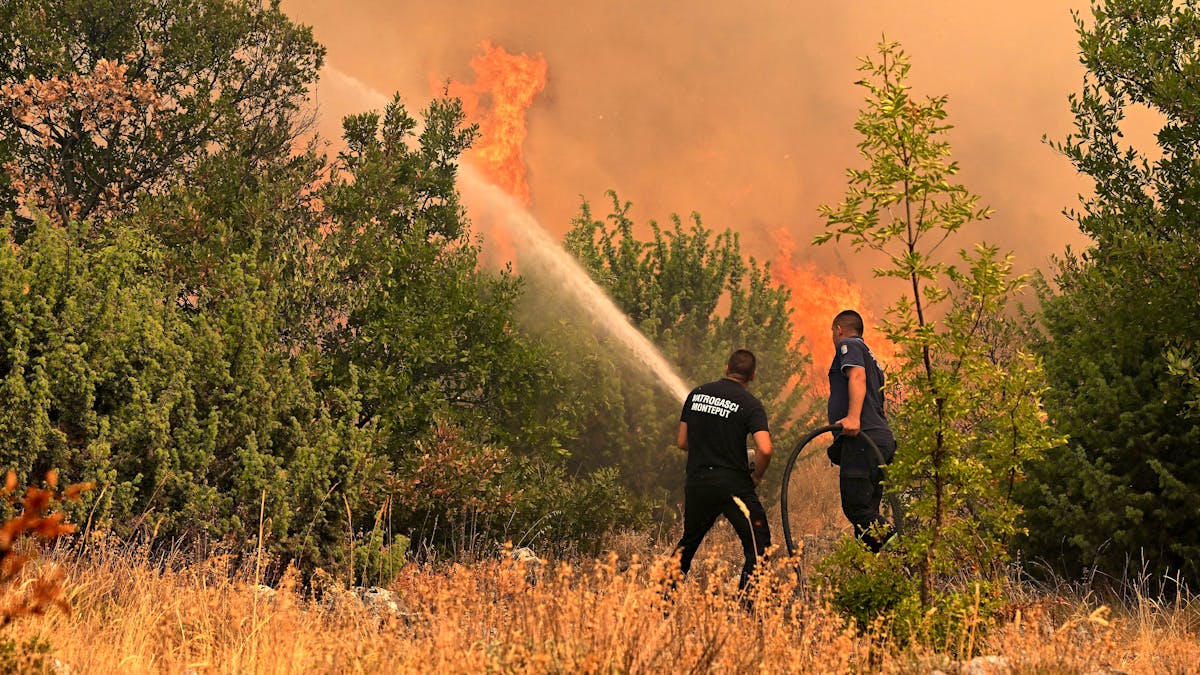
The Caucasus and the North of the Balkans are the regions most affected by drought. Georgia and Armenia are thus affected by drought on 97% of their territory, as well as Bulgaria and Kosovo, while Serbia, Northern Macedonia, Albania, Hungary and Montenegro all have at least three quarters of their area in warning or alert. This part of Europe had been affected in July and August by waves of heat, promoting many forest fires, including some mortal (one dead in Montenegro, one in Albania).
Spain, Portugal and Italy, also struck by violent fires at the beginning of the month, are no longer affected by drought than locally. In the United Kingdom (69.5%) and in France (63%), it is a much broader part of the territory that the EDO considers to be affected.
Back to normal in Switzerland
The only improvement is to be reported in the center of Europe. The humidity of the soils and the state of the vegetation return to normal conditions in Germany, Switzerland, Austria and the Czech Republic, which is more affected in previous months.
According to a calculation of AFP from the estimates by country provided by the European Forest Information System (Effis), fires, whose appearance and spread are facilitated by drought, have already ravaged more than a million hectares in the EU in 2025, exceeding in eight months the record over a year.
