
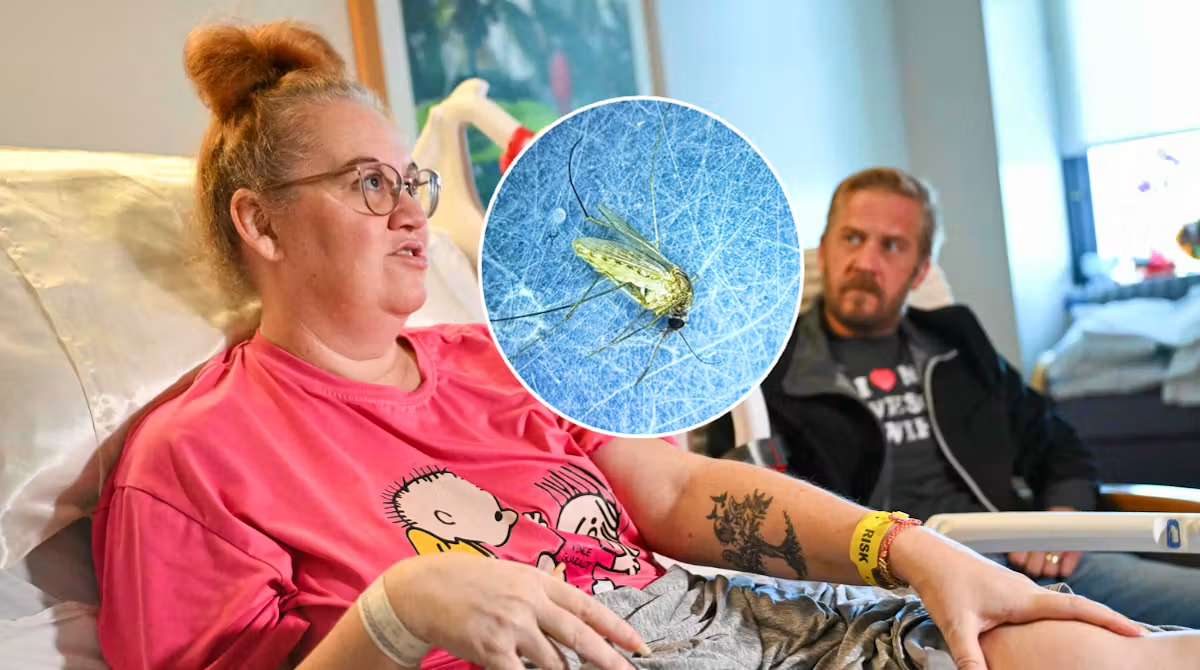
A simple mosquito bite almost cost Mandi Budd her life. Infected with West Nile virus, this American woman has been paralyzed for two months in her hospital bed in Burbank, a suburb of Los Angeles. “I’m happy to be on the right side of the grass, (…) because I could have been one of the victims of this virus, and that’s a terrifying thought,” breathes the fifty-year-old.
With 617 people infected and 45 dead, California is experiencing its second deadliest year facing the disease. An unprecedented resurgence since 2015, facilitated by the abnormally high heat and humidity of recent months. The West Nile virus remains little known, because the vast majority of those infected are asymptomatic, or get away with the equivalent of a little flu.
But for the most unlucky (around 1% of cases), it can cause potentially fatal brain damage, with neurological complications causing cognitive impairment and paralysis. This is what happened to Ms. Budd in September. She initially mistook her hip pain for sciatica, before collapsing because her legs could no longer support her. At the hospital, her fever rose to 39.5°C and doctors fought to keep her alive.
Infected by biting contaminated birds
“It’s scary,” she confided to AFP, between two rehabilitation sessions to relearn how to stand. This consultant for humanitarian organizations could not imagine contracting this virus of African origin, without vaccine or treatment, on the American west coast. “I lived in Florida, (…) with all types of mosquitoes that could carry anything and I never had a problem,” she says. “So I didn’t expect to catch this here in California with its perfect weather all year round.”
Mosquitoes become infected by biting infected birds, then transmit the virus to humans. Discovered in Uganda, it only arrived in the United States in 1999. Its spread area continues to expand, particularly under the effect of climate change, recalls Ryan Harrigan, biologist at the Center for Tropical Research at UCLA University. “As the climate warms, these diseases that were historically considered more tropical are moving north,” summarizes the researcher. “We see the same thing in Europe too.”
The influence of the El Niño phenomenon
This year, more than 2,000 cases of West Nile virus have been detected in twenty European countries, a record. Italy, Greece and France — where the virus is now spreading well beyond the Mediterranean regions — are the most affected. California suffered a record heat wave in the spring, a sticky summer fueled by the El Niño phenomenon and an abnormally hot autumn, marked by a tropical storm.
An ideal scenario for mosquitoes, which breed in stagnant water. “We have favorable conditions for many of these (mosquitoes) vectors from spring and well into winter,” observes Mr. Harrigan. “This lengthens the amplification cycles of West Nile virus.” In Los Angeles County, where the epidemic is most severe, the first infected mosquito was detected earlier than usual, as early as May.
“Difficult to be in everyone’s garden”
“We were two months ahead of schedule throughout the summer,” says the director of the local mosquito control agency, Susanne Kluh. Every month, its teams treat the pipes evacuating rainwater with larvicide, release sterile male mosquitoes to hinder reproduction, and track down poorly maintained swimming pools and grounds. But “it is very difficult to be in everyone’s garden”, to empty the smallest buckets and wheelbarrows where the water stagnates, she admits.
She therefore recommends that residents and tourists spray themselves with repellent spray, especially at dawn and dusk. A reflex that is all the more important as El Niño increases precipitation in California and could encourage mosquitoes from the next mild spells. “The question is how long the rain will persist in spring and arrive with temperatures already high,” she insists. “That’s going to be a concern.”
