
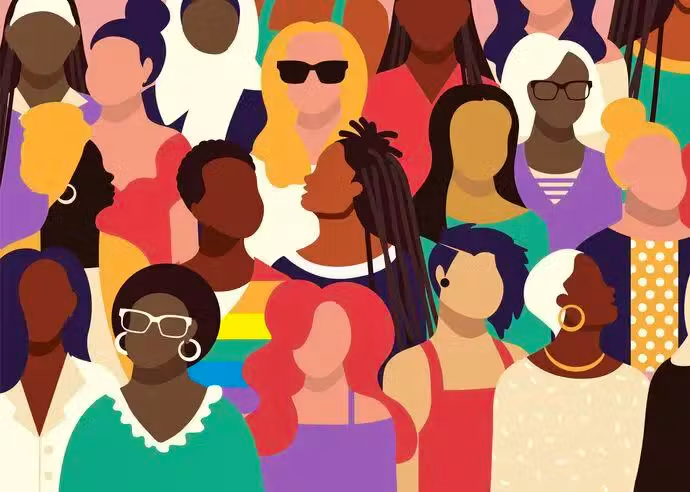
We are unique and different people. This is what makes life on earth both a paradise and a hell. Cohabiting is the biggest challenge.
In addition to being singular individuals, our particularities are grouped by social categories: women, men, Westerners, Christians, disabled, bourgeois, racialized, etc. These categories even sometimes intersect: woman, black and Jewish.
Depending on where we are geographically and sociologically, we have very specific points of view and interests. They are connoted by all these layers which make up our identity. Even if our positions seem obvious, legitimate, or even the best, they will never be shared unanimously. Is this even desirable? Perhaps, on certain basic notions, we still need to agree on these. For the rest, it would amount to denying the diversity of humanity. The difference is extremely healthy biologically, sociologically and humanly.
Respecting the multiplicity of unique cultures, putting them in dialogue, bringing them to fertilize each other is essential. Complicated exercise that sometimes requires courage. However, it is necessary because “I am because we are,” as Sub-Saharan Ubuntu thought explains.
Our differences are neither valued nor cultivated in the same way
It’s said. Now I must add that humans are not equal, nor are their cultures. All our differences are neither valued nor cultivated in the same way. They are not considered at the same level, openly or not, consciously or not. Certain “dominant” categories, by passivity or by intention, benefit from these inequalities, exploit, discriminate, make them invisible, exclude, sometimes without even realizing it. Other “minorized” groups are relegated to the margins of their countries, international relations, politics, economics and spheres of power. These minorities lack resources and sometimes end up doubting their legitimacy, their value or even their place.
Two choices present themselves to minoritized groups: use their energy, their time and their intelligence to reach out to majority groups and work for a rebalancing or even a transformation of society. On this subject, Léonora Miano writes that “to rise against violence, against injustice, is to refuse one’s own debasement, but also that of the criminal who destroys himself through his action. And it’s heroic!”
The second choice is to stick to your guns, withdraw into yourself, build a protective fortress and convince yourself that you are only your community and for your community.
To transform the world, you must fully inhabit your home
Personally, I move from one posture to another. In my case, the first cannot exist without the second. I go to meetings, to dialogue, to confrontation, often. However, to recover from these demanding exchanges, from these battles fought with more modest weapons and less sharp tools, to regain energy before returning to the arena, to lead projects, to take risks and to expose myself, I rest in my community, in the arms of my sisters, in spaces of chosen non-mixed people, populated by beings who look like me and share exactly the same vision of the world and the issues that govern it. I anchor myself deeply in this margin from which I come and cultivate it because “it is from oneself and one’s place that everyone is invited to work to transform the world. For this, it is necessary to fully inhabit your home,” writes Miano.
Are you interested in learning more about my home, talking with its occupants? Wherever you live, I invite you to the Black Helvetia Festival (FBH), which will be held at the Vidy theater in Lausanne from November 25 to 29. The FBH questions the way we view black and Afro-descendant women who are Swiss or live in Switzerland. Joyful, inclusive, open to the general public, it celebrates the diversity of the Swiss population and its positive impact through artistic and educational proposals while encouraging reflection on living together. Welcome to this margin!
This column is published in partnership with the show The Fine Talkersbroadcast every Sunday on RTS La Première.
Your opinion deserves more than a comment? Submit an article!
Your voice deserves to be heard. Expand your views here.
