
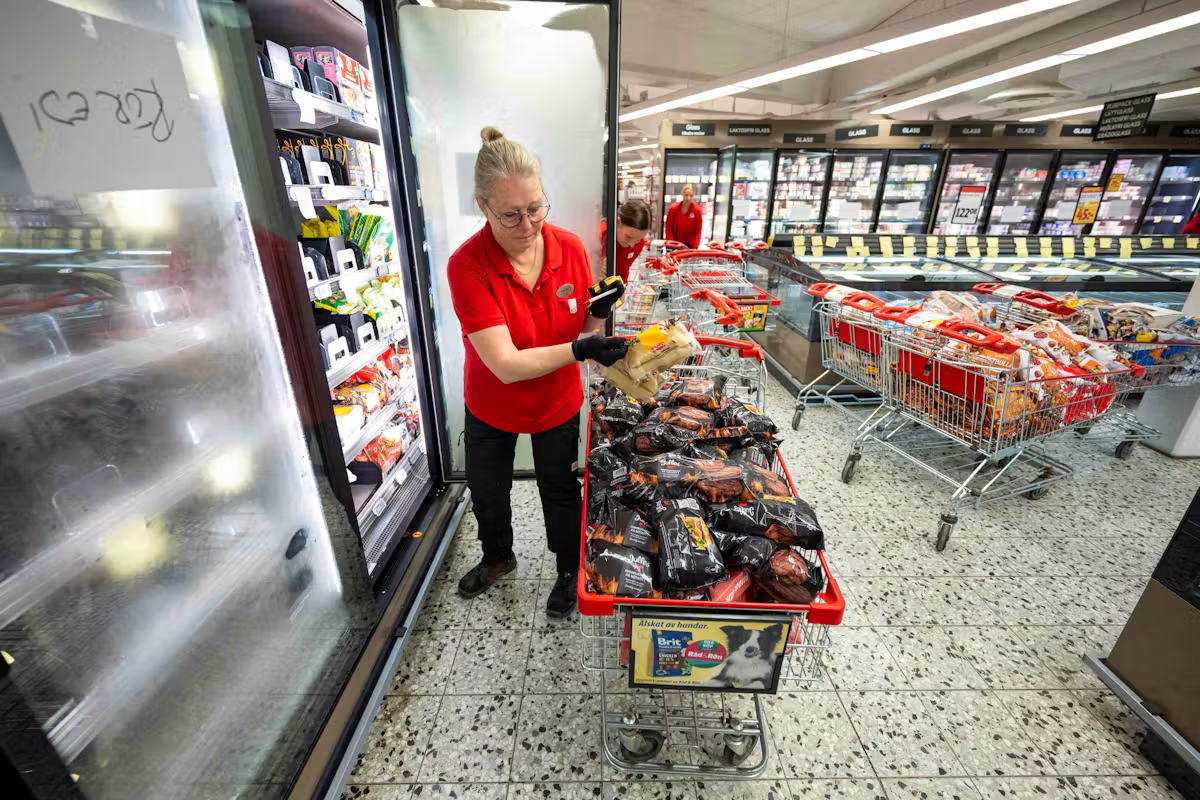
Supermarkets in several European countries saw the temperature of their refrigerators soar and spoil food on Monday from Sweden to Sicily, due to a cyberattack similar to that which occurred in France three weeks ago.
Supermarkets in Belgium, Estonia, Finland, Ireland, Italy, Luxembourg, the Netherlands, Portugal and Sweden have been affected by this new hacker attack. They were forced to throw away quantities of food.
On October 12, major French retail brands indicated that hundreds of refrigeration systems in their stores had been hit by a cyberattack, forcing them to throw away expired foods and raising concerns for food safety.
In Belgium, where dozens of stores belonging to several supermarket chains reported disruptions, federal prosecutors announced the opening of an investigation, without calling the incident a cyberattack at this stage.
The European Commissioner for Agriculture and Food, Christophe Hansen, for his part denounced “extremely worrying repeated cyberattacks” and “a deliberate attempt to disrupt our food supply chain and undermine consumer confidence – a warning that we must take seriously”.
“Food security requires more attention at all levels. “Aiming for food” is now “a reality,” he said after the cyberattacks against France.
Meeting in Italy
No one has claimed responsibility for either attack. “It’s a cyberattack, there is no other reason,” said Carrefour Belgium spokesperson Mich Vergauwen, who reported disruptions in around fifteen of the chain’s 700 stores in the country on Monday.
Ikea Belgium also announced that a cyberattack had hit its store in Mons, in southwest Belgium, causing freezer temperatures to rise sharply in the early hours of Monday.
The Delhaize, Colruyt and Intermarché chains also suffered technical problems affecting their refrigerators in Belgium. Delhaize also reported that four of its stores in Luxembourg were also affected.
The Belgian industrial refrigeration group Sabcobel said it had started to secure its installations after the October 12 attack in France, but that around 10% of them were still not overhauled and that some were in the stores affected on Monday.
“If Sabcobel had not launched this operation, the impact would have been much greater,” said the company’s general manager Stephan Moelans to AFP.
The Musgrave group, which notably owns the Supervalu chain in Ireland, announced that 13 of its stores had been affected, as well as a small number of its convenience stores in the Netherlands.
In Italy, at least four Coop supermarkets were affected in Sicily, according to the press, as well as a Tuscan company operating in the collective catering sector according to the national cybersecurity agency.
“The attack took place at 4:00 a.m.,” Giuseppe Spadaro, general director of the Radenza group, which manages Coop brand supermarkets, told the Ansa agency. “This is an attack on our frozen food aisle remote control system. (…) In some cases, we have resolved the problems,” he added. A meeting on cybersecurity is planned for Tuesday morning at the Presidency of the council, according to a spokesperson.
“Vulnerabilities”
In Sweden, the Coop chain confirmed that six of its approximately 800 stores had been victims of a cyberattack at dawn on Monday. “We can confirm that this is a cyber incident. The problem is now resolved and the refrigerators and freezers are working normally,” spokesperson Carlos Cancino told AFP.
He said Coop did not know who was behind the attack, but noted that the six affected stores were connected to a 4G mobile network, not the updated 5G system, making them “more exposed” to hackers.
Swedish chain Ica also said “a limited number” of its stores had experienced refrigeration problems, but the group could not confirm that a cyberattack was the cause.
According to Ica spokesperson Helena Johansson, the affected stores were all connected to an external refrigeration control system provided by Danish manufacturer Danfoss – the same service provider targeted in the October 12 cyberattack against French brands. She referred all questions to Danfoss, which did not respond to AFP’s request for comment.
Roni Kokkola, an information security specialist at the National Cybersecurity Center of the Finnish transport and communications agency Traficom, did not rule out cyber interference against Finland.
“We have observed this phenomenon in Europe in recent months, so the fact that it extends beyond France to other countries was expected,” he told AFP. It is now common to see all kinds of vulnerabilities exploited in an ever more active and rapid manner.
