
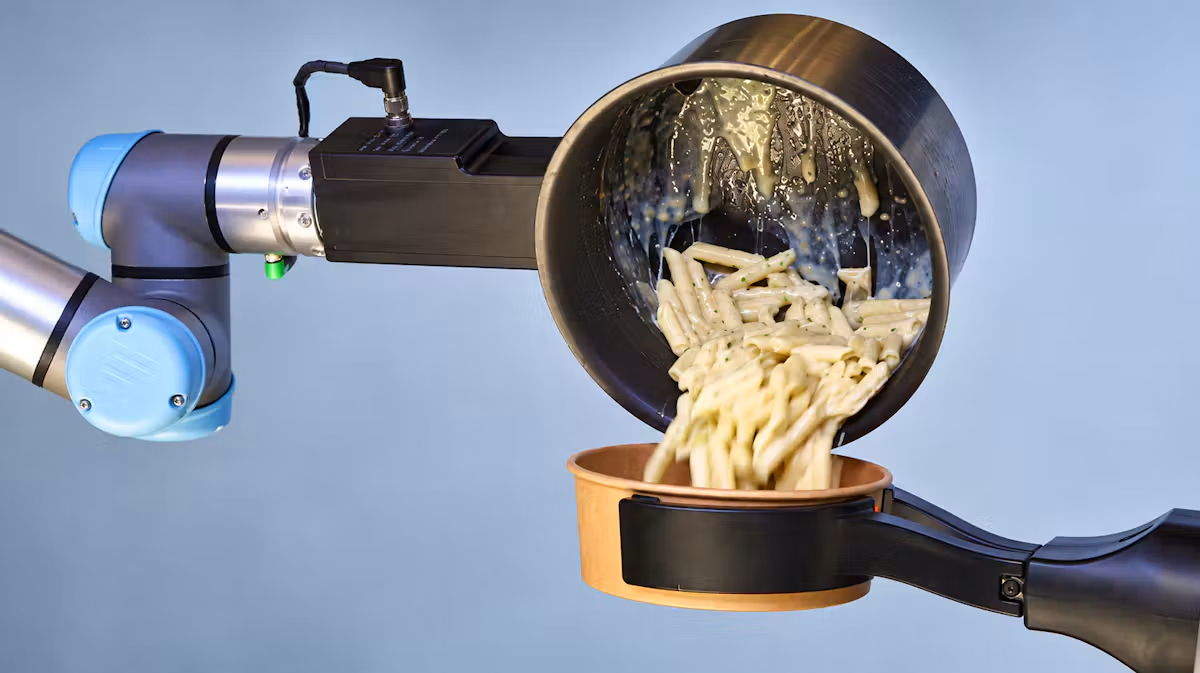
“No meal, no fight!” is the motto of the German army. And to feed its approximately 186,000 soldiers, the Bundeswehr is relying on technology: until the end of the year it is testing a robot controlled by artificial intelligence. The machine is capable of preparing truffle pasta, chili con carne or even Kaiserschmarrn, this Austrian specialty made from pancake dough, in just a few minutes.
Since April, the German army has been testing the CA-1 robot, developed by the Munich company Circus Group, at the Hugo-Junkers barracks in Alt-Duvenstedt, in Schleswig-Holstein, in the north of Germany. Some 900 soldiers can benefit from this installation, accessible even outside the opening hours of the traditional canteen.
The installation, whose dimensions are reminiscent of a small caravan, occupies an area of approximately seven square meters. Inside, the ingredients are kept at a temperature of 6 degrees in order to respect the cold chain. Two robotic arms select the food stored in around thirty tanks, then pour them into rotating cooking containers. Sensors monitor the different preparation stages. The system thus automates tasks usually carried out by a cook.
A thousand meals already served
It only takes a few minutes to prepare a meal, which the soldier then collects in one of the eight distribution compartments. Users can even watch the robot while it cooks. Human intervention is limited to restocking ingredients and cleaning the facility.
Since the start of the experiment, the robot has prepared around 1000 meals. According to a head of the Bundeswehr catering service, the initial feedback from the soldiers is positive.
The objective, however, is not to eliminate existing canteens, but to offer a complementary solution, particularly in small military bases or during missions abroad. The test is to continue until December 31, 2026. The German army will then decide whether it wants to acquire further devices.
Also used by the Ukrainian army
Technology is not limited to the military sector. According to Circus Group, comparable systems are already in use in supermarkets, hospitals, hotels, notably in Abu Dhabi, as well as at an automobile manufacturer in Sindelfingen, Germany.
The company also claims that units are used by Ukrainian ground troops.
But this automation is not unanimous in the catering sector. Andreas Tedsen, head of the German professional association DEHOGA, believes that a robot cannot replace a qualified chef. For him, cooking remains above all a craft profession.
