
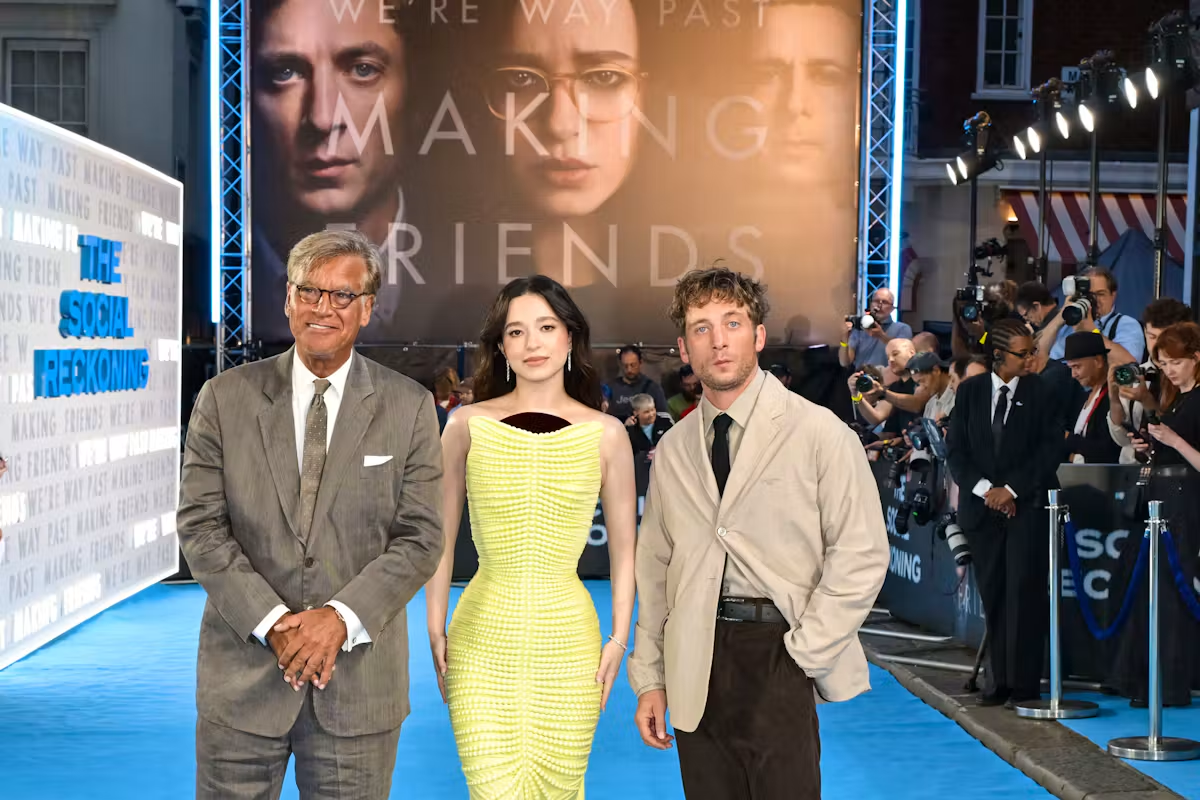
He won the Oscar for best adapted screenplay for “The Social Network”, an emblematic film of the 2010s on the birth of Facebook. With “The Social Reckoning,” in theaters October 7, Aaron Sorkin gives a captivating sequel to David Fincher’s masterpiece and calls for a reckoning for the social network. The brilliant American screenwriter also put on the director’s hat to tell the true story of Frances Haugen (Mikey Madison, Oscar winner for “Anora”), a young engineer at Facebook who turns into a whistleblower with the help of a journalist from the Wall Street Journal to bring to light the harmful effects of the powerful social network.
In particular, we discover that Facebook’s algorithms promote extremist groups, fuel division and hatred, and are harmful to users of the platform. And that Mark Zuckerberg’s company has done nothing to remedy these flaws. An investigation revealed in the “Facebook Files” in the Wall Street Journal in 2021. Aaron Sorkin and Mikey Madison spoke exclusively to “Matin” in a London palace.
Aaron Sorkin, did the publication of the “Facebook Files” in 2021 and the storming of the Capitol give you the impetus to make this film?
Aaron Sorkin: More like the storming of the Capitol. I wasn’t even aware of the “Facebook Files” until I started thinking about this movie. I wasn’t looking to return to the world of Facebook. A story presented itself to me that really interested me. I met Frances Haugen, the character Mikey plays. I discovered during my first two meetings with her that Frances is a phenomenally intelligent woman, one of those people whose IQ puts her at a level that I find difficult to understand. So it took me a little while to get to follow the story.
Why did you choose Mikey Madison to play on screen? She doesn’t look like him physically at all.
A.S.: I wasn’t interested in a physical or vocal resemblance. Mikey is a phenomenal actress, which is the first reason why I wanted to offer her this role. And then Frances is like a left-hander in a world of right-handers. For some reason, she doesn’t really fit in. I figured it was something Mikey would be able to bring up effortlessly.
Mikey, have you met Frances? What did you think of her?
Mikey Madison: We have communicated but we are going to meet in person very soon, I can’t wait. As Aaron suggested, I’m playing a version of Frances, a character inspired by her. Obviously, all the things that happened and the story of the film are based on true events. I found Frances to be a very courageous person. I consider her a hero, someone with a real moral compass and great integrity. I liked the idea of trying to play someone really good.
Aaron, you say that Mark Zuckerberg is an antihero, not a villain, because he has good intentions. In your film, however, he gives the impression of being a villain, obsessed with growth and almost not human in his behavior.
A.S.: It was important for Jeremy Strong, who plays Mark, to come close to a vocal or physical imitation of him. Simply because Mark is someone we know well, with a unique physical presence and voice. As far as whether he’s a villain or a tragic hero, his intentions are good. His goal is not to rule Gotham City. He wants to bring people together, connect them. Or at least those were his intentions. I’m not sure what they are anymore. But the results are bad. If his intentions were evil, he would be a villain.
Frances Haugen recently said the company is in worse shape today than when it leaked the documents. And the recent amicable agreement reached by Meta with nearly fifty American states to settle the lawsuit on the addiction of adolescents to its platforms does not resolve everything. Is the future bleak and can Meta really change?
A.S.: I’m not good at predicting the future, especially when it comes to tech. I believe Frances. She is good at predicting the future. The deal you’re talking about only scratches the surface. There is a terrible problem that maybe got 5% better with this.
