
In 2025, the Swiss drank around 211 million liters of wine, according to the Federal Office of Public Health (FOPH). Despite a decline overall, Swiss wine consumption increased in 2025, reaching just over 79 million liters.
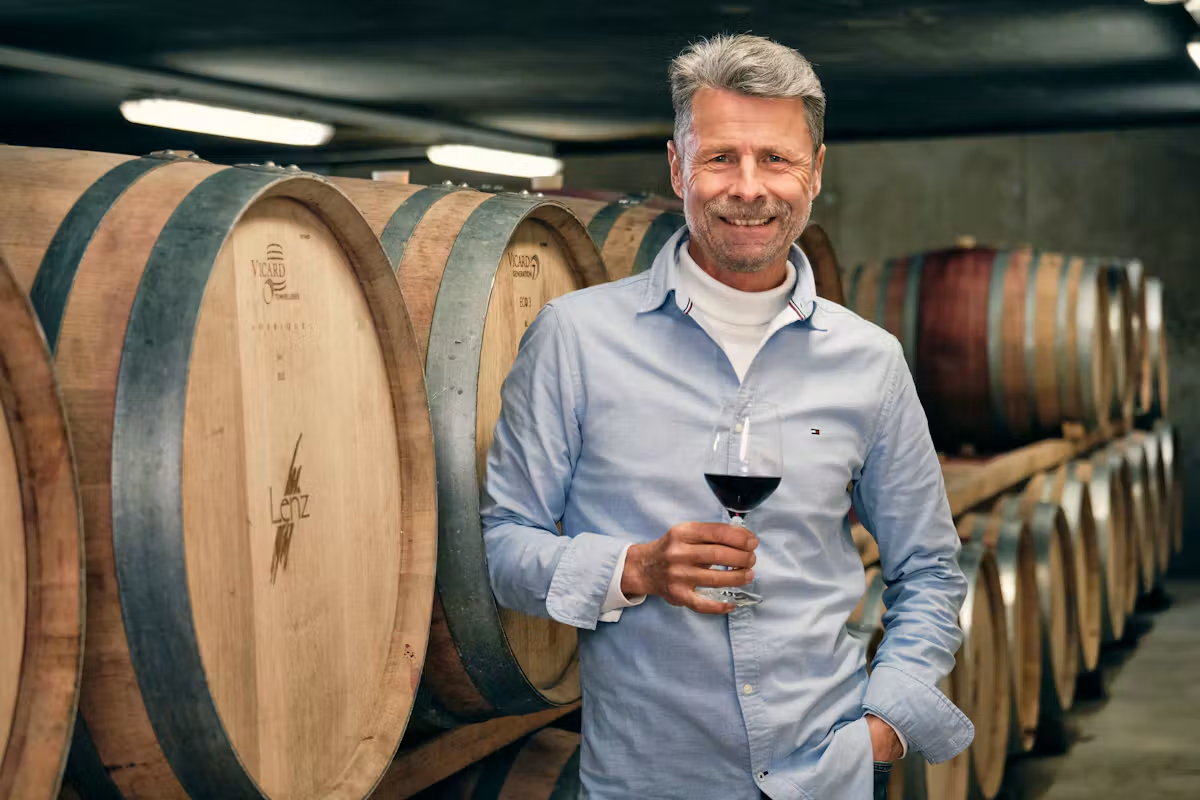
Short circuits improve the environmental and climate balance of Swiss wine. But regional provenance alone is not enough to make a wine sustainable. In this interview, Roland Lenz, qualified master winemaker and founder of the Thurgau organic winery Lenz, explains what goes into assessing the sustainability of a wine.
Mr Lenz, how does climate change influence wine production in Switzerland?
It is especially extreme weather episodes and persistent high heat that weigh on production. Violent events are increasing, and hail in particular can destroy a large part of the harvest in a very short time. Our side protection nets, however, preserved our grapes from the most significant damage so far. Rising temperatures also tend to increase the sugar and therefore alcohol content. We rather seek to produce wines with moderate alcohol content. The heat also takes its toll on the workforce. During the harvest, we must increasingly take advantage of the coolest hours of the day to work.
Sustainability and climate protection have many faces
Whether they work in a recycling center or volunteer for the animal cause, these citizens take concrete action for the environment, in the shadows or the light. In this 18-episode series, we profile personalities who illustrate the diversity of daily life focused on the future. We follow them in their activities, behind the scenes, giving them a direct voice.
What inspired you to produce organic wine?
The main reason for me was health. In 1994, after a year of conventional work, I developed an allergic reaction to the pesticides used. The situation bordered on the absurd: a phytosanitary product manufactured by a subsidiary of Bayer gave me headaches, which I then treated with a tablet… from Bayer. It was this experience that pushed us to gradually move to organic viticulture. We have been certified organic for thirty years.
What does sustainable wine production mean to you?
To me, sustainability means giving back to nature more than we take from it. This is why we practice regenerative agriculture: we promote the diversity of the entire ecosystem, replenish humus and thus capture CO2 in the soil. According to our calculations, the soil here stores two to three tonnes of carbon dioxide per hectare.
How does this diversity manifest itself in the vines?
Our biodiversity strips provide valuable habitats for insects, birds, mammals and reptiles. This benefits the entire system, of which we humans are also a part. For example, bats help us limit pests, while healthy soil gives us healthy fruit. For me, these diverse surfaces release a particular energy, while monocultures deprive nature of it. These strips of biodiversity also serve as a buffer against pesticides from neighboring farms.
What should environmentally conscious consumers pay attention to when buying wine?
An important point, often forgotten, is the bottle. Its manufacturing and transport generate a considerable part of CO2 emissions. Heavy bottles provide no taste advantage, but they are more resource-intensive, both in production and transport. As a general rule, a maximum weight of 450 grams is sufficient. Wines made from fungus-resistant grape varieties, known as “piwi”, are also a good choice: they require significantly fewer phytosanitary products and allow more environmentally friendly cultivation. Recognized organic labels also offer a useful benchmark. For natural wines, on the other hand, it is better to take a close look at the method of production, because the term alone does not say much about how the grapes were grown.
What role do you think the increasingly popular natural wines play?
Natural wine does not have a uniform definition. It is therefore not automatically made from organically grown grapes, even if many think so. I nevertheless find the approach to natural wine interesting, because it limits interventions in the cellar as much as possible. Every year we produce an unfiltered organic wine from white grapes, which we market in the form of orange wine.
Are consumers willing to pay more for sustainable Swiss wine?
In Switzerland, we spend on average 7 €. 50 per bottle of wine. For organic products in general, there is a certain willingness to pay more. But we note that organic alone hardly justifies an extra price. It must be able to compete with other good wines. Faced with two wines of comparable quality in the same price segment, many opt instead for the organically produced one. With us, each customer now buys fewer bottles, but there are more and more of them.
Alcohol consumption is declining throughout Switzerland, and Generation Z is said to be drinking less than all previous generations. Can you respond to this trend with more sustainable wine?
We too observe this renunciation. Sustainable wine alone cannot counter this development. This is why we launched an alcohol-free wine project. It wasn’t easy, but with the right team, anything is possible. Several wines from the Nullkommalenz line have since won awards. The Secco obtained, with 89 points, the best score in its category at the Expovina Wine Trophy 2026. In the Falstaff Trophy for dealcoholized wines, our Nullkommalenz rosé took joint first place with 91 points, while the Secco obtained 90 points.
What do you think the future of Swiss wine production looks like?
Fungus-resistant grape varieties, “piwi,” are the future. Anyone who wants to make viticulture more resilient to climate change almost inevitably turns to organic cultivation methods. More and more farms are already working more sustainably today. I trained more than thirty apprentices, and above all I taught them what is not necessary in viticulture, and what traditional methods we can give up to preserve our environment. But this change must also be driven by consumers: through their purchasing choices, they can exert the necessary pressure.
We are the future
“We are the future” is a national initiative launched in 2020 which aims to inspire and stimulate thinking on the themes of energy efficiency, climate protection and the environment. Together with renowned partners from the private sector, with the support of SuisseEnergie and Tamedia as an established media partner, it highlights different aspects of an energy-efficient and climate-friendly future.
Do you pay attention to the organic quality of wine?
