
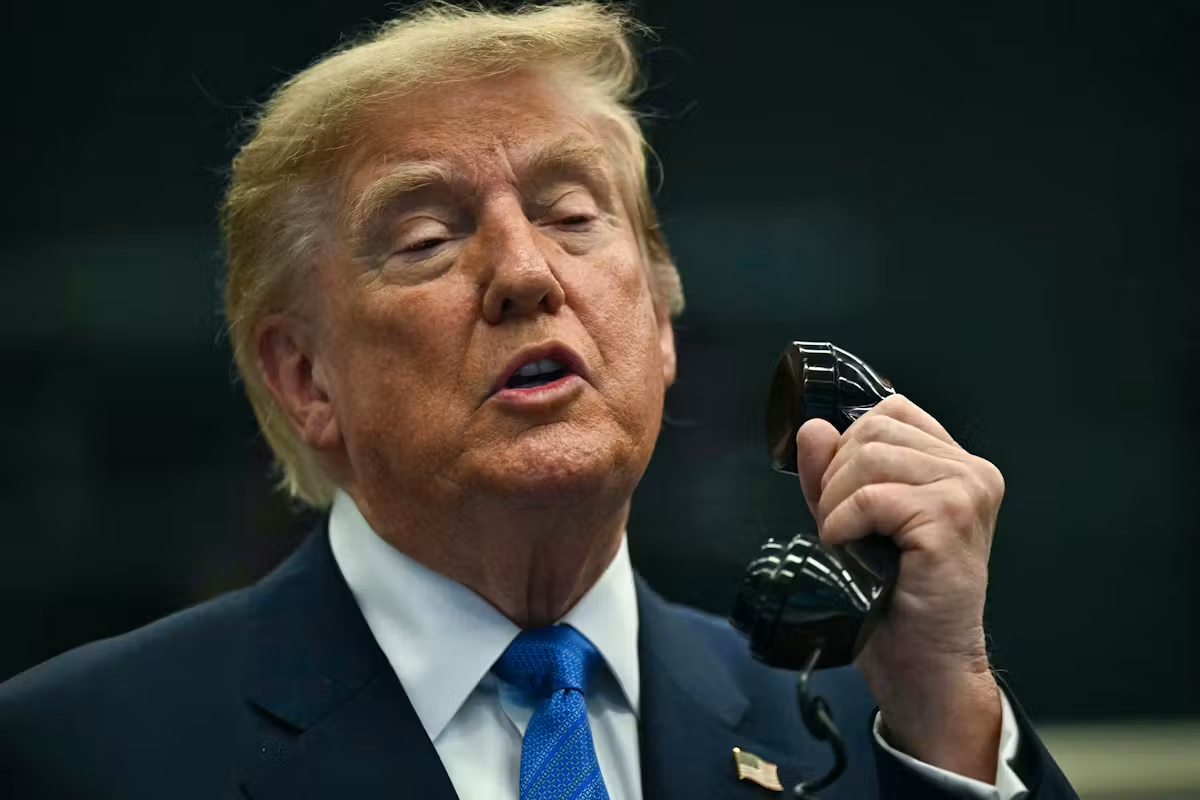
Donald Trump on Friday refused an Iranian proposal aimed at reopening the Strait of Hormuz within seven days, according to the Wall Street Journal, the American president also considering a resumption of strikes in Iran after the mid-term legislative elections in November.
In the evening, the Republican billionaire published on his Truth Social network a map representing the Strait of Hormuz with the words “Strait Trump”.
Citing American officials, the Wall Street Journal specifies that Donald Trump would be skeptical about Tehran’s ability to meet his demands.
Iran had submitted a proposal to the United States earlier in the day to reopen this strategic strait within seven days, adding that “the choice now rests” with Washington whether to accept it or not.
“The seven-day period will begin as soon as the United States accepts this plan,” said the head of Iranian diplomacy, Abbas Araghchi, from UN headquarters in New York.
The reopening of the Strait of Hormuz is at the heart of the conflict between Tehran and Washington, which the United States and Israel triggered at the end of February with strikes on Iran.
A fifth of the world’s hydrocarbons passed through this sea route before the war.
“The measures that the United States must take are not new,” the Iranian minister stressed when questioned by journalists. “They are all already included in the memorandum of understanding” signed in June with Washington.
“If the United States agrees to proceed in this way, everything will return to the way it was before,” Iranian President Massoud Pezeshkian said in an interview with CBS on Friday, affirming that “the process will begin the same day they accept it.”
US President Donald Trump and Mr. Pezeshkian signed a memorandum of understanding in June which aimed to end the war in the Middle East, reopen the Strait of Hormuz and then hold talks on the sensitive aspect of Iran’s nuclear program.
But the text was the subject of divergent interpretations by the two parties and the discussions failed.
Frozen assets
Among the conditions set in June by Iran was an end to hostilities with an immediate and definitive halt to military operations and the war on all fronts, including in Lebanon where the Israeli army is fighting the pro-Iranian group Hezbollah.
Tehran also demanded the release and payment of frozen Iranian assets as well as the removal of economic sanctions, while the country’s economy is collapsing and the dizzying rise in prices fueled popular demonstrations on an unprecedented scale in early January which were bloodily repressed.
Iran has been the subject of American sanctions for decades which penalize its economy and international transactions. The country also saw its foreign assets frozen in the wake of the Islamic Revolution in 1979.
In the absence of official figures, local media estimated these assets in the spring at between 100 and 123 billion $.
In an exclusive interview with AFP on Tuesday, the spokesperson for the Revolutionary Guards, Hossein Mohebi, mentioned the end of hostilities in Yemen among the Iranian conditions.
“It is up to America to decide whether or not it wants to end” this conflict, declared Iranian President Massoud Pezeshkian in an interview with the American channel Fox News, in New York, on the sidelines of the UN General Assembly in which he participated.
Donald Trump announced Tuesday that discussions had taken place in New York between Iranian and American officials on the sidelines of the high mass of world diplomacy.
The American president has so far failed to conclude negotiations that would reopen the Strait of Hormuz and moderate oil prices.
As the midterm elections approach on November 3, crucial for his Republican Party, the American president is increasingly unpopular because of the high cost of living in the United States and the surge in fuel prices, caused in part by the war he started in Iran and the closure of the Strait of Hormuz.
