
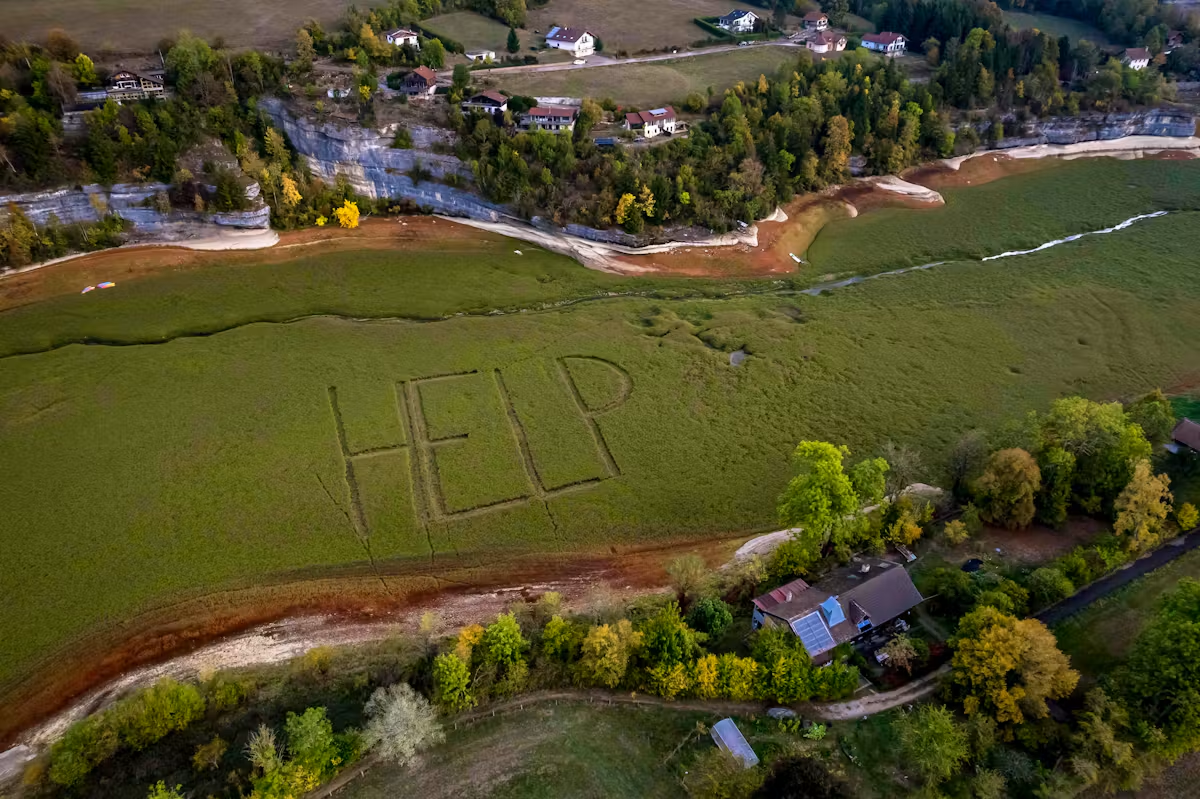
Deprived of water almost all summer, Lac des Brenets, located on the Franco-Swiss border, sees its dry bed almost entirely covered with vegetation, in which local residents have recently drawn gigantic “HELP” and “SOS” signs. Yvan Durig, owner and captain of the navigation company on Lac des Brenets, measures every day the level of the remaining water basin to the north of the usual lake.
“Normally we have 25 meters, 30 meters here, and we see that this volume has decreased, there are 9 meters of water so two thirds less, the fish are really in saturation in this place,” he explains to AFP.
Lac des Brenets (Swiss appellation) or Lac de Chaillexon (French appellation) is a natural water reservoir fed by the Doubs on the border of the eponymous department on the French side and the canton of Neuchâtel. The lake opens into a funnel which usually feeds a 27 meter waterfall called “Saut du Doubs”, today dry.
On the Haut-Doubs plateau, on the borders of the Jura mountains, the karst nature of the soils, with its numerous faults and cavities, easily allows water to infiltrate underground and disappear on the surface.
Local residents are therefore used to periods of low water, but such low water is worrying and the minimum level record dating from 1906 is not far away.
On most of Lac des Brenets, the water has disappeared, giving way to vegetation in the middle of which runs a thin stream of water. The words “Help” and “SOS” traced on this green bed illustrate the frustration of the inhabitants of the banks of the Doubs in the face of the inaction of the authorities.
A “task force” was created by the French and Swiss authorities in 2022, in particular to explore ways to limit the flow of water in the faults, but nothing has been done since.
Navigation stopped on July 20
“The lake dried up this year quite early in the season, so from July 20 we had to stop navigation (…) Imagine: in high season and we stop like that, it’s unbearable for a company like ours,” confided Yvan Durig, while his 20 cruise boats remain trapped in the dry bed.
“We, children, spent all our summers swimming, on the beach (…) having fun at the water’s edge, diving, jumping, then even other times fishing,” explains David Favre, resident of Brenets and 76-year-old amateur historian.
But “since the last drought of 2018, it has been a disaster. Every two years, or even soon every year, the lake empties, unfortunately,” he adds, saying he feels “totally abandoned” by the authorities.
