
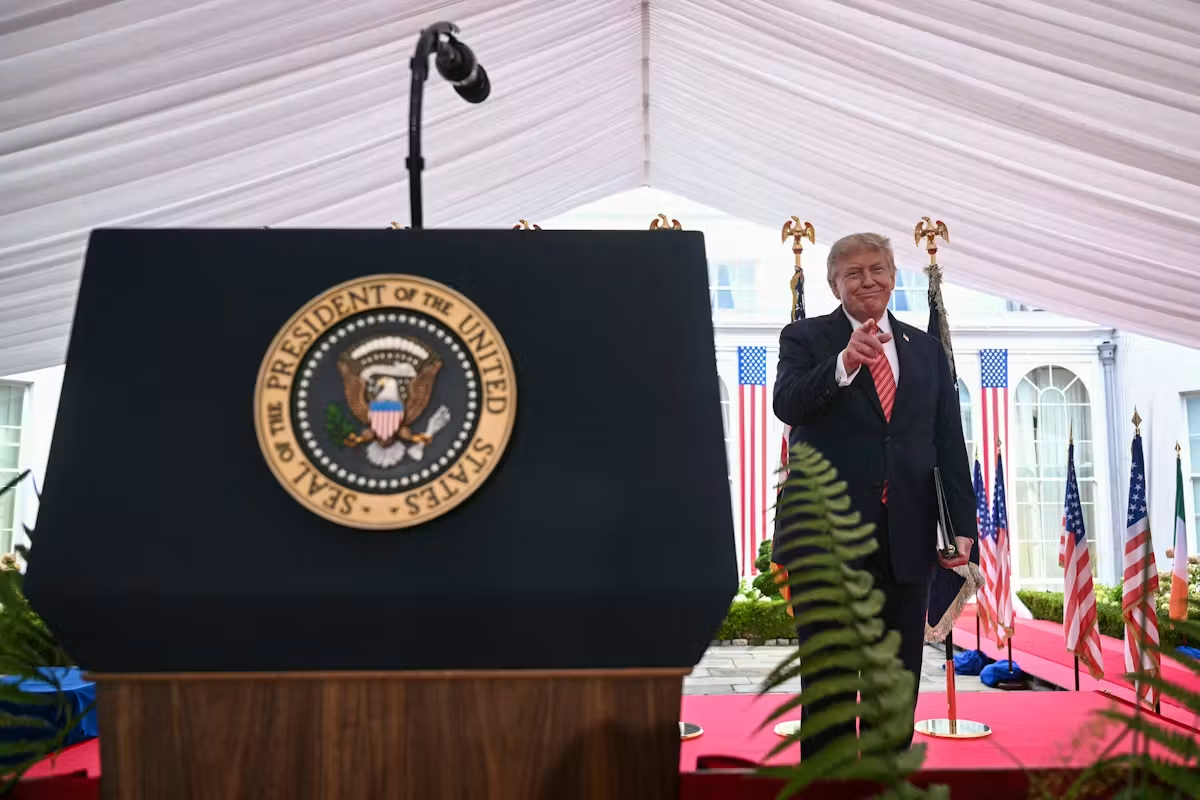
Passing through Ireland for a visit that promised to be without any particular significance, Donald Trump, as he often does, took his world by surprise by unexpectedly pleading for a “unified” Ireland. The American president indicated on Saturday that he would “very much like” to see a “unified” Ireland, during a press briefing with Irish Prime Minister Micheal Martin in Dublin.
“I think it would be fantastic, how bad could it be?” launched the Republican leader, while a journalist asked him his opinion on a unification of the Republic of Ireland and Northern Ireland, which is part of the United Kingdom.
The 80-year-old billionaire, taking sides on this highly sensitive subject for Dublin and London, also felt that such a prospect seemed inevitable to him: “It will eventually happen.”
London, for its part, is sticking to the peace agreements signed in 1998 to end hostilities in Northern Ireland.
A referendum on a potential unification of the British province with the Republic of Ireland can only be organized in the event of “a clear consensus in the country, when public opinion has changed to the point that such a decision must be considered”, British Prime Minister Andy Burnham recently indicated. He judged that such a consultation was “not relevant”. While polls generally give a majority to supporters of unification in the Republic of Ireland, this is not the case in Northern Ireland. A May 2026 poll by the Institute of Irish Studies at the University of Liverpool gave only 35% of Northern Irish people in favor of unification.
The United States has until now displayed a position of neutrality, believing that it was up to the populations concerned to decide.
In a speech afterwards at the American embassy in Dublin, Trump seemed satisfied to have thrown a stone in the pond. “It’s one of those questions where, no matter what you say (…), there’s no right answer,” he said with a laugh. Donald Trump also recently ventured into another hot topic for London, saying he was open to any eventuality regarding the Falklands, this Atlantic archipelago under de facto British administration but over which Argentina claims sovereignty.
Warm but fierce locals
The US President also offered his views on the Irish population, The Guardian reported:
“You know, they say you can’t generalize about groups of people, about countries, but actually you can. People love coming to Ireland. Do you know why? Because they love you. They love people. There is a real conviviality. There is also a form of ferocity, of hardness. I’ll tell you what, you are some of the most vicious bastards… but when you want to be nice, there’s no one nicer. »
Courtesy visits
These statements on Ireland give an unexpected turn to the trip of Donald Trump, who came to the country to focus more on golf than diplomacy, mixing as he often does the promotion of his private interests with his presidential function.
Opponents of the American president are to demonstrate in Dublin, where the American leader began by meeting President Catherine Connolly, whose function is essentially ceremonial.
A figure of the Irish left, pacifist and anti-NATO, the latter, who openly criticized the Republican leader in the past, offered him a collection by Michael Longley, a Belfast poet who died in 2025, known for a poem written during the Troubles in Northern Ireland, entitled “Ceasefire”.
Donald Trump was accompanied for this visit by his son Don Jr., his children and his wife, as well as Natalie Harp, an assistant whose proximity to the American president is much commented on in Washington.
At least 4,000 police officers and members of the security forces are mobilized for this visit, presented as one of the largest security operations ever carried out in Ireland, with a cost estimated at 20 million euros.
Donald Trump was then welcomed by Irish Prime Minister Micheal Martin, whom he had received twice at the White House and with whom he said on Saturday he had an “excellent” relationship.
Ireland’s positions diverge from those of the Trump administration on several issues, notably the Palestinian question, of which Dublin is one of the most fervent supporters in Europe.
Golf above all
Donald Trump is due to return at midday to his hotel and golf resort in Doonbeg, on the Irish west coast, which is hosting the Irish Open, and spend the rest of the weekend there.
“He’s basically coming to visit the golf resort he owns, with a stopover in Dublin for a courtesy call,” said Daniel Geary, professor of American history at Trinity College Dublin.
Donald Trump also extolled the merits of his property alongside the Irish Prime Minister, ensuring that Doonbeg golf course was “considered one of the best in the world.”
Some 40,000 spectators are expected during the weekend. The star player of the competition is Rory McIlroy, a six-time major tournament winner and currently the second-ranked player in the world.
The American president could himself present the trophy to the winner on Sunday evening.
