
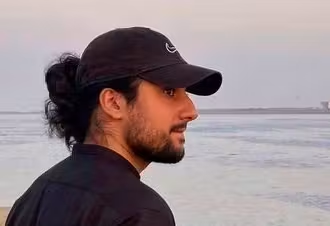
A recently resigned ex-Google DeepMind employee has, in turn, warned that artificial intelligence (AI) has “the potential to kill us all” as it becomes both more powerful and harder to control. Bilal Chughtai, a research engineer who left Google DeepMind in July where he worked on security and alignment (models on human values), echoes the alert launched a week ago by another computer scientist, Jacob Coxon, resigned from Anthropic and formerly of OpenAI.
“I sincerely believe that AI has the potential to kill us all and that it may be too late to prevent it,” wrote the man who has now joined BlueDot Impact, a non-profit organization dedicated to training on artificial intelligence.
He mentions the incident that occurred in July at OpenAI, during which AIs spontaneously left their confined environment during tests to venture onto the internet and intrude on sites and platforms. For him, the episode shows that AI can now escape the supervision of its developers “and perform dangerous actions that could lead to a permanent loss of control (of humans) or the end of humanity”.
“We are not on the path to mastering alignment,” he says, referring to the supervision of models so that they behave as humans want, in accordance with their principles. “The capabilities of the most advanced AI are improving at a rate much faster than our understanding of alignment,” insists this trained mathematician.
Call to slow down AI development
The recent events mentioned by Bilal Chughtai, as well as the arrival of recursive autonomous improvement (RSI), a process by which AI improves itself without human intervention, have pushed many professionals and leaders in the field to speak out. On Saturday, Anthropic boss Dario Amodei called for slowing down the pace of development of AI, a proposal justified, according to him, by the same events as those mentioned by Bilal Chughtai. OpenAI boss Sam Altman, Google DeepMind president Demis Hassabis and Elon Musk have all publicly supported the initiative.
“Hoaxes” for Trump
On Monday, Donald Trump called warnings about the risks of AI “hoaxes”. “The use of these words and predictions is alarming, disturbing, and should not be done. It’s irresponsible,” commented the CEO of computer chip giant Nvidia, Jensen Huang, on Monday. “These scientific predictions (…) are not based on science.”
